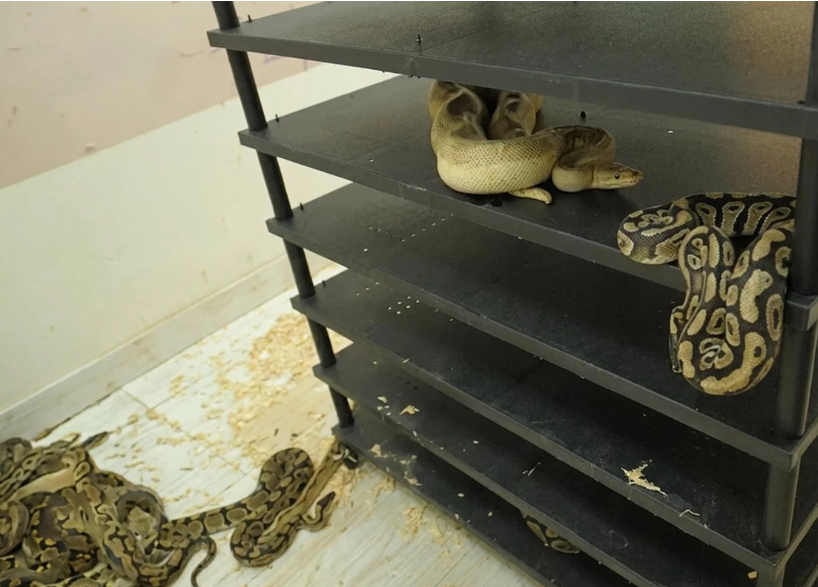
An unemployed man in Zhejiang province has been handed a prison sentence for operating one of China's most unusual wildlife trafficking schemes: an illegal python breeding operation conducted entirely within his residential flat. The case, made public by state broadcaster CCTV in late June, exposed how a solitary individual managed to maintain a colony of over 300 pythons in domestic quarters, converting his living spaces into sprawling reptile farms that caught authorities' attention through an unexpected investigative angle.
The investigation began in March 2024 when a senior citizen in Taizhou discovered a large python coiled near the base of a local mountain. The tawny-coloured serpent, thick as an adult's arm, struck the elderly resident as distinctly out of place. Upon reporting the sighting to police, the discovery initially seemed routine, but investigators recognised an important pattern: pythons are not native to the region, and they typically remain inactive during March when temperatures drop. The escaped snake provided the crucial initial lead that would unravel an operation spanning years.
Detectives theorised that the reptile had fled from a breeder's facility, prompting them to consider the infrastructure requirements necessary to maintain such animals. A professional snake handler consulted during the investigation revealed a critical detail: pythons demand consistently warm and humid conditions, requiring sustained temperatures between 20 and 30 degrees Celsius. This specialised environmental control would demand significant electrical resources, offering authorities an unconventional forensic approach. Rather than pursuing traditional surveillance or informant networks, police officers shifted focus toward utility records, identifying residents with unusually elevated electricity consumption patterns in the surrounding area.
The screening process led investigators to a man surnamed Guo, who lived alone, was unmarried, and maintained no formal employment. The electricity spike in his residence stood out dramatically against neighbourhood averages. When detectives began monitoring Guo's activities, they observed a visitor named Di making regular trips to courier collection points, consistently retrieving packages containing small white mice. Online sellers confirmed they supplied such mice primarily to customers breeding reptiles as food sources. Guo himself had been sharing snake photographs on social media platforms, occasionally making veiled suggestions about selling pythons to interested parties. Transaction records eventually revealed that Di had sold two pythons to another buyer for 1,000 yuan, establishing a commercial dimension to the operation.
When police executed a search warrant at Guo's flat, officers encountered a scene of extraordinary scale. Plastic storage containers, each housing individual pythons, were stacked throughout the residence in densely packed arrangements. Guo had compressed all his personal furniture into a single bedroom, effectively surrendering the remaining two bedrooms and his living room entirely to the reptile operation. In total, authorities seized 309 pythons from the property, subsequently transferring the animals to a local zoo for proper care and housing. The sheer number and condition of the animals raised immediate concerns about both the legality of the operation and the welfare of the creatures themselves.
During interrogation, Guo revealed his passion for snakes extended back to 2014, when he had purchased four pythons to begin his breeding experiments. He expressed no fear of the species and demonstrated considerable enthusiasm for his work, claiming proficiency in cultivating pythons with varied colour patterns and markings. In one statement quoted by authorities, Guo declared: "I am capable of cultivating snakes of various colours. I feel like a creature creator." His motivation appeared rooted in genuine fascination with reptile genetics and breeding rather than purely financial gain, though his operation had clearly generated significant revenue. The breeding hobby had evolved into a commercial enterprise that had distributed dozens of animals through the market.
The criminal network extended beyond Guo himself. His associate Di had facilitated sales transactions, while a third individual named Deng, who had originally sold four snakes to Guo in 2014, was also arrested. Police discovered 47 additional pythons in Deng's residence, bringing the total number of confiscated reptiles to 436 animals. The estimated market value of this entire collection exceeded 30 million yuan, equivalent to approximately US$4.4 million, indicating substantial economic activity had occurred beneath law enforcement's awareness.
Pythons carry special legal protection in China, classified as Grade Two protected animals under national wildlife regulations. The law explicitly prohibits the purchasing, selling, breeding, and transportation of this species without prior official authorisation. These restrictions reflect China's commitment to wildlife conservation frameworks and the international agreements that designate pythons as species requiring protection from overexploitation. Violating these provisions constitutes a serious criminal offence, as Guo and his associates would discover when facing judicial proceedings.
A court in Taizhou proceeded with criminal charges against Guo, Di, and Deng. While official sources did not disclose the precise duration of their sentences, China's Criminal Law establishes that individuals convicted of violating Grade Two protected animal regulations may receive prison terms extending to five years. The sentencing represented a significant judicial response to what authorities characterised as a serious threat to rare and endangered wildlife conservation objectives. The case demonstrates how enforcement mechanisms may operate through unexpected investigative pathways when traditional methods prove insufficient.
The incident carries implications beyond China's borders for regional wildlife protection efforts. Southeast Asian nations, where pythons occur naturally and face considerable poaching pressures, watch Chinese enforcement actions closely. The sophistication of Guo's operation highlights how internet commerce and online social media facilitate wildlife trafficking networks that span multiple jurisdictions. Malaysian authorities and those across the region confront similar challenges with protected reptile species, where domestic demand and cross-border smuggling networks present ongoing enforcement difficulties. The case illustrates both the determination of enforcement agencies and the persistence of illegal wildlife traders in adapting their operations to avoid detection.