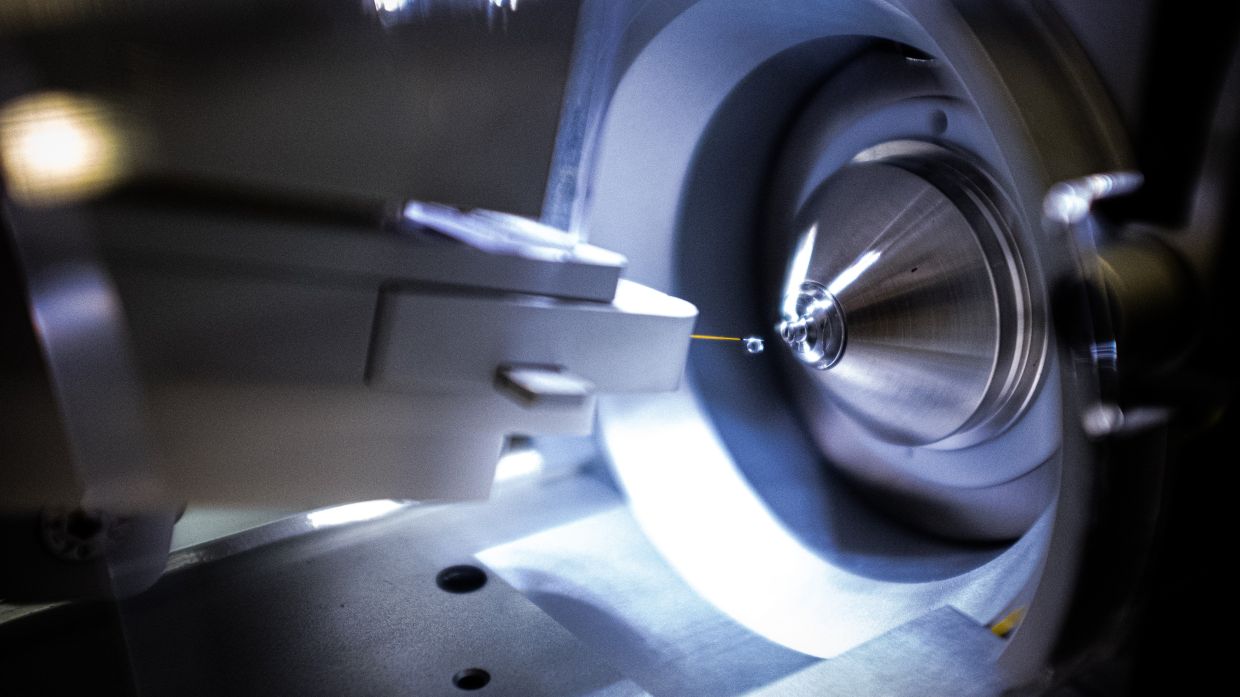
China's push to leverage artificial intelligence for scientific discovery confronts a fundamental constraint that threatens to undermine the nation's research capabilities. The country's overwhelming dependence on imported precision scientific instruments—from mass spectrometers to spectrographs—creates a bottleneck that could significantly slow progress in AI-driven research, according to leading Chinese scientists and policy analysts assessing the state of the sector.
At the heart of this challenge is a seemingly straightforward problem: generating the high-quality experimental data that AI systems require to develop, validate, and refine advanced scientific models. Weinan E, a mathematician at Peking University and member of the Chinese Academy of Sciences, made this point vividly at the "AI for Science" conference in Shanghai, employing a memorable metaphor. Without domestically produced precision instruments capable of producing reliable, detailed experimental data, he suggested, researchers attempting to build sophisticated AI systems would find themselves "cooking without rice"—possessing the conceptual tools but lacking the essential raw materials to construct anything meaningful. This observation carries particular weight coming from E, who pioneered the "AI for Science" concept in 2018 as a fresh framework for conducting research across multiple disciplines.
The scale of China's import reliance paints a sobering picture of the structural challenge. According to a December report from Beijing consulting firm Puhua Policy, China imported nearly US$17 billion in scientific equipment during 2024 alone, with more than three-quarters of the major research instruments deployed across Chinese laboratories sourced from international suppliers. The dependency deepens further when examining specific categories. LeadLeo, another consultancy focused on scientific equipment markets, found that China relies on imports for approximately 83 percent of its mass spectrometers and chromatographs—instruments fundamental to identifying molecular composition and separating chemical compounds for detailed analysis—and 75 percent of its spectrometers, which use light-based methods to characterise material properties. The picture becomes even more acute in optical instruments and biological tissue analysis equipment, where China remains almost entirely dependent on foreign suppliers.
This import dependence translates into concrete operational disadvantages for Chinese research institutions. Extended wait times for equipment procurement, expensive maintenance contracts negotiated on unfavourable terms, and sluggish after-sales technical support all conspire to raise the effective cost of conducting research while simultaneously extending project timelines. The efficiency losses accumulate across the entire research ecosystem, weakening China's competitive position in fields where rapid innovation cycles determine technological leadership. Supply chain vulnerabilities compound these efficiency concerns, leaving research programmes vulnerable to disruption should geopolitical tensions affect the flow of critical equipment.
The situation has grown more pressing as the United States has systematically tightened export controls targeting Chinese access to advanced scientific instruments. During Donald Trump's first presidency, the pace of restrictions accelerated dramatically, with more than 42 percent of all China-related entries on the US Commerce Department's export control lists added by December 2020. The Biden administration maintained this restrictive posture, and Trump's second term shows every sign of intensifying these measures. In January alone, the Commerce Department unveiled fresh export controls specifically targeting high-parameter flow cytometers and particular categories of mass spectrometry equipment, explicitly citing concerns that these technologies could generate the precise biological data required to train artificial intelligence systems for biological design and weapons development. The strategic logic underlying these restrictions is unmistakable: the same instruments that advance civilian scientific research can potentially accelerate military innovation in an era of AI-driven autonomous systems.
Beyond the equipment question, E identified another significant vulnerability constraining China's AI-for-science ambitions: a substantial capability gap between Chinese foundation models and their international counterparts. He characterised this disparity as a top-tier risk that demands unflinching acknowledgment and direct confrontation. The challenge extends beyond superficial differences in model architecture or training data volume. E argued persuasively that the fundamental issue lies in how the two powers have approached integrating scientific knowledge into AI systems. Simply grafting scientific capabilities onto existing open-source foundation models represents a fundamentally flawed strategy, he contended, because solving genuinely complex scientific problems requires substantially more powerful underlying architectures rather than merely applying additional layers of refinement to existing models.
The divergence in approaches reflects deeper strategic choices. The United States has concentrated resources on progressively strengthening general-purpose foundation models while simultaneously building automated research infrastructure that allows these systems to interact dynamically with laboratory equipment and experimental design. China has pursued a different path, favouring an application-driven strategy that constructs scientific AI infrastructure by integrating experimental data, software tools, computing resources, and automated equipment into unified platforms, then deploying these purpose-built systems against specific research questions and scientific domains. Each approach carries inherent advantages and limitations, but the American model currently appears better positioned to address the foundational weaknesses that constrain model capability.
Addressing these intertwined challenges will require thoroughgoing structural reforms across China's research ecosystem. E proposed three fundamental "breaks" that must occur simultaneously. First, disciplinary boundaries must become more porous, enabling researchers to collaborate across traditional fields where genuine innovation frequently occurs at the intersection of disparate domains. Second, the artificial divide separating theoretical research from experimental validation needs dissolution, fostering closer integration between computational and laboratory work. Third, and perhaps most challenging, the long-standing separation between academic institutions and industrial laboratories must be dismantled, allowing knowledge and resources to flow more fluidly between sectors. Each represents not merely organisational tinkering but rather a fundamental reorientation of how scientific enterprise is conducted.
Equally important, E argued, is overhauling the evaluation frameworks through which scientific contributions are assessed and rewarded. Traditional research evaluation systems emphasise published papers as the primary metric of scientific productivity. These systems must evolve to recognise and incentivise contributions that may not appear in journal articles but prove equally or more valuable: the development of high-quality experimental datasets, sophisticated software tools, shared computing infrastructure, and well-designed research platforms. Such recognition would signal that foundational contributions deserve career advancement and institutional prestige comparable to novel empirical discoveries. Without such systemic reform, researchers and institutions will continue prioritising traditional publication metrics over the unglamorous but essential work of building scientific infrastructure.
For Southeast Asian observers and policymakers, China's scientific challenges carry implications extending well beyond Beijing's borders. The region's own research capabilities depend partly on access to the same imported instruments and models constraining Chinese progress. As US export controls potentially tighten further, neighbouring countries may face elevated equipment costs and supply uncertainties. Simultaneously, China's effort to establish technological self-sufficiency in precision instrumentation could eventually create regional competition or cooperation opportunities, depending on whether Beijing succeeds in developing competitive indigenous alternatives. The outcome of China's AI-for-science ambitions will significantly shape the technological landscape across Asia for years to come.

