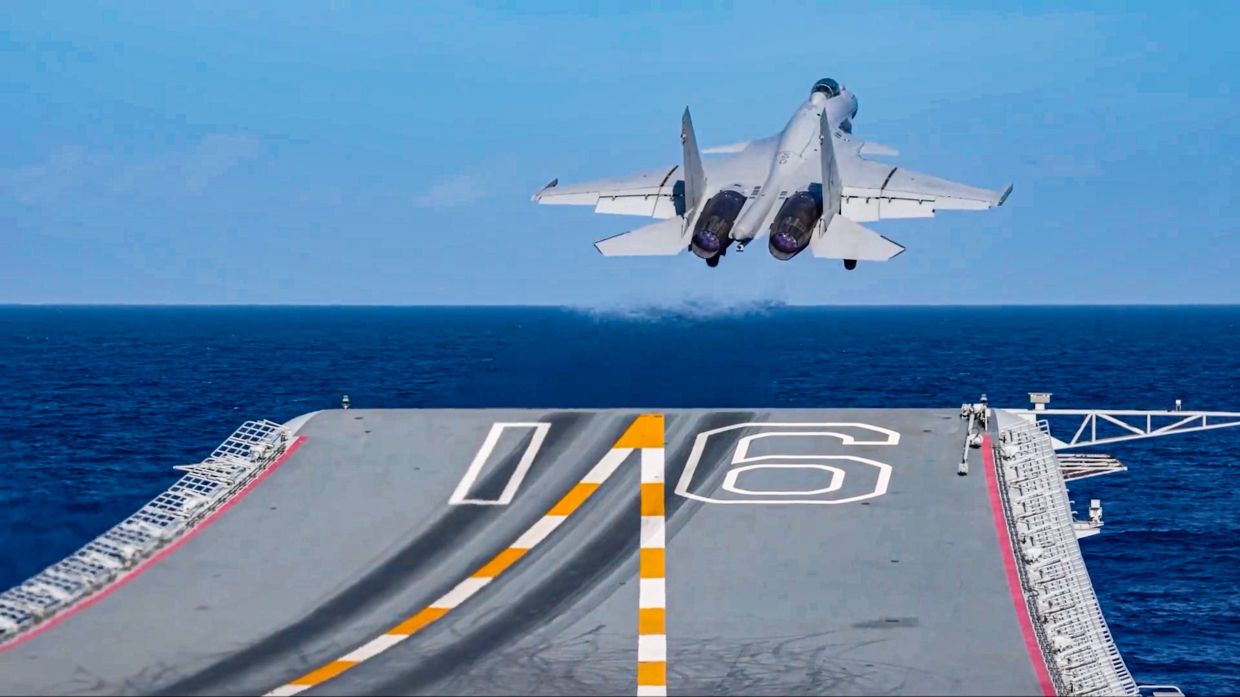
China's burgeoning aircraft carrier fleet represents a major shift in its military capabilities, yet defence analysts increasingly point to a fundamental limitation that could undermine these expensive vessels: vulnerability to submarine attack. The weakness has attracted serious scrutiny from strategic institutions, particularly as Beijing projects naval power deeper into the Indo-Pacific and waters surrounding Taiwan, raising questions about the long-term viability of carrier-centric naval strategy in contested regions.
A comprehensive analysis from the Washington-based Centre for Strategic and International Studies has outlined how a coordinated "cost-imposition" strategy could neutralise Chinese carrier groups through multiple vectors. This multifaceted approach encompasses land-based strike networks, long-range aircraft supported by satellite intelligence, electromagnetic and cyber operations, and unmanned vehicle swarms. Among these offensive options, however, submarine warfare emerges as perhaps the most concerning for Chinese naval planners. The strategy explicitly identifies American attack submarines operating across the western Pacific as presenting one of the most potent threats to carrier formations, exploiting significant gaps in the People's Liberation Army Navy's underwater surveillance and tracking infrastructure.
Geography compounds this vulnerability in ways that create particular operational challenges for the Chinese military. The Indo-Pacific's strategic architecture channels naval traffic through a limited number of critical maritime passages and chokepoints, creating predictable routes where submarines and supporting forces could concentrate their efforts. Rather than requiring deployment across vast ocean expanses, an adversary could position assets at these strategic gateways to intercept and threaten carrier groups as they transit between operational zones. This geographical constraint essentially narrows the defensive problem from an oceanic scale to a manageable set of tactical locations, making interdiction tactically feasible for opposing navies.
Beyond these chokepoints, the tactical picture grows more complex. Carrier-based aircraft equipped with extended-range weapons and supported by satellite surveillance systems could conduct long-range strikes against opposing carriers, while coordinated attacks on enemy sensors and communications infrastructure would progressively blind Chinese naval operations. The combined effect of these pressure points creates a scenario where Chinese carriers operating at distance from protected coastal waters face mounting risks that potentially outweigh their utility. Christopher Sharman, director of the China Maritime Studies Institute at the US Naval War College, emphasises that the undersea dimension remains "significant today," though he acknowledges it is not an unchanging weakness as Beijing works systematically to narrow the capability gap.
The core problem, according to Sharman's analysis, centres on China's relative deficiency in understanding the undersea environment itself. Chinese naval specialists have publicly acknowledged that their meteorological and oceanographic capabilities remain inferior to those deployed by the United States Navy, a disparity that directly degrades Chinese submarine operations and anti-submarine warfare effectiveness. This knowledge disadvantage proves particularly acute beyond the first island chain, where operating conditions become less predictable and environmental data sparsier. Without precise understanding of water temperature gradients, salinity variations, and acoustic propagation patterns, submarine operators cannot optimally position their vessels or accurately predict where threats might emerge.
Beijing has undertaken substantial programmes aimed at reversing this information asymmetry. The Transparent Ocean initiative, conceived over a decade ago, envisions an integrated network of satellites, research vessels, oceanographic buoys, autonomous underwater vehicles, and seabed sensor arrays deployed across strategically vital waters including the western Pacific, South China Sea, and Indian Ocean. Chinese officials have explicitly framed this initiative as a national security imperative, and the Ocean University of China has established hundreds of deep-sea observation systems while progressively expanding monitoring capabilities from regional waters into distant Pacific zones. This infrastructure development suggests Chinese planners view oceanographic mastery as fundamental to their broader maritime strategy.
Simultaneously, the Chinese military has invested in expanding its anti-submarine warfare capabilities. The maritime studies institute has documented the growing inventory of fixed-wing maritime patrol aircraft and Type 927 ocean surveillance vessels equipped with advanced towed-array sonar systems. Personnel and sensors aboard aircraft and helicopters deployed for submarine-hunting duties have undergone systematic upgrades, intended to enhance detection and tracking performance. These incremental improvements, while meaningful, must overcome fundamental physics constraints: American nuclear-powered submarines rank among the world's quietest vessels, making them exceptionally difficult to locate regardless of sensor sophistication.
Yet the submarine challenge represents only one component of a broader strategic puzzle confronting Chinese naval planners. Undersea warfare occupies central importance within PLA naval strategy, particularly regarding the objective of achieving sea control within the first island chain during wartime. Beyond that boundary and extending into the Indian Ocean, Chinese strategists increasingly view effective underwater operations as essential countermeasures against residual American naval superiority and as tools for complicating potential third-party intervention in any conflict scenario involving Taiwan. Military-affiliated Chinese analysts have characterised their coastal waters as possessing a "wide-open door," reflecting acknowledged difficulties in monitoring and controlling underwater approaches sufficiently to exclude hostile submarines.
Defence analysts, including Timothy Heath of research firm Perceptum, underscore how anti-submarine warfare remains a persistent challenge particularly given the technological sophistication of American submarines. The calculus becomes even more complex if Japan became militarily involved in a Taiwan conflict, potentially seeking to target Chinese warships operating in adjacent waters. While carriers might theoretically operate in the western Pacific to provide air cover for fleet units attempting to delay or prevent foreign intervention, deployment at such distances introduces unacceptable risk. Heath cautions that "it would be foolish for China to deploy the carriers that far out," given the multiplicity of targeting options available to American forces.
China's land-based intermediate-range ballistic missiles remain the superior instrument for threatening naval vessels across extended ranges, which Heath emphasises further suggests that risking expensive carriers in such a vulnerable posture represents questionable strategic logic. This assessment fundamentally challenges assumptions about carrier centrality in Chinese naval planning, particularly in contested regional scenarios. The strategic institute's authors contend that these carrier protection challenges should directly inform American military procurement decisions and defence investments. They specifically advocate for expanded production of torpedoes, undersea drone systems, and missile capabilities developed in coordination with allied partners including Japan and Australia, effectively proposing a defensive investment posture that exploits recognised Chinese vulnerabilities.
These findings carry significant implications for Southeast Asian and Indo-Pacific security architecture. As China expands its carrier capabilities, the undersea dimension of maritime competition intensifies precisely when undersea awareness and submarine technologies are proliferating among regional powers. Malaysia, Singapore, Indonesia, and Vietnam have all been modernising their underwater forces, potentially adding complexity to the strategic environment. The identification of Chinese submarine detection limitations as a fundamental vulnerability reshapes calculations about naval power projection in contested waters and suggests that continued American technological advantages in undersea warfare could prove decisive in any serious conflict scenario, despite China's quantitative naval expansion.

