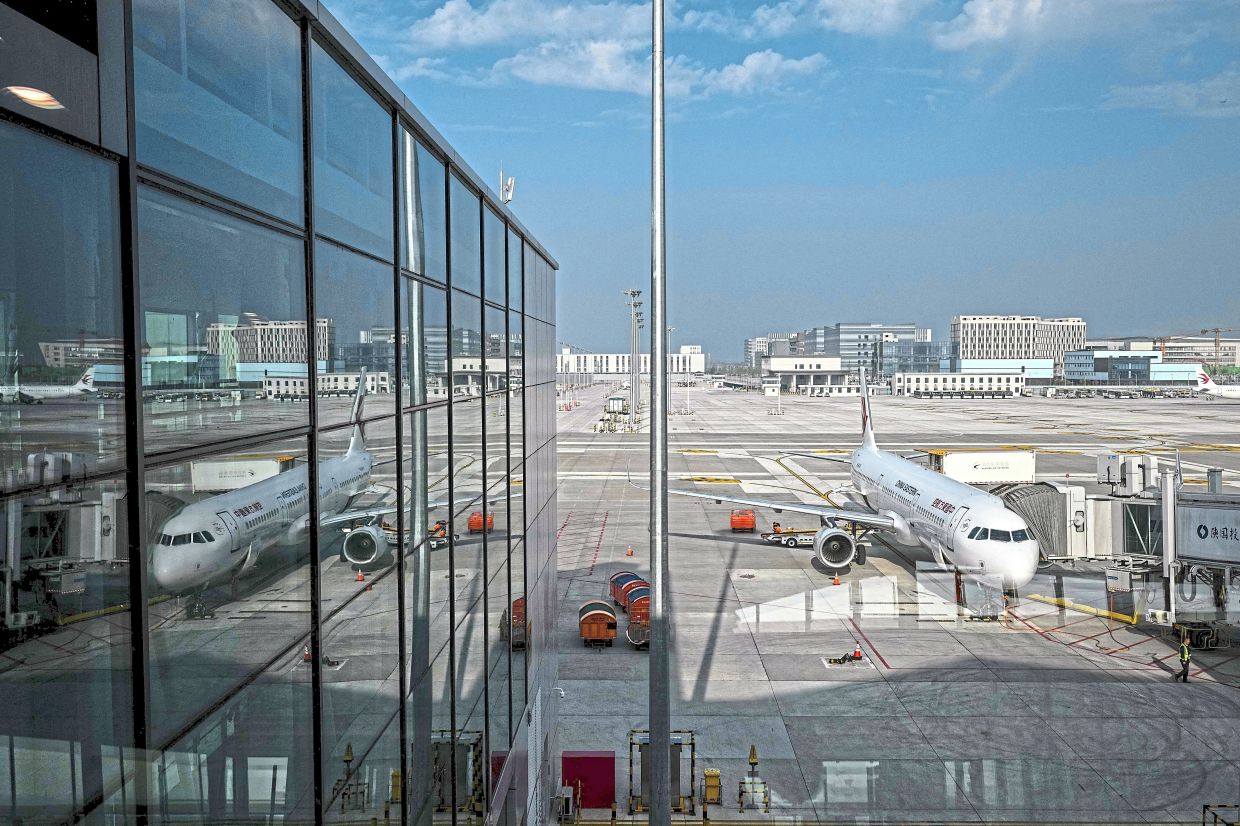
The operating environment for China's aviation giants has grown grimmer by the quarter. Air China, China Eastern Airlines and China Southern Airlines collectively reported net losses of approximately 8.2 billion yuan in the first six months of 2026, extending an unbroken streak of annual losses that now stretches back seven years. The result represents a substantial deterioration from their initial forecast of up to 9 billion yuan and underscores the persistent structural challenges afflicting the nation's state-owned carrier sector.
The magnitude of the reversal was stark when viewed against the carriers' opening-quarter performance. A combined first-quarter profit of 4.82 billion yuan, buoyed by the surge in Lunar New Year bookings, evaporated entirely during the second quarter, leaving shareholders nursing significant paper losses. Air China's deficit widened to 2.3 billion yuan from 1.81 billion yuan twelve months prior, while China Eastern's shortfall reached 2.2 billion yuan compared to 1.43 billion yuan in the corresponding 2025 period. China Southern bore the heaviest burden with a 3.7 billion yuan loss, more than double its year-earlier deficit of 1.53 billion yuan. The announcements triggered a sharp selloff across all three carriers in both Shanghai and Hong Kong equity markets on the day of disclosure.
Fuel expenses represent the core driver of this deepening malaise. Jet fuel costs climbed between 35 and 38 percent across the Big Three during the first half, a consequence of geopolitical turbulence in the Middle East that has kept crude prices elevated. Unlike their counterparts in Europe, North America, and much of Asia, Chinese carriers have historically employed minimal hedging strategies to cushion themselves against petroleum market volatility. China Southern's regulatory filing explicitly acknowledged possessing "no effective means available" to shield itself from fuel price fluctuations, a remarkable admission of strategic vulnerability that highlights a systemic weakness pervading the sector. Even though international crude benchmarks have retreated from their second-quarter zenith, jet fuel remains approximately 50 percent costlier than prewar baseline levels, suggesting little near-term relief for operators struggling to manage margins.
A counterintuitive bright spot emerged in topline revenue figures, which expanded notably despite the mounting losses. Air China's revenues climbed 10.5 percent, China Eastern achieved 11.1 percent growth, and China Southern posted a 9.7 percent increase, all driven substantially by rekindled international demand as passengers rerouted away from disrupted Middle Eastern transit hubs caused by the Iran conflict. European destinations particularly benefited from this rebalancing, as travellers sought alternative routing paths. However, this revenue expansion masks a fundamental pricing problem domestic carriers face. Unlike American carriers, which successfully implemented steep fare increases following the pandemic's conclusion, Chinese airlines operate within a far more price-sensitive domestic market constrained by competition from high-speed rail networks and self-drive holiday alternatives. Any attempt to substantially lift domestic fares risks triggering demand destruction rather than yield improvement.
The third quarter, ordinarily the most lucrative trading period for Chinese carriers, has delivered precious little solace. An exceptionally virulent typhoon season has ravaged domestic flight operations during the critical summer peak travel window. Meteorological services have recorded 21 typhoon formations across the northwestern Pacific and South China Sea year-to-date, representing nine additional systems above the thirty-year average for the equivalent timeframe. Flight Master, a specialised aviation analytics firm, has projected that Chinese carriers will transport 142 million passengers across domestic and international networks during July and August, representing a 3.6 percent year-on-year contraction. Such a decline would constitute the first summer contraction since 2022, when pandemic-related lockdowns had essentially shuttered large segments of the Chinese economy and grounded most air travel.
Forward guidance from investment analysts paints an even more alarming picture than the current interim results. HSBC banking analysts anticipate the Big Three will accumulate combined losses approaching 16.8 billion yuan throughout 2026 as a whole, a forecast that sits in dramatic contrast to the broader market consensus projecting a modest 1.3 billion yuan profit for the trio. Shanghai-listed equity valuations have deteriorated substantially, with all three carriers experiencing share price declines exceeding 36 percent during 2026 to date. The absence of interim dividend distributions from any of the three carriers signals management's determination to preserve liquidity and avoid exacerbating losses through shareholder payouts, a prudent defensive posture given the deepening uncertainty surrounding recovery timelines.
One area demonstrating cautious domestic industrial ambition involves fleet modernisation centred on China-built aircraft. China Eastern expanded its fleet of COMAC C919 narrow-body jets to seventeen following three deliveries during the six-month reporting period. Both Air China and China Southern each operated eleven C919s, having respectively taken two and three additional airframes. Yet even this apparent positive momentum carries troubling undertones. China Eastern has disclosed expectations to receive thirteen fewer C919 deliveries than previously anticipated across the 2026-2028 horizon, a material revision suggesting either manufacturing delays or, more concerning, a rationalisation of fleet expansion plans in response to weakening demand forecasts. Air China maintained its delivery expectations unchanged, while China Southern declined to issue forward guidance in its interim filing, leaving considerable uncertainty regarding the trajectory of domestic aircraft orders.
The deeper implications of sustained airline losses extend well beyond the three carriers themselves and touch upon broader questions regarding Beijing's industrial policy and support mechanisms. China's aviation sector has historically benefited from implicit state backing given its position as a strategic industry, yet seven consecutive years of losses raise uncomfortable questions about whether current fleet compositions, route networks, and operational models remain viable without substantial restructuring. The sector's vulnerability to fuel price swings, compounded by structural domestic demand constraints and international route disruption, suggests that cyclical recovery alone may prove insufficient to restore the carriers to sustainable profitability levels. For Malaysian and Southeast Asian aviation stakeholders, the struggles of China's Big Three carry important implications, as route competition, capacity management, and pricing dynamics across regional networks will likely remain influenced by the financial desperation driving Chinese carriers' competitive strategies in the near term.

