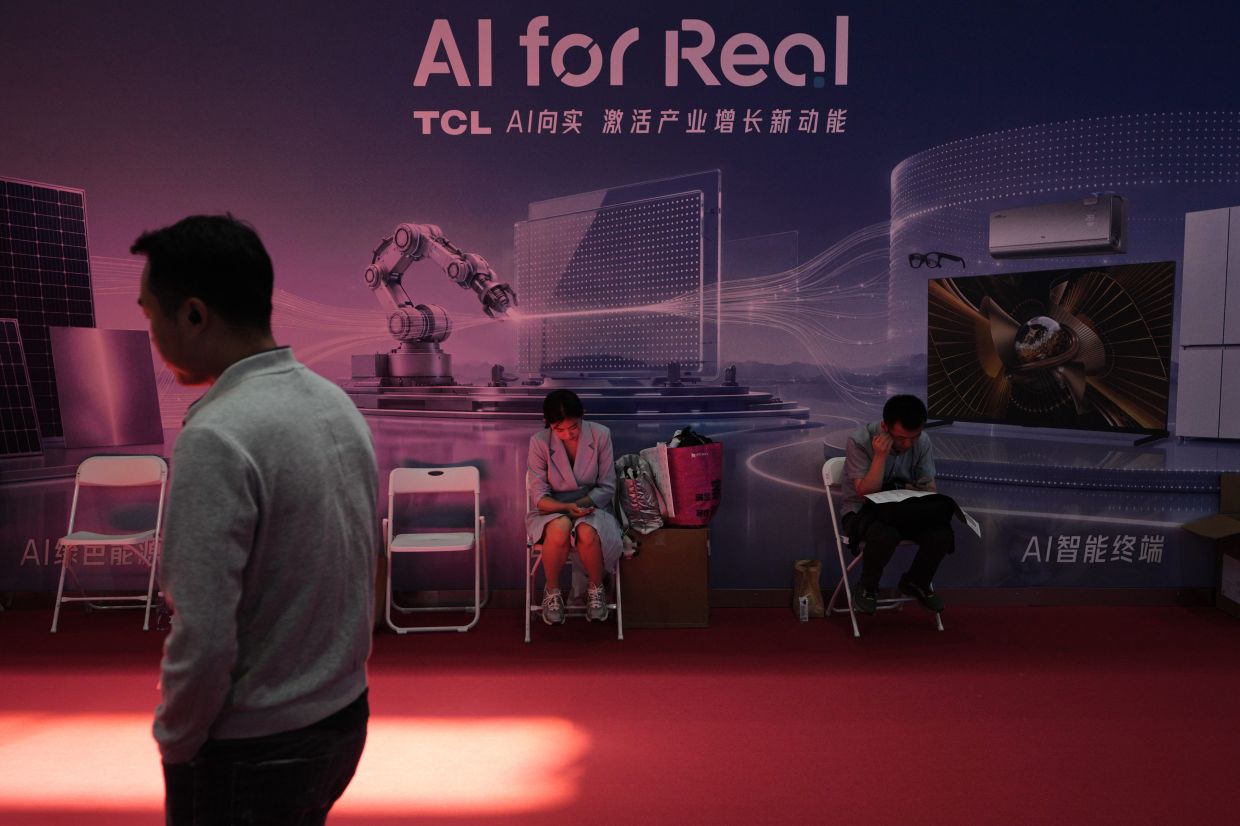
China's embrace of artificial intelligence is fundamentally reshaping its labour market, with workers across diverse industries confronting the prospect of technological redundancy at an unprecedented pace. Government policies actively encouraging AI adoption and robotics deployment are accelerating this transition faster than comparable economies, creating a distinctive challenge for the world's second-largest economy that economists warn could undermine broader growth prospects if employment disruptions prove too severe.
The scale of AI integration into Chinese enterprises has become staggering. Industrial firms deploying AI models and automated agents surged to 47.5 per cent last year from just 9.6 per cent in 2024, according to market intelligence firm IDC. This penetration reflects deliberate government strategy. China's "AI Plus" initiative and its technology roadmap through 2030 are explicitly designed to distribute AI capabilities across economic sectors, granting the nation competitive advantage in its technological rivalry with the United States. Unlike many Western economies where AI adoption has proceeded more organically, China's state-directed approach means entire industries face simultaneous transformation rather than gradual transition.
The employment consequences are already tangible. A 40-year-old programmer named Fei, who once questioned whether artificial intelligence could handle complex coding tasks, now acknowledges that mid-level programming positions are "essentially replaceable in most cases." Rather than resist technological change, he reasoned that universal adoption means individual workers must embrace AI or face competitive disadvantage. Translation work exemplifies wage compression effects: Du Qinchun, a part-time translator assisting in AI model training, reports that industry compensation has collapsed by more than half compared to previous years. The translation sector's deterioration has proven so severe that university programmes in foreign languages have fallen markedly out of favour as AI-powered translation tools proliferate.
Automation is penetrating physical and creative domains beyond conventional software development. Humanoid robots now sort parcels in postal centres, direct traffic, and prepare beverages, though deployment remains limited. Food delivery robots are expanding rapidly nationwide, potentially endangering livelihoods for millions of workers in that sector. Within China's vibrant short-drama industry, generative AI tools now handle creation, production, and distribution functions. The impact proved dramatic: live-action short and vertical video series designed for mobile platforms declined approximately 75 per cent in the first quarter of 2024 compared to the prior year, according to Chinese media reports.
Critically, displacement is not evenly distributed. International Labour Organization research demonstrates that women face disproportionately higher employment risks from AI adoption, as they concentrate in sectors particularly amenable to automation, such as electronics assembly, while remaining underrepresented in technology and science domains. This gender disparity compounds existing labour market inequalities and raises concerns about widening opportunity gaps as AI reshapes occupational structures.
Despite these pressures, Chinese workers display markedly different psychological responses to AI compared with counterparts in Western economies. Shujing He, a Beijing-based analyst at advisory firm Plenum, observes that anti-AI sentiment appears substantially weaker in China than internationally. Most Chinese express either positive or neutral attitudes, and crucially, those experiencing displacement often demonstrate eagerness to experiment with AI-enabled entrepreneurial ventures and independent businesses. This orientation reflects cultural adaptability but also pragmatic recognition that resistance proves futile when technology adoption becomes universal.
The broader economic implications trouble policymakers and academics alike. Cornell University economist Eswar Prasad warns that while AI will enhance productivity across sectors, employment disruption could prove severe, potentially worsening China's existing jobs crisis and destabilizing social order. China's overall urban unemployment officially hovers near five per cent, but unemployment among those aged 16 to 24 reaches roughly 15 per cent, revealing acute challenges for young workers entering labour markets simultaneously experiencing technological transformation.
Consumer spending patterns already signal economic anxiety. Chinese households increasingly restrict expenditures due to employment insecurity, compounding difficulties from the prolonged property market downturn that eroded household wealth. This reluctance to spend directly constrains aggregate demand and economic growth, which has already decelerated. The employment effects thus cascade beyond individual workers, influencing macroeconomic performance in ways that threaten the stability underpinning China's development model.
Yet some experts identify potentially mitigating factors over longer timeframes. China's population of 1.4 billion is aging rapidly and beginning to contract. By 2050, demographers project fewer than two working-age adults will exist for every retiree, compared with over 2.5 in the United States. San Francisco Bay University scholar Xuenan Cao argues that automation could partially offset this workforce shrinkage rather than representing purely disruptive threat. If labour supply tightens dramatically, productivity gains from AI adoption might prove economically beneficial by maintaining output despite demographic contraction.
Workers are adapting in varied ways, reflecting both resilience and uncertainty. Wang Zhicheng, a 32-year-old scriptwriter for a company producing animated educational content, experienced his employer halving its writing staff following AI integration. Rather than seek comparable positions, he resigned and established an independent studio creating illustrated children's books. While he acknowledges AI's utility for brainstorming and fact-checking, he observes that generated scripts feel formulaic and repetitive, with inconsistent detail levels. His approach treats AI instrumentally—as a tool analogous to Microsoft Word—rather than as a replacement for human creative judgment. This perspective encapsulates broader worker responses: acknowledging AI's capabilities while maintaining that humans remain ultimate decision-makers regarding which outputs warrant pursuit.
Educational sector responses reveal complex dynamics around technological integration. High school chemistry teacher Yang Zheng expressed no existential anxiety regarding AI despite students leveraging the technology for homework assistance. His confidence partly reflects embedded professional expertise and the irreplaceable value of in-person pedagogical relationships. Yet this sanguinity may not extend universally across education, particularly in subject domains where AI-generated content approaches instructional quality.
The divergence between short-term disruption and potential long-term equilibrium remains unresolved. China's government clearly intends to pursue AI diffusion as central technology policy, expecting aggregate productivity gains to justify transitional employment costs. However, if displacement outpaces job creation across multiple sectors simultaneously, social stability risks could materialize before demographic benefits from workforce contraction manifest. The critical policy challenge involves managing this transition period while ensuring disrupted workers access retraining opportunities, social support, and pathways toward economically viable futures in an AI-intensive economy.

