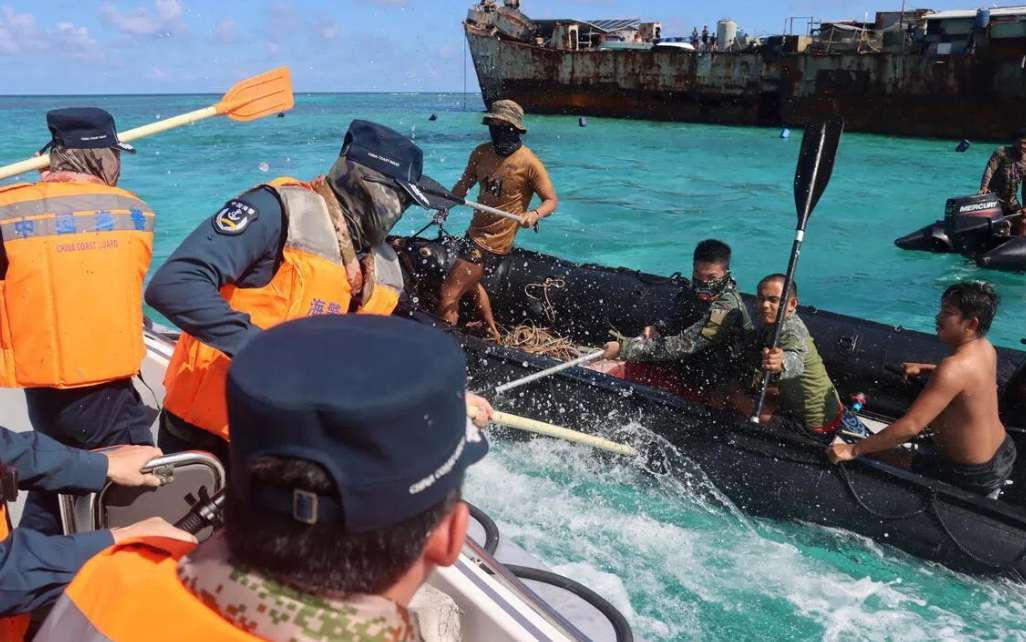
Beijing escalated its diplomatic response to a maritime confrontation on Monday by formally summoning the Philippine ambassador on Tuesday, July 21, marking another flashpoint in the increasingly fractious dispute over the South China Sea. The incident, which allegedly involved a Chinese coast guard officer striking a Filipino sailor with a baton near a contested feature known locally as the Second Thomas Shoal or internationally as Ren'ai Reef, has drawn sharp rebukes from Manila and its Western allies, signalling deepening divisions over freedom of navigation in Southeast Asia's most contested waters.
China's assertion of sovereignty over virtually the entire South China Sea remains legally hollow following a 2016 international tribunal ruling that explicitly rejected Beijing's historical claims as having no basis in international law. Despite this decisive legal rebuke, China has continued to assert administrative control over the resource-rich waterway through an expanding coast guard presence and military infrastructure. The waters in question represent one of the world's most critical maritime corridors, through which approximately one-third of global maritime commerce transits annually, making the stakes considerably higher than territorial pride alone.
The South China Sea remains one of Asia's most densely disputed zones, with overlapping claims from multiple regional players including the Philippines, Vietnam, Malaysia, Brunei, and Taiwan, all competing against China's expansive assertions. Confrontations between coast guards and fishing vessels have become routine occurrences in this heavily monitored area, with incidents escalating in frequency and intensity over recent years. The Philippine military's account of the latest encounter describes a deliberate act of violence against its personnel during what Manila characterises as a routine supply mission to a long-established military outpost.
Beijing's Foreign Ministry responded with characteristic defensiveness, asserting that the Philippine side initiated provocations and subsequently misrepresented the facts to generate international sympathy. The ministry's formal statement employed language suggesting premeditation by Manila, claiming the Philippines had deliberately engineered the confrontation to provoke Beijing and attract international attention. This rhetorical framing reflects China's broader strategy of portraying itself as a victim of coordinated Western-backed efforts to constrain its regional influence and maritime access.
The diplomatic fallout extended rapidly beyond the immediate bilateral relationship, with key Philippine security partners mobilising public criticism of Beijing's conduct. Australian Foreign Minister Penny Wong characterised the Chinese coast guard's behaviour as destabilising and dangerous, framing the incident within a broader pattern of coercive tactics deployed by Beijing in contested waters. Washington similarly condemned what it termed aggressive and dangerous actions, with US Secretary of State Marco Rubio arriving in Manila on the day of the diplomatic summoning to attend an Association of Southeast Asian Nations summit.
Rubio's presence at the Asean gathering, which convened eleven member states, reflected the strategic importance the United States places on maintaining influence in Southeast Asia and demonstrating solidarity with allies facing pressure from China. Although the State Department indicated openness to bilateral talks between Rubio and his Chinese counterpart Wang Yi, both attending the summit, no such meeting materialised immediately. The two diplomats had previously met during last year's Asean summit in Kuala Lumpur and again in Munich earlier this year, suggesting ongoing diplomatic channels despite the public tensions.
In a carefully crafted opinion piece published in Philippine newspapers on the day of the diplomatic crisis, Rubio articulated Washington's strategic position with remarkable clarity. He emphasised the fundamental American commitment to guaranteeing freedom of navigation throughout Southeast Asian waters, framing such access as non-negotiable to regional stability and prosperity. The language employed conveyed subtle but unmistakable warnings about the consequences should any single power gain hegemonic control over these vital passages.
Rubio's commentary contained barely veiled references to China, warning that if these waters fell under control of a power willing to weaponise trade relationships for geopolitical leverage, both American and Asean interests would face unprecedented threats. This formulation moves beyond traditional security concerns to encompass economic coercion and the potential asymmetric leverage a dominant power might exercise over smaller trading nations dependent on reliable maritime access. For Malaysian readers particularly, such warnings carry acute relevance given Malaysia's substantial maritime commerce and exposure to supply chain disruptions.
The incident represents the latest in an escalating cycle of confrontations that demonstrate the inadequacy of existing dispute-resolution mechanisms in the South China Sea. While a Code of Conduct negotiation between China and Asean has proceeded fitfully for years, the agreement remains unsigned and largely symbolic, lacking enforcement provisions that might prevent precisely the type of physical altercations now occurring with increasing regularity. Regional states including Malaysia find themselves navigating an exceptionally delicate diplomatic balance, seeking to maintain economic ties with Beijing while preserving strategic flexibility and demonstrating solidarity with smaller neighbours facing overwhelming pressure.
The broader trajectory suggests that maritime incidents will continue multiplying rather than diminishing, particularly as Chinese administrative presence and military capability in disputed areas expand. For Malaysia and other Southeast Asian nations with their own maritime claims and interests, the Philippines dispute serves as a cautionary illustration of how quickly diplomatic language can escalate into physical confrontations when underlying power asymmetries remain unresolved. The international attention focused on this latest incident, while providing short-term diplomatic support for Manila, ultimately underscores the dependency of regional stability on great power restraint rather than institutional frameworks designed to manage competition.

