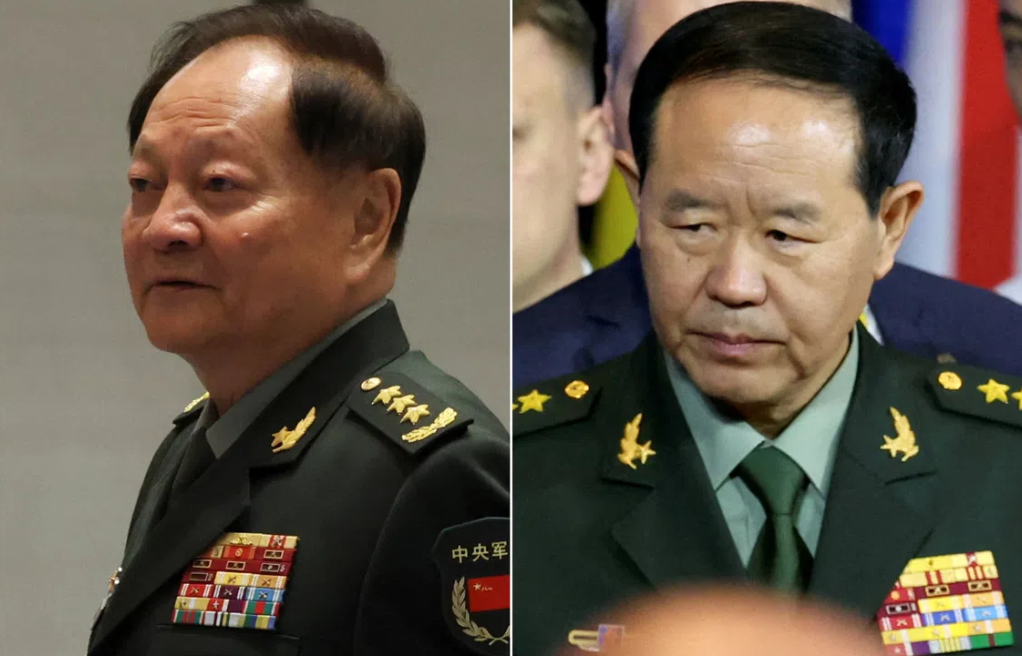
China's leadership has stripped two prominent military commanders from its supreme defence body, the Central Military Commission, following probes into alleged breaches of party discipline and legal violations. The removal of Zhang Youxia, who held the second-ranking position as vice-chairman, and Liu Zhenli, the chief of staff, represents a dramatic reshuffling of the country's highest military authority and underscores President Xi Jinping's iron grip over the armed forces.
The departures have left the state-controlled CMC with just two active serving members besides Xi himself, a stark reduction from the seven-member structure that once characterised the body. The announcement came through the Standing Committee of the National People's Congress, China's legislative body, which published updated deputy lists removing the two officers' names. Significantly, while Zhang and Liu have been formally excised from the state CMC, they have not yet been publicly or officially dismissed from parallel positions within the Communist Party's own military commission, suggesting the process may still be unfolding.
Zhang's removal is particularly consequential given his status as one of China's most powerful defence officials. As vice-chairman of the CMC, he was Xi's immediate subordinate in military matters and also held membership in the Politburo, the party's inner sanctum of about two dozen top leaders. Liu's position as director of the CMC's Joint Staff Department placed him at the operational heart of China's military command structure, responsible for coordinating the country's armed forces across all domains. The loss of both figures simultaneously signals potential systemic problems within military leadership or Xi's determination to consolidate absolute authority.
The purge extends beyond the two primary removals. The parliamentary announcement also affected Lieutenant General Zhong Shaojun, formerly in charge of the CMC's General Office, and General Ju Qiansheng, a previous commander of China's Strategic Support Force—the branch responsible for cyber warfare, electronic warfare, and space operations. Additionally, Gao Shiwen, who previously served as mayor of Nanchang in southern China and worked within the defence sector at China Aerospace Science and Technology Corporation, was removed from his lawmaker position. Separately, Zhao Zongqi, a former commander of the Western Theatre Command who oversaw military operations during the 2020 border conflict with India, was stripped of his advisory body membership.
These removals must be understood within Xi's broader anti-corruption initiative launched over a decade ago. Since 2012, the military has been a primary focus of this campaign, with dozens of senior officers and high-ranking officials investigated, dismissed, and imprisoned. The armed forces have proven particularly fertile ground for graft, given their control of vast budgets, procurement contracts, and real estate holdings. The cumulative effect has been to replace institutionalised leadership structures with networks of officers personally loyal to Xi, fundamentally reshaping civil-military relations in China.
Just last month, Xi himself called for intensified efforts against military corruption, signalling that the anti-graft campaign shows no signs of abating. His public appeals keep pressure on party cadres and military commanders to remain vigilant against misconduct and reinforce his message that no official, regardless of rank, enjoys immunity from investigation. This rhetorical emphasis suggests that additional removals may follow and that the current instability in military leadership could persist.
The structural complexity of China's military command arrangements partly explains why these removals required parliamentary action. China maintains parallel Communist Party and state CMC bodies that technically operate as distinct institutions but function as a unified command structure in practice. By removing officers from the state CMC through parliamentary action, Beijing can make public announcements and signal oversight, while maintaining flexibility regarding their party positions—a useful device when officials' ultimate fates remain undecided or when the party wishes to preserve optionality.
For regional observers in Southeast Asia, these developments carry implications for military stability and strategic posturing. The turnover in senior military positions, particularly involving commanders with operational experience in disputed border areas, creates potential uncertainties in crisis management and strategic decision-making. The removal of Zhao Zongqi, who commanded forces during the 2020 India-China border clashes, suggests ongoing reassessment of how previous military engagements were handled and may reflect internal disagreements about strategic doctrine.
The concentration of power around Xi through these purges represents a deliberate choice to eliminate competing centres of authority within the military establishment. Rather than building consensus through collegial decision-making among peers, Xi has systematically removed potential rivals and established direct chains of command. This personalisation of military leadership, while enhancing Xi's control domestically, could complicate strategic signalling with neighbouring nations by creating ambiguity about whose voice carries authority in crisis situations.
The scale and persistence of military removals also reflects deeper structural challenges within China's defence establishment. The problem of corruption is endemic rather than episodic, suggesting that systemic reforms alone have proven insufficient to root out misconduct. Whether through cultural factors, institutional incentives, or the sheer complexity of managing such a vast organisation, the armed forces continue generating cases worthy of investigation and punishment at the highest levels.

