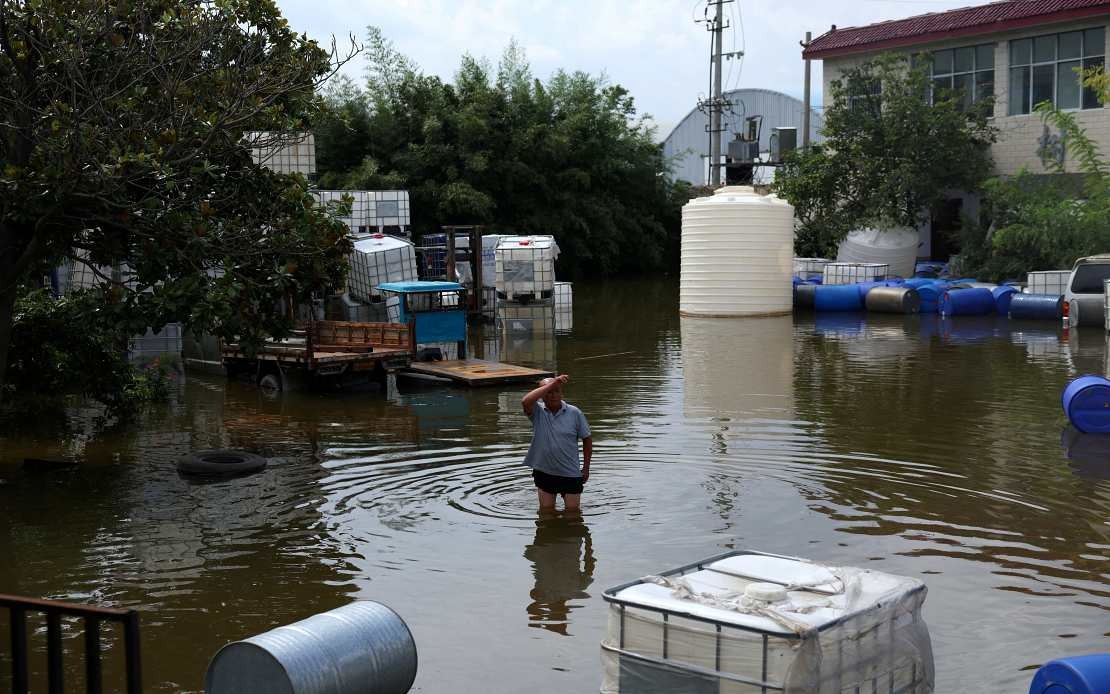
China has launched an urgent rescue operation in Zhoukou City, Henan Province, after torrential rainfall from Typhoon Dolphin caused a critical levee failure late Thursday night. The Ministry of Emergency Management responded swiftly by mobilising 200 specialist engineering personnel from China Anneng Group, supported by 110 units of heavy machinery, who arrived on Friday to commence emergency repair and relief efforts. The breach represents one of the season's most serious infrastructure failures in the flood-prone central region.
Typhoon Dolphin, classified as the year's 13th typhoon, brought unprecedented rainfall across multiple provinces as its remnants drifted inland from coastal zones. The resulting swollen rivers overwhelmed existing flood defences at Zhoukou around 11 pm Thursday, breaching critical levee structures and threatening downstream communities. The scale and speed of the water surge necessitated immediate government intervention at the highest level, prompting authorities to classify the emergency as a significant national disaster requiring coordinated federal response.
The National Commission for Disaster Prevention, Reduction and Relief activated a Level-IV national disaster relief emergency response on Friday, reflecting the severity of the situation and the potential for cascading impacts across the affected region. This designation ensures mobilisation of national resources and inter-agency coordination to prevent further deterioration of conditions. Zhoukou and neighbouring Xuchang have emerged as focal points of the emergency, with rescue operations centring on stabilising breached sections and evacuating vulnerable populations from flood-prone areas.
Immediate relief efforts have prioritised material support for displaced residents and emergency operations. The central government allocated 30,000 items of disaster relief supplies—including folding beds, summer quilts, and family emergency kits—to support resettlement and basic welfare needs across affected municipalities. These supplies were distributed on Friday through coordinated efforts involving the National Commission's office, the Ministry of Emergency Management, and the National Food and Strategic Reserves Administration, ensuring rapid delivery to frontline operations.
For Malaysian and Southeast Asian observers, this incident underscores the recurring vulnerability of river systems to extreme weather events, particularly as monsoon and typhoon seasons intensify. Henan Province, situated along the Yellow River system, has historically experienced catastrophic flooding; this breach echoes earlier disasters and demonstrates that modern infrastructure remains susceptible to unprecedented precipitation events. The rapid deployment of specialised engineering forces reflects Chinese government capacity for emergency response, though the continuing recurrence of such breaches raises questions about long-term resilience and adaptation planning in vulnerable regions.
The incident also carries implications for regional disaster preparedness frameworks. Southeast Asian nations sharing similar geographic exposure to typhoons and monsoons—including Malaysia, Thailand, and Vietnam—face comparable infrastructure and evacuation challenges during extreme weather. The Chinese government's emphasis on rapid resource mobilisation and coordinated inter-agency response offers lessons in crisis management, though each nation's varying institutional capacities and resource bases necessitate contextualised approaches.
Typhoon Dolphin's inland penetration and the resulting levee failure illustrate how coastal storms generate significant inland impacts through rainfall accumulation rather than wind damage alone. This phenomenon remains underappreciated in some disaster planning frameworks, which historically emphasised coastal evacuation and storm surge preparedness. The Henan breach demonstrates that riverine systems hundreds of kilometres inland face genuine risk from atmospheric rivers and monsoonal moisture transported by weakening tropical cyclones, warranting investment in early warning systems and inland evacuation protocols across vulnerable watersheds.
China's engineering response capacity proves formidable; deploying 200 specialists and 110 equipment units within hours of breach notification reflects pre-positioned resources and command structures refined through decades of flood management experience. However, the continuing need for such large-scale responses suggests that preventive measures—including levee reinforcement, controlled discharge protocols, and upstream retention systems—may require acceleration. The financial and human costs of emergency response operations far exceed those of robust preventive infrastructure investment.
Longer-term regional implications warrant consideration. Climate change modelling projects increasing frequency of extreme rainfall events across East and Southeast Asia, potentially rendering historical design standards for water management infrastructure inadequate. Countries including Malaysia, facing similar risks, should examine China's response architecture—particularly inter-agency coordination mechanisms and specialised engineering reserve forces—while simultaneously investing in climate-adaptive infrastructure standards. The Henan incident serves as contemporary reminder that disaster preparedness remains incomplete without rigorous preventive infrastructure management.

