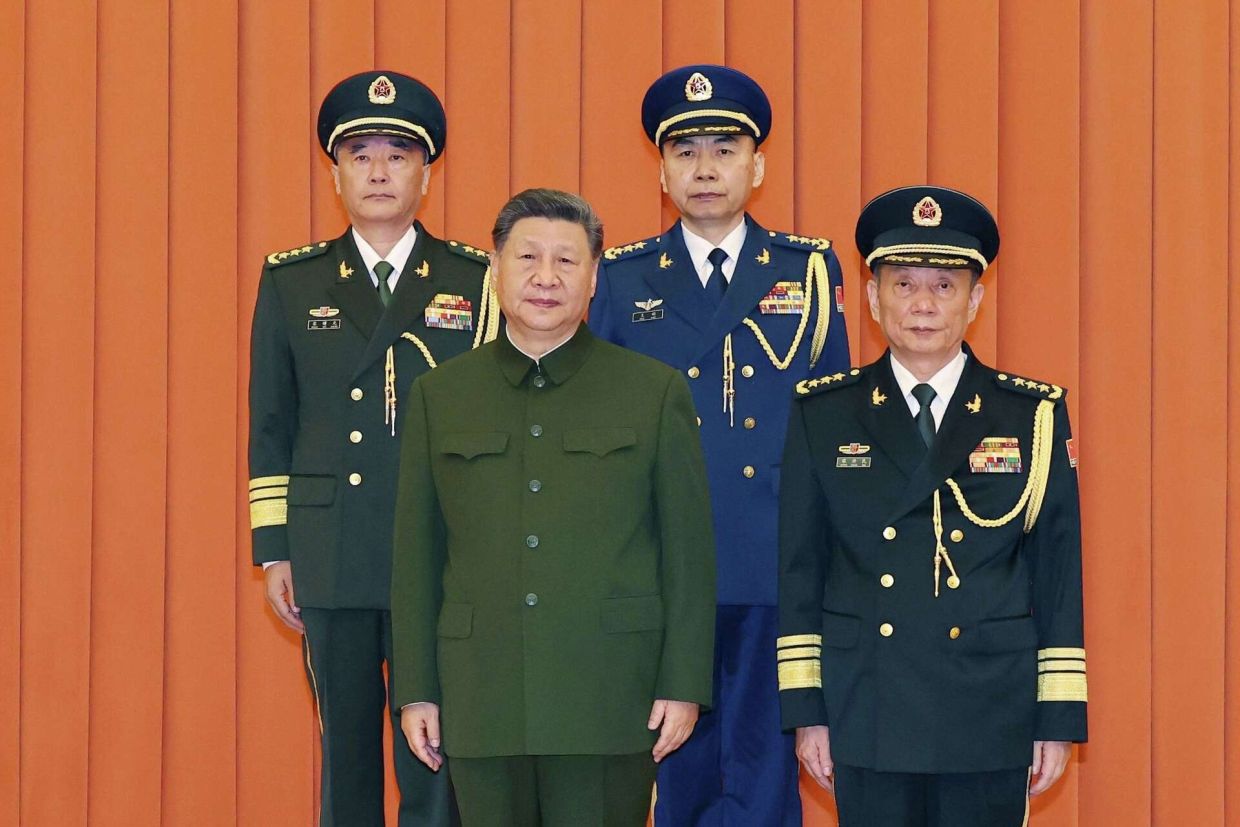
China's military hierarchy has undergone significant changes with the promotion of two senior officers to the rank of general, a development that appears to signal broader organisational shifts within the armed forces following an extended anti-corruption investigation. The ceremony, presided over by President and military chief Xi Jinping on Friday, July 3, elevated Zhang Shuguang and air force commander Wang Gang to their new positions. These appointments carry particular significance given the depleted state of China's highest military decision-making body, which has been substantially weakened by the removal of several prominent leaders implicated in corruption allegations.
The timing and nature of these promotions suggest a carefully orchestrated effort to replenish leadership ranks that have been hollowed out by investigations. Zhang Shuguang's simultaneous appointment as head of the corruption investigation division within the Central Military Commission—the military's supreme authority—indicates a deliberate consolidation of power within the anti-corruption apparatus itself. This dual appointment effectively places him at the intersection of leadership renewal and disciplinary oversight, a position that underscores the ruling Communist Party's determination to maintain control over military institutional development during a sensitive transition period.
The Central Military Commission, which operates as the supreme command structure for China's armed forces, has been reduced to a mere shadow of its intended operational capacity. With Xi Jinping serving as chair and Vice Chair Zhang Shengmin as the only other active member maintaining their positions, the commission's seven-member composition has effectively collapsed to two functioning officials. This dramatic contraction reflects the scale of the anti-corruption campaign's impact on military leadership, with multiple former vice chairs either formally removed from office or sidelined from active participation. Among those affected is the military's former top general, whose removal represents a particularly significant personnel loss given the strategic importance of that position.
For Malaysian observers and Southeast Asian policymakers, these developments carry important implications for understanding China's military governance and its external posture. The thoroughness of Xi Jinping's consolidation efforts suggests a leadership determined to ensure absolute loyalty within the armed forces before advancing major strategic initiatives. The degree to which senior commanders are being replaced and restructured could influence Beijing's approach to regional security matters, territorial disputes, and military modernisation programmes that directly affect neighbouring nations. The tightening of civilian Communist Party control over military structures may also reshape decision-making processes regarding foreign military engagement and strategic planning.
The expected announcement of a completely reconstituted commission in the autumn of next year represents the formal conclusion of the current five-year institutional cycle. This timeline provides clarity regarding when the Chinese military's leadership structure will be formally stabilised, though the interim period of uncertainty may itself affect strategic decision-making. The gap between now and the formal reconstitution creates a window during which the military operates under transitional leadership, potentially constraining major operational decisions or policy shifts that would normally require full commission approval.
The anti-corruption campaign itself has demonstrated remarkable persistence and scope, functioning as both a genuine disciplinary mechanism and a tool for ensuring political loyalty. By framing the removal of senior officers in terms of corruption investigations rather than purely political purges, the Communist Party has provided institutional legitimacy for what amounts to a wholesale restructuring of military command. This approach allows the party to maintain its stated commitment to fighting corruption whilst simultaneously consolidating control and removing potential rivals or dissenting voices from the decision-making hierarchy.
Zhang Shuguang's role as head of the anti-corruption investigation division within the Central Military Commission positions him as a gatekeeper for military discipline going forward. This position grants him significant influence over which officers face investigation, how investigations proceed, and what consequences result from findings. His elevation to general rank simultaneously rewards him for his apparent willingness to execute this mandate and ensures that the individual overseeing military discipline holds sufficient institutional rank to command respect and compliance from other senior officers. The arrangement reflects a strategic appreciation for ensuring that accountability mechanisms within the military are staffed by individuals whose loyalty is beyond question.
Wang Gang's promotion as air force commander to general rank addresses staffing needs within one of China's three service branches. The air force has assumed increasing strategic importance in Chinese military doctrine, particularly regarding operational capabilities in the Asia-Pacific region where maritime and aerial power projection represent central concerns. Ensuring that the air force's commanding officer holds the rank of general signals the Communist Party's commitment to maintaining coherent command structures even as purges continue throughout the officer corps.
The broader pattern of military reorganisation reflects Xi Jinping's ambition to reshape the armed forces according to his own strategic vision. Since assuming military leadership, he has undertaken systematic efforts to modernise force structures, adjust command relationships, and ensure that officers throughout the ranks understand that advancement depends on demonstrable political reliability. The anti-corruption campaign, whilst addressing genuine institutional problems, has simultaneously served as a mechanism for removing officers of questionable loyalty or independent influence.
For regional powers monitoring Chinese military developments, the significance of these promotions extends beyond simple personnel changes. The willingness of the Communist Party to maintain substantial vacancies within the Central Military Commission until the formal reconstitution suggests confidence in its ability to manage military affairs through the current leadership configuration. This confidence may reflect genuine organisational strength or alternatively a determination to proceed with restructuring despite potential institutional vulnerabilities. Either interpretation has implications for how China might respond to security challenges or opportunities in Southeast Asia and the broader Indo-Pacific region during this transition period.

