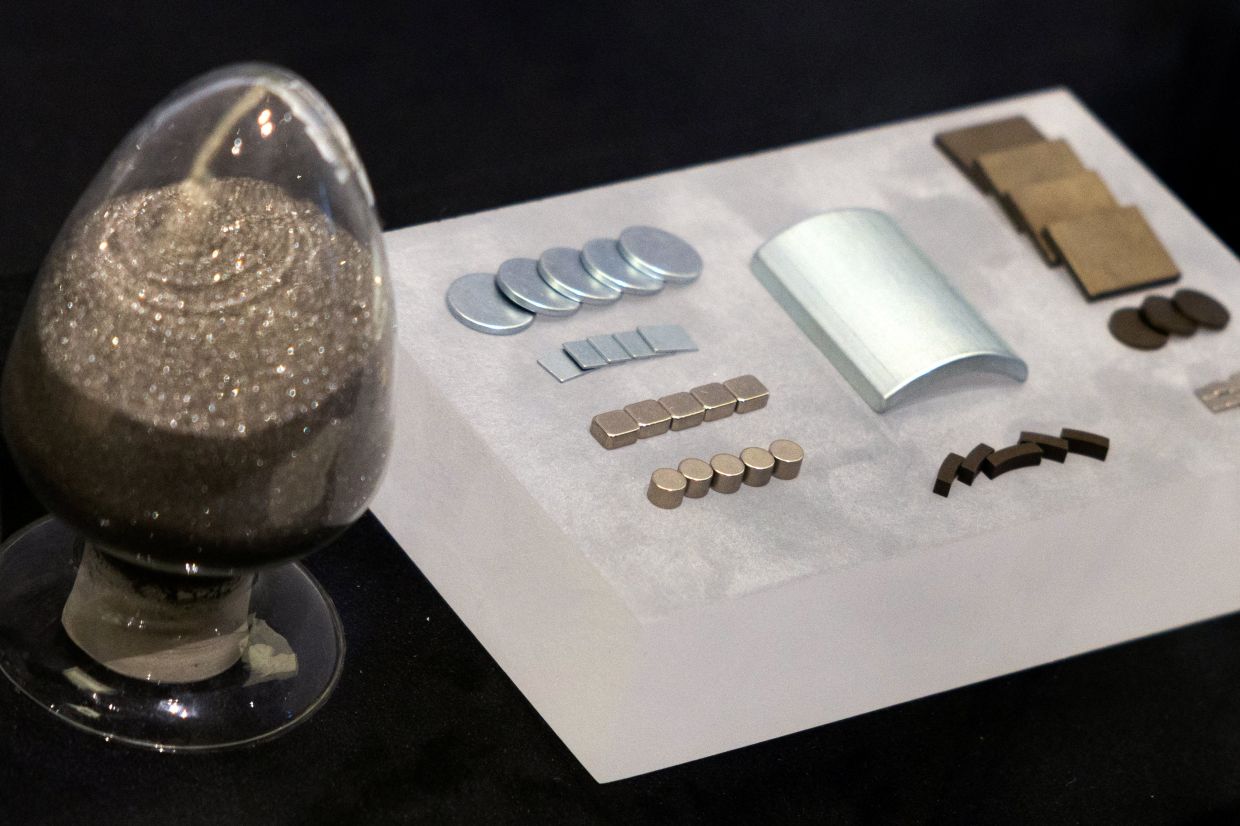
Beijing and Tehran are forging closer scientific ties in rare earth exploration and processing, marking a significant expansion of their research partnership at a moment when global competition for these strategically vital materials has intensified. The collaboration between China's National Natural Science Foundation (NSFC) and Iran's National Science Foundation reflects a broader pattern of deepening technological cooperation between the two nations, one that carries implications well beyond academic exchange and signals geopolitical positioning over resources essential to modern military and industrial capabilities.
Rare earths represent a group of seventeen metallic elements with distinctive magnetic and electronic properties that have become indispensable to contemporary defence systems. These materials feature prominently in the construction of advanced weaponry including missiles, fighter jets, radar installations, and sophisticated electronic components that underpin military modernisation programmes globally. The strategic importance of controlling rare earth supply chains has never been more apparent, particularly as tensions between major powers have prompted nations to reassess their dependence on single suppliers and shore up alternative sources.
The financial mechanics of the collaboration demonstrate Beijing's commitment to the partnership. The NSFC will contribute 30,000 yuan, equivalent to approximately US$4,200, for each workshop conducted under the programme, with these funds allocated toward meeting costs, accommodation, and internal transportation requirements. Iran's National Science Foundation will assume responsibility for international travel arrangements for its researchers and lodging for Chinese scientists conducting fieldwork in Iran. This cost-sharing arrangement reflects a structured approach to sustained cooperation rather than a one-off initiative.
The timing of this expanded cooperation carries particular significance given the shifting landscape of US-China competition over critical minerals. Earlier this month, the Trump administration announced US$3 billion in targeted investments directed toward developing domestic capacity in critical minerals and battery manufacturing, explicitly framed as a strategy to rebuild weapons stockpiles while reducing American reliance on Chinese supply chains. This policy response underscores Washington's recognition that mineral security has become a matter of national defence, driving urgent efforts to diversify sourcing and develop alternative processing capabilities.
China currently commands overwhelming dominance in the global rare earth sector, holding the world's largest proven reserves whilst simultaneously controlling the majority of global production and processing capacity. More significantly, Beijing has increasingly tightened restrictions on transferring rare earth-related technologies to foreign entities, a leverage point that became starkly evident when the country implemented export controls following the onset of Trump's trade war last year. Those restrictions rattled American manufacturers and starkly illustrated the vulnerability inherent in Washington's supply chain architecture.
Iran's rare earth endowment presents considerable untapped potential, though the extent and accessibility of these deposits remain incompletely characterised compared to established reserves elsewhere. The country's geological formations, particularly its iron ore and phosphate zones, display characteristics favourable for rare earth accumulation according to geological surveys. Research conducted by the Netherlands-based Hague Research Institute identified rare earth anomalies distributed across approximately 7,000 square kilometres of central Iran, suggesting resources that could eventually contribute meaningfully to global supply if properly developed.
Yet Iran currently operates from a position of technological immaturity in this domain. The country possesses only nascent extraction and processing capabilities, remaining substantially removed from the industrial-scale operations required to serve as a genuine alternative supplier. This is where Chinese expertise becomes invaluable to Tehran. By combining China's world-leading technical knowledge and processing sophistication with Iran's mineral endowments, the partnership could theoretically enable Iran to develop capacity over time, though such advancement would require years of sustained investment and technical transfer.
The broader framework underpinning this rare earth cooperation dates to 2017, when the two foundations signed a memorandum of understanding in Beijing that established the institutional foundation for ongoing scientific partnership. Since then, the arrangement has expanded to encompass diverse fields spanning mathematics, biological sciences, medicine, renewable energy technologies, materials science, climate research, and artificial intelligence. The NSFC has explicitly positioned Iran as a central participant in China's Belt and Road Initiative, framing scientific collaboration as instrumental to strengthening bilateral ties and delivering mutual benefits.
The joint workshop programme launched in 2024 represents a more formalised mechanism for executing this cooperation, initially allocating 150,000 yuan per workshop across priority areas including climate change, artificial intelligence, advanced materials, and manufacturing innovation. This year's expanded call for proposals maintains those foundational pillars whilst adding new dimensions including nano materials for medical diagnostics, environmental monitoring systems, earthquake-resistant construction methodologies, and cleaner manufacturing processes. The inclusion of rare earth exploration and processing signals an escalation in ambition and an explicit commitment to narrowing Iran's technological gap in this field.
For Malaysia and broader Southeast Asia, these developments merit careful attention. The region's own mineral-rich nations and its geographic position within supply chains make it vulnerable to disruptions stemming from rare earth competition between major powers. Beyond immediate trade implications, the pattern of deepening China-Iran scientific cooperation illustrates how strategic competition over critical resources increasingly manifests through technological partnerships and capacity-building initiatives rather than exclusively through trade or military mechanisms. Nations throughout Southeast Asia seeking to reduce dependency and build resilience in their own supply chains must consider whether similar collaborative frameworks might serve their interests, or whether relying on established Western partnerships remains strategically preferable. The rare earth question has transcended narrow commercial concerns to become a defining feature of great power competition, reshaping investment decisions and technological development priorities across the globe.

