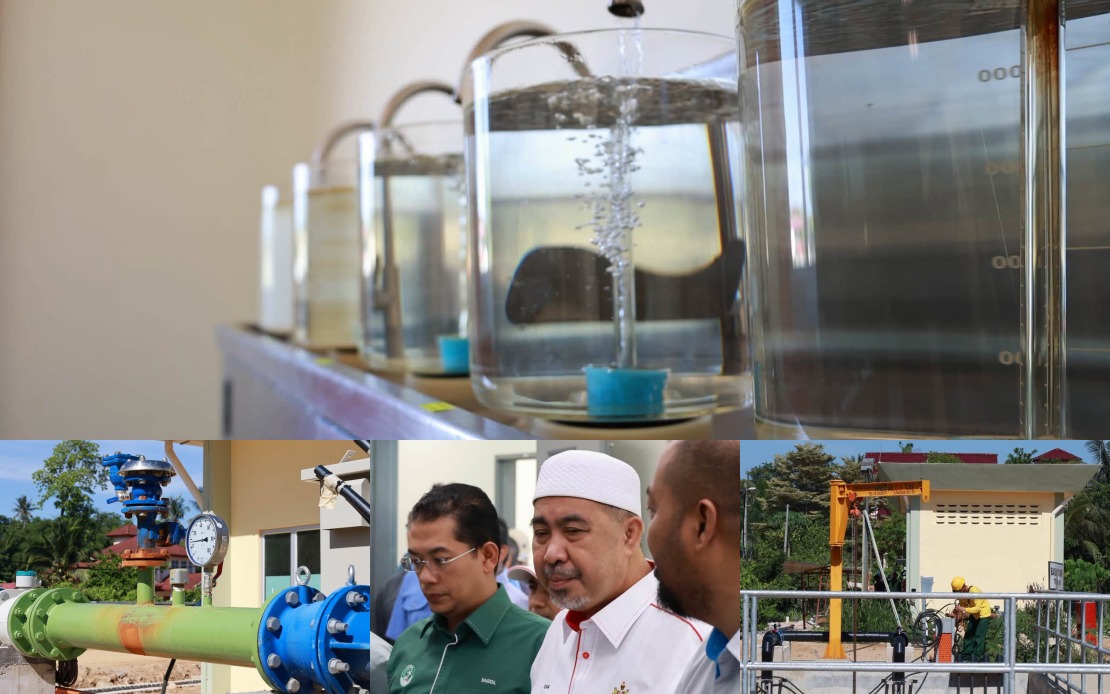
Water infrastructure development in Kelantan is entering a critical phase with the impending launch of the Chicha 2 Water Treatment Plant in Pasir Hor, a facility that represents significant progress in addressing the state's long-standing supply challenges. The RM54.98 million project has reached 97 per cent completion and is scheduled to commence operations in September, directly benefiting more than 13,000 consumers across Pasir Hor, Telipot, Kota Seribong, Mulong and Tunjong. According to Datuk Dr Izani Husin, the State Public Works, Infrastructure, Water and Rural Development Committee chairman, the advancement of this facility marks a tangible step forward in alleviating water shortages that have plagued rural and semi-urban areas within the state.
The Chicha 2 WTP represents a substantial infrastructure investment that demonstrates Kelantan's commitment to modernising its water distribution network. Spanning 1.84 hectares, the facility will produce 20 million litres per day, providing treated water sourced through groundwater extraction at depths of 100 metres. The treatment methodology employed at the facility is particularly noteworthy—the use of aeration technology constitutes the first application of this specific water treatment approach in Kelantan. This innovation not only ensures high-quality output but also establishes a replicable model that state authorities may implement across other treatment plants, positioning Kelantan as a testing ground for advanced water technology in Malaysia.
Beyond the immediate supply expansion, the project carries significant implications for consumer accessibility and account activation. Approximately 10,000 consumer accounts currently remain inactive due to inadequate water supply infrastructure, and the commissioning of Chicha 2 WTP is expected to facilitate their reactivation. This represents an expansion of formal water services to previously underserved populations, translating dormant accounts into active households with regular access to treated water. For residents who have endured intermittent or unreliable supply, this represents a fundamental improvement in living standards and public health outcomes.
Kelantan's water supply challenges have historically stemmed from systemic infrastructure deficiencies rather than resource scarcity. The state currently experiences non-revenue water losses exceeding 50 per cent, a figure substantially above the national average and indicative of widespread leakage and distribution inefficiencies. The primary culprits include ageing pipe networks, underground fractures, and malfunctioning water meters—issues that have accumulated over decades of underinvestment. Dr Izani acknowledged these inherited challenges, attributing water loss directly to deteriorating physical infrastructure rather than production capacity constraints. This diagnostic clarity is essential, as it frames water supply recovery as fundamentally an infrastructure rehabilitation exercise rather than a resource management crisis.
The state's response to these challenges operates across a multi-year timeline, with authorities projecting complete resolution of water supply issues by 2030. This phased approach reflects both the magnitude of required investment and the practical constraints of implementation. Rather than attempting instantaneous system overhaul, Kelantan is pursuing sequential infrastructure projects designed to progressively enhance treatment capacity and reduce distribution losses. The Chicha 2 WTP represents one component of this broader strategy, contributing incremental supply improvements that cumulatively address the supply-demand imbalance. Such long-term planning horizons, while testing public patience, acknowledge the scale of work required to fundamentally restructure water provision across an entire state.
For Malaysian readers, the Kelantan case illustrates broader regional patterns in water infrastructure development. Many states confronting similar challenges—inadequate treatment capacity, aging distribution networks, and high non-revenue water loss—are adopting comparable staged intervention approaches. The aeration technology employed at Chicha 2 WTP may have particular relevance for other states contending with groundwater treatment and quality concerns. Additionally, the project demonstrates how infrastructure investment can simultaneously address production capacity, supply reliability, and service accessibility, three dimensions often requiring parallel rather than sequential attention.
The economic dimensions of this project extend beyond immediate consumer benefits. The RM54.98 million investment represents capital expenditure that strengthens Kelantan's physical asset base, creates temporary employment during construction, and establishes operating jobs upon commissioning. For a state frequently characterised as economically disadvantaged relative to peninsular peers, infrastructure investment of this magnitude signals deliberate commitment to productivity enhancement and service-delivery parity. The successful completion of Chicha 2 WTP, should it progress to September commissioning without significant delays, would demonstrate governmental capacity to execute large-scale infrastructure projects effectively.
Communication challenges have historically complicated water infrastructure initiatives in Malaysia, with public frustration often amplified by perception of slow progress or insufficient transparency. Dr Izani's explicit appeal for public patience, combined with provision of specific completion timelines and technical specifications, represents an attempt to manage expectations and build confidence through information sharing. The disclosure of current NRW rates, specific loss mechanisms, and the timeline to full resolution provides measurable benchmarks against which future progress can be assessed. Such transparency, when coupled with demonstrated project advancement, can gradually reconstruct public trust in water authorities.
The technological dimension of Chicha 2 WTP—particularly the aeration treatment methodology—introduces an element of innovation within what is often perceived as routine infrastructure maintenance. This distinction matters for perception and institutional learning. By featuring novel treatment approaches, the project positions Kelantan not merely as a state recovering from infrastructure deficits but as an experimental site for improved water treatment methods. Should the aeration technology perform successfully, documentation and dissemination of outcomes could benefit other Malaysian water utilities grappling with similar groundwater treatment challenges, effectively transforming a single state initiative into a template for broader national improvement.
The reactivation of 10,000 consumer accounts assumes particular significance when understood within frameworks of service equity and developmental inclusion. Inactive accounts typically indicate households that either cannot afford connections, lack infrastructure access, or have abandoned service due to chronic supply failures. By restoring these accounts, the Chicha 2 WTP contributes to formalisation of water service provision, potentially improving revenue collection for water authorities whilst simultaneously ensuring that previously marginalised populations gain access to regulated, treated water supplies. This intersection of infrastructure investment with service democratisation represents the most profound impact of the project beyond aggregate supply metrics.
Looking toward 2030, Kelantan's comprehensive water supply recovery programme requires sustained political commitment, adequate budget allocation, and technical capacity to execute multiple concurrent projects. The Chicha 2 WTP must be understood within this broader context—as one facility within a portfolio of interventions designed to incrementally reconstruct the state's water infrastructure. Should momentum be maintained and subsequent projects advance similarly, the state could plausibly achieve supply adequacy within the projected timeline. Conversely, any significant delays or budget constraints could extend the recovery period further, prolonging public inconvenience and undermining confidence in state administration. The September commissioning of Chicha 2 WTP thus becomes a crucial early test of programme viability and governmental execution capability.

