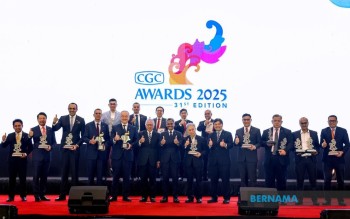
Malaysia's financial ecosystem took centre stage this month as the Credit Guarantee Corporation Malaysia Bhd presented its 31st CGC Awards, honouring 32 businesses and financial institutions that exemplify the resilience and adaptability now essential to the nation's enterprise sector. The ceremony underscored a fundamental shift in how policymakers and lenders view business survival—moving beyond simple access to capital towards a holistic understanding of entrepreneur discipline, institutional collaboration, and ecosystem-wide support.
At the heart of CGC chairman Datuk Mohammed Hussein's remarks lay a striking proposition: that resilience cannot be manufactured through credit alone. The character of business owners, their operational discipline, and their ability to pivot under pressure form the bedrock upon which enterprises survive economic downturns and market disruptions. This philosophy reflects a maturation in Malaysia's approach to enterprise development, recognising that sustainable growth emerges from the intersection of personal entrepreneurial qualities and systemic institutional support. Such nuance matters deeply for Malaysian policymakers seeking to strengthen the MSME base at a time when global supply chain instability and regional competition intensify.
The chairman's call for a coordinated ecosystem approach carries particular relevance for Southeast Asian nations grappling with similar enterprise challenges. Datuk Mohammed Hussein articulated that government responsibility extends to creating business-friendly regulatory environments, research institutions must accelerate technology commercialisation, corporations should open their procurement networks, and financial institutions must supply growth capital at critical junctures. This multi-stakeholder framework acknowledges that no single actor—neither government nor private finance—can independently sustain a thriving MSME sector. For Malaysia, where SMEs account for a substantial share of employment and economic activity, such ecosystem thinking offers a template increasingly adopted across the region.
Bumiputera enterprise participation emerged as a central theme of the 2025 awards cycle, with CGC reporting that it channelled RM223 million in guarantees to 27 Bumiputera companies during the previous year. This figure signals a deliberate intensification of support mechanisms designed to address historical inequities in access to financing and business networks. The award categories reflected this priority, with Maybank Islamic Bhd receiving a Special Recognition Bumiputera Award and OCBC Al-Amin Bank Bhd earning recognition in the Bumiputera SMEs category. Such institutional acknowledgment reinforces government policy commitments to inclusive growth while creating competitive incentives for financial institutions to deepen their engagement with Bumiputera entrepreneurs.
Environmental, social, and governance-linked guarantees reached RM1.2 billion against a RM1 billion target, exceeding expectations and signalling accelerating corporate appetite for sustainable financing mechanisms. This development holds strategic importance as regional businesses face mounting pressure from global supply chain partners, investors, and regulators to demonstrate environmental stewardship and social responsibility. Malaysian MSMEs, often embedded within global manufacturing and export networks, benefit from financing products that reward sustainability transitions. The surplus in ESG-linked guarantees suggests that Malaysian entrepreneurs increasingly recognise sustainability not as regulatory burden but as competitive necessity.
The award categories themselves reflected the complexity of Malaysia's financial architecture. Traditional financial institutions—Alliance Bank Malaysia Bhd, Public Bank Bhd, CIMB Islamic Bank Bhd, and Standard Chartered Saadiq Bhd—dominated the top partner categories, underscoring the continued centrality of banks to MSME financing. Simultaneously, recognition for development finance institutions including Bank Simpanan Nasional and Small Medium Enterprise Development Bank Malaysia Bhd acknowledged their specialised role in serving underserved enterprise segments. The inclusion of non-traditional finance partners, notably Peoplender Sdn Bhd (Fundaztic) in the imSME category, reflects the emerging fintech ecosystem supporting Malaysian entrepreneurs.
The ceremony's centrepiece was the formal launch of two complementary guarantee schemes totalling RM10 billion: the Bank Negara Malaysia-CGC Portfolio Guarantee (PG) and Portfolio Guarantee-i (PG-i) mechanisms. These instruments, initially announced on June 3, 2026, employ a risk-sharing architecture whereby CGC and Bank Negara Malaysia absorb portions of lending risk, encouraging participating financial institutions to extend credit to MSMEs they might otherwise deem too risky. The schemes' estimated reach of 12,100 businesses across key economic sectors suggests substantial potential for enterprise financing expansion, particularly in industries undergoing productivity transitions or sustainability upgrades.
The design of these guarantee schemes warrants closer examination for Malaysian policy observers. By targeting financing for business expansion, productivity enhancement, sustainability transitions, and competitive strengthening, the schemes address multiple economic imperatives simultaneously. An MSME accessing guaranteed financing for a production efficiency upgrade not only strengthens its own margins but simultaneously reduces energy costs, environmental footprint, and input requirements—outcomes aligned with both individual enterprise interests and broader national sustainability commitments. This alignment of incentives across micro and macro levels characterises sophisticated financial engineering.
For Malaysian entrepreneurs operating within regional supply networks, these developments carry direct implications. As multinational corporations increasingly require supplier compliance with sustainability standards and financial stability metrics, MSMEs that successfully utilise these guarantee schemes to upgrade facilities or adopt cleaner technologies strengthen their competitive positioning. The schemes thus function as bridge mechanisms enabling Malaysian SMEs to meet evolving international requirements, with particular significance for manufacturers competing within ASEAN and global markets. Sectors ranging from electronics assembly through food processing to light manufacturing stand to benefit substantially.
CGC's commitment under its CGC Group 2030 strategic framework to deepen MSME impact while advancing financial inclusion anchors these immediate award and financing initiatives within longer-term institutional purpose. The framework acknowledges that sustainable economic development emerges through deliberate collaboration among financial institutions, government agencies, corporations, and entrepreneurs themselves. For Malaysian policymakers, this forward-looking posture suggests that the relationship between enterprise support institutions and their clients requires continuous evolution, with successful models requiring genuine partnership rather than transactional lending relationships.
The convergence of institutional awards, Bumiputera support emphasis, and substantial new financing infrastructure deployed through the CGC Awards 2025 reflects Malaysia's considered approach to enterprise development at a critical juncture. As global economic uncertainty persists and regional competition intensifies, a resilient MSME sector represents critical national economic infrastructure. Through coordinated ecosystem engagement, targeted support for underrepresented entrepreneur groups, and risk-sharing financing mechanisms, Malaysia positions itself to strengthen its enterprise foundation for the remainder of the decade.

