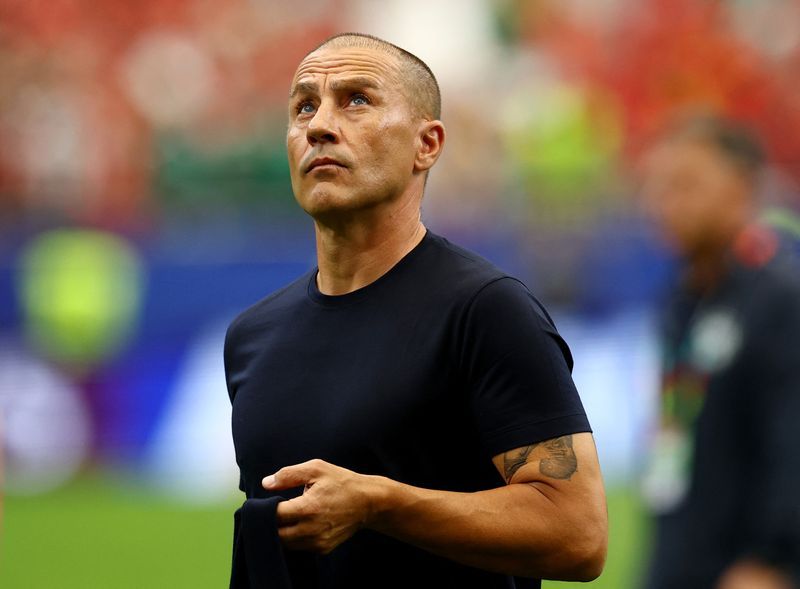
Uzbekistan's debut World Cup campaign suffered a crushing setback in Houston on Tuesday when the Central Asian nation conceded five goals to Portugal in a Group K match that exposed the vast gulf between the tournament's established powers and an emerging football nation. Coach Fabio Cannavaro, the Italian legend who lifted the World Cup with his country in 2006, stood before reporters immediately after the final whistle and demonstrated the leadership qualities that define his career by shouldering the full weight of responsibility for the lopsided scoreline.
Cannavaro's willingness to absorb blame rather than deflect it to his players represented a calculated managerial decision to preserve confidence in a squad making its inaugural appearance at football's greatest stage. He acknowledged that his own tactical decisions and in-game adjustments fell short of what the Portuguese intensity demanded, while simultaneously reassuring his young team that mistakes and setbacks were inevitable components of their development as international competitors. This diplomatic approach balanced honest assessment with the psychological protection necessary for a fragile squad navigating the emotional minefield of early World Cup elimination.
The broader context for Uzbekistan's position has become increasingly perilous after consecutive defeats left them virtually eliminated from knockout stage contention. Following the loss to Portugal came on the heels of a 3-1 defeat against Colombia in their opening fixture, the Central Asian representatives now face a must-win scenario against the Democratic Republic of Congo in their final group assignment on Saturday. Mathematically, progression to the round-of-32 remains theoretically possible, but realistically Uzbekistan requires not only victory but also a significant reversal in goal difference to dislodge either Colombia or Portugal from second place in a group that appears destined for European and South American dominance.
A particularly contentious moment in the Portugal match threatened to derail Uzbekistan's morale entirely when midfielder Azizjon Ganiev had what appeared to be a well-worked goal disallowed for a foul committed during the build-up phase. The decision arrived when the scoreline stood at 2-0, representing a critical juncture where a goal would have halved the deficit and potentially shifted momentum toward the underdogs. Cannavaro reflected that this reversal disproportionately affected his team's psychological state, suggesting that the contested decision had a cascading effect on confidence and tactical execution as Portugal subsequently ran riot.
The timing of Uzbekistan's World Cup entry coincides with a broader expansion of the tournament from 32 to 48 teams starting in 2026, a structural change that rewards emerging football nations with expanded qualifying berths and group stage opportunities. For a country with growing football infrastructure and investment, this inaugural participation represents both a sobering reality check and a valuable foundation upon which future campaigns can be built. The experience gained by players and coaching staff in dealing with elite opposition at the world's most scrutinized sporting event carries immeasurable value for developing football programmes in Central Asia.
Cannavaro's own trajectory from World Cup-winning centre back to international coach positions him uniquely to mentor younger players through adversity. During his playing days, the Italian defender absorbed tactical lessons from multiple tournaments and adapted his game accordingly. His emphasis to his current squad that mistakes and misplaced passes should not inhibit their natural football instincts reflects a coaching philosophy grounded in long-term player development rather than short-term results obsession. By encouraging courageous, attacking football despite the scoreline becoming progressively unfavourable, Cannavaro signalled that tournament experience transcends individual matches.
The structural disadvantage facing nations competing at the World Cup for the first time deserves consideration beyond simplistic narratives of poor performance. Uzbekistan's players lack the collective experience of handling pressure situations, managing fatigue over multiple matches against superior opposition, and adapting tactical approaches mid-tournament. Portugal, conversely, enters as a seasoned European outfit with players accustomed to competing at the highest club and international levels. The five-goal margin, while stark, partially reflects the developmental gulf between an emerging football nation and an established European powerhouse rather than exclusively poor play from the Uzbek side.
For Malaysian readers observing Uzbekistan's World Cup journey, the Central Asian team's experience offers parallels to Southeast Asian efforts at global tournaments. Nations investing in football development and producing players capable of competing internationally must navigate the uncomfortable reality that World Cup participation involves facing elite teams unlikely to show mercy. Uzbekistan's willingness to continue attempting attacking football despite the mounting deficit suggests a squad prioritizing learning and growth over defensive preservation of appearance and statistics. This philosophical approach, while producing unfavourable immediate results, potentially positions the programme for incremental improvement in subsequent tournaments.
Cannavaro's final message to reporters—that Uzbekistan entered the tournament to gain experience regardless of outcomes—acknowledges the broader strategic perspective that inaugural World Cup appearances function as platforms for football development. The coach's refusal to retreat into defensive cynicism or blame external factors after the Portugal loss, combined with his explicit instruction to players to embrace courage and attacking intent, establishes a narrative framework suggesting that genuine learning transcends traditional win-loss metrics. As Uzbekistan prepares for Saturday's final group encounter, the coaching staff appears committed to extracting developmental value from an otherwise unsuccessful campaign, positioning the squad's maturation as the true measure of success.