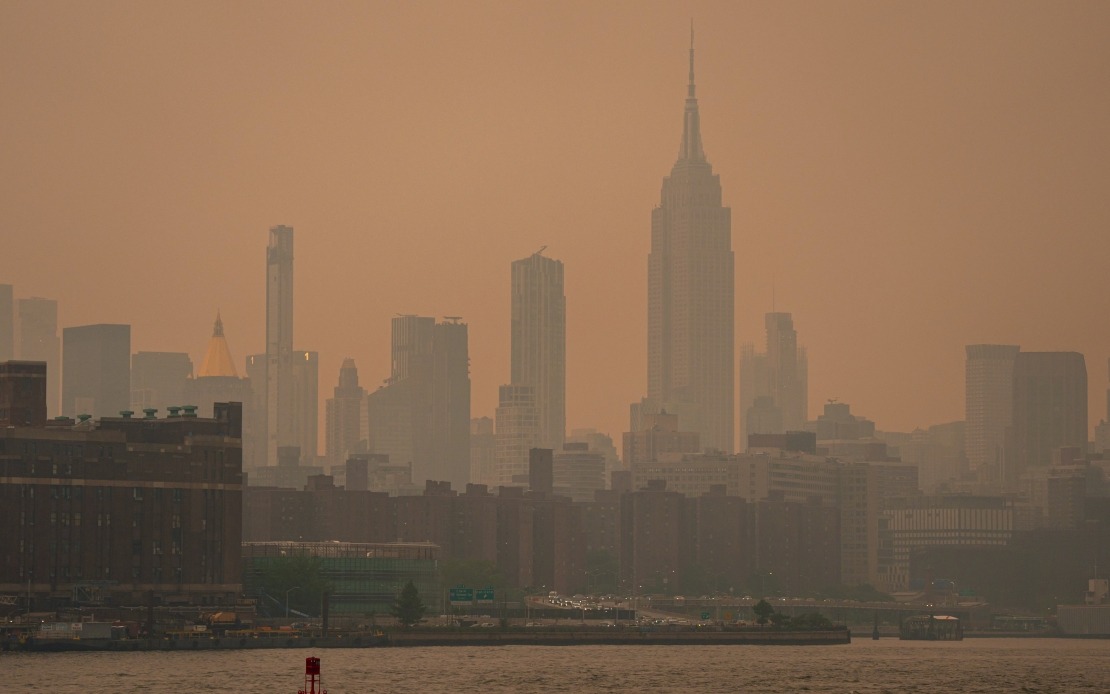
Mexican President Claudia Sheinbaum encountered significant travel complications on her way to Sunday's World Cup final between Argentina and Spain in East Rutherford, New Jersey, as smoke billowing from wildfires raging across Canada created hazardous air conditions over New York and forced aviation authorities to restrict flight operations.
The president's initially scheduled commercial flight from Cancún to New York faced a two-hour delay on Saturday, but conditions deteriorated sufficiently that authorities cancelled the service entirely. The deteriorating air quality stemmed from smoke and atmospheric pollution drifting southward from active wildfires in Canada, a phenomenon that has periodically affected air quality across North America in recent years as climate patterns and fire seasons intensify.
Rather than abandoning her attendance, Sheinbaum adapted her travel arrangements by departing for New York overnight into Sunday aboard a specially arranged aircraft from Mexico's Defence Ministry. This solution, while logistically more complex, ensured she could fulfil her diplomatic obligations and attend the high-profile sporting event despite the environmental obstacles.
The invitation itself carried diplomatic weight beyond the sporting spectacle. United States President Donald Trump extended a surprise invitation to Sheinbaum to attend the final, positioning the event as a trilateral showcase since Canada, Mexico, and the United States are jointly hosting the competition. Trump's gesture in extending the invitation—and the resulting attendance of leaders from all three host nations—underscored football's capacity to transcend typical political tensions.
Canadian Prime Minister Mark Carney will also attend the final, completing the triumvirate of leadership from the three co-hosting nations. Their collective presence at the match represents a rare moment of symbolic unity among the three neighbouring countries, even as underlying diplomatic relations remain complicated by substantive disagreements.
The Mexico-United States relationship has encountered considerable strain in recent months, primarily driven by disputes over trade arrangements and security matters affecting both countries. These tensions have created a backdrop of caution in bilateral engagement, making Trump's personal invitation and Sheinbaum's acceptance particularly noteworthy from a diplomatic perspective.
Their previous interaction provides context for understanding the significance of this gathering. Sheinbaum and Trump had met only once before in an official capacity—during the World Cup draw ceremony held in Washington in December of the previous year. That single prior meeting underscores how the football tournament has provided relatively rare opportunities for direct engagement between the Mexican leader and the American president, suggesting that major sporting events can occasionally serve as neutral venues for international relations.
The wildfire incident, while ultimately resolved through practical problem-solving, highlighted the growing intersection of environmental phenomena and diplomatic schedules. The transboundary nature of air pollution from Canadian wildfires demonstrated how climate and environmental challenges do not respect national borders and can affect even high-priority government activities. For Malaysian and Southeast Asian observers, this serves as a reminder of how regional environmental issues—whether forest fires as periodically experienced in the region, or other climate-related phenomena—can have cascading effects on official activities and international engagement.
Sheinbaum's determination to attend the match despite the obstacles reflected the perceived importance of the World Cup as a diplomatic platform. The tournament's hosting by three nations simultaneously has created numerous opportunities for multilateral engagement at various levels, and attendance by heads of state at marquee matches carries symbolic value regarding national pride and commitment to the games.
The incident also underscored the vulnerability of air transport to environmental disruptions. Modern aviation operates within narrow parameters regarding air quality and visibility, and wildfire smoke can trigger immediate operational restrictions. For officials and delegations requiring urgent travel, such environmental events necessitate backup plans and alternative arrangements—in this case, the deployment of a military aircraft that operates under different protocols than commercial carriers.
For regional observers in Southeast Asia, the story carries particular resonance given the peninsula's own experiences with transboundary haze, particularly during certain seasons when agricultural burning and natural fires create air quality challenges across multiple countries simultaneously. The pragmatic response demonstrated by Mexico's government—adapting travel methods rather than cancelling attendance—offers a model for how officials manage such disruptions when diplomatic commitments remain essential.
The successful navigation of these logistical obstacles allowed the three leaders to attend what is expected to be one of the tournament's most significant matches, demonstrating that even environmental challenges and diplomatic tensions can be managed through flexibility and determination to maintain international engagement.

