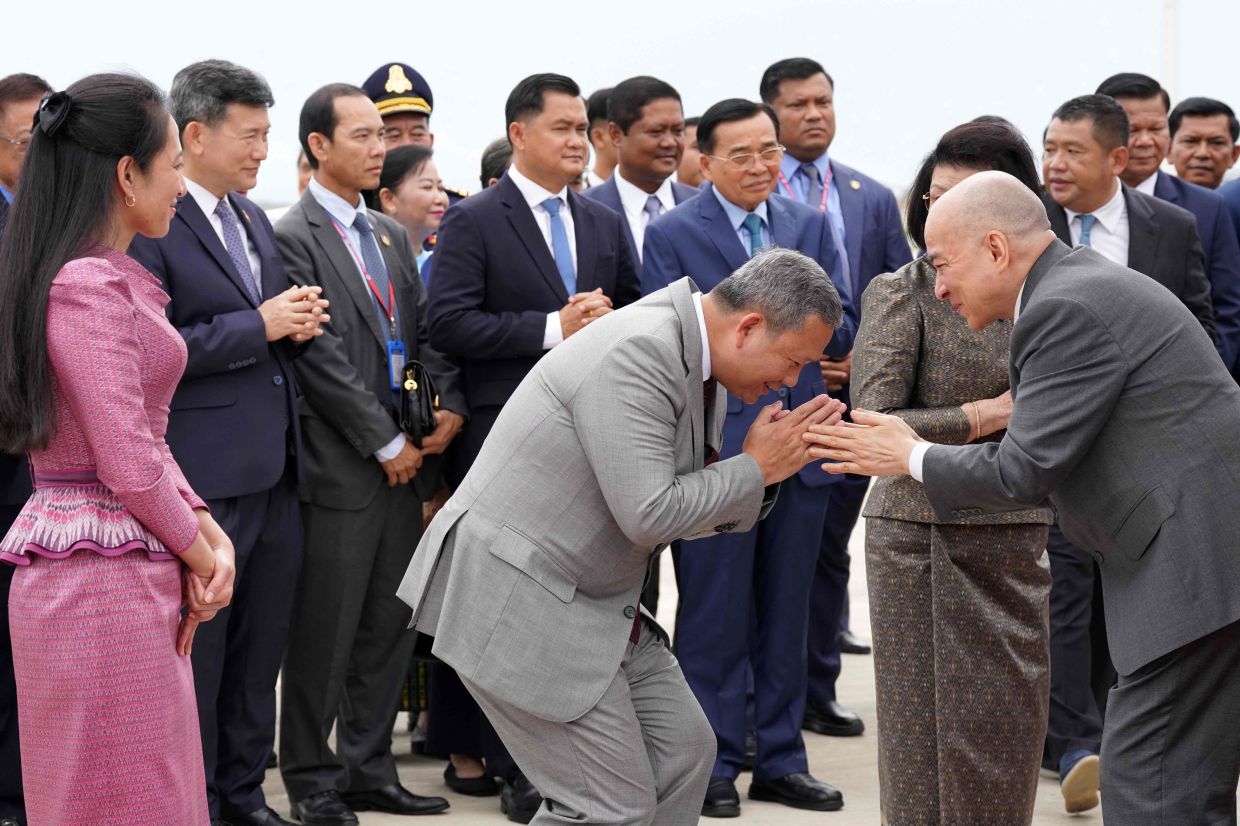
Cambodia's King Norodom Sihamoni arrived back in Phnom Penh on Friday afternoon following an extended medical stay in Beijing, marking a significant moment for the Southeast Asian kingdom's political landscape. The 73-year-old monarch, who had been receiving treatment for prostate cancer at a Chinese medical facility, was received by a delegation of senior officials led by Prime Minister Hun Manet and his father Hun Sen, the influential former leader who dominated Cambodian politics for decades. State media confirmed that the king's condition had stabilised after more than three months of medical intervention.
The sovereign had initially departed Cambodia earlier in the year for routine health examinations, which subsequently led to the discovery of his cancer diagnosis in April. Following the diagnosis, he made the decision to remain in Beijing for comprehensive surgical treatment performed by specialists at the Chinese hospital. The Royal Palace released a statement on Tuesday indicating that his condition was "getting better" as his medical course progressed, providing reassurance to the Cambodian public and regional observers concerned about the nation's leadership stability.
King Sihamoni's journey to the throne reflects Cambodia's complex recent history. He assumed the crown in 2004 following the abdication of his father, King Norodom Sihanouk, who had similarly travelled to Beijing for cancer treatment decades earlier. The elder king eventually passed away in 2012, having spent his final years in relative retirement. This pattern of seeking advanced medical care in China underscores the strong historical relationship between Cambodia and Beijing, a dynamic that has only intensified during Hun Sen's tenure as prime minister and continues under his son's administration.
Before ascending to Cambodia's throne, Sihamoni spent the majority of his adult life abroad, pursuing a distinguished career in the performing arts and cultural affairs rather than political life. Fluent in Khmer, French, Czech and English, he had cultivated an artistic reputation across multiple countries before being selected to fill the constitutional role of monarch. His background distinguishes him significantly from his predecessors and reflects Cambodia's broader cultural and diplomatic connections with nations across Europe and Southeast Asia.
The presence of Hun Manet alongside his father Hun Sen at the airport symbolises the current political arrangement in Cambodia, where power has formally transferred to the younger generation whilst Hun Sen retains considerable influence as chair of the ruling Cambodian People's Party. This succession has been portrayed by the government as a modernisation of leadership, though international observers note that core power structures remain concentrated within the ruling elite. The public display of unity between current and former leadership figures at the airport suggested efforts to project stability at a time when questions about the king's health had occupied regional diplomatic circles.
Cambodia's reliance on Chinese medical expertise reflects broader regional patterns in Southeast Asia, where several monarchies and senior leaders have sought treatment in Beijing or other major Chinese medical centres. This trend strengthens economic and political ties between Cambodia and China, particularly given Beijing's role as a major infrastructure investor and strategic partner under agreements reached during Hun Sen's administration. The visibility of the king's medical journey therefore carries implications extending beyond simple health considerations into the realm of diplomatic signalling and geopolitical positioning.
The king's return to full duties will likely require a period of recovery and rehabilitation, though the palace has not disclosed specific details about the timeframe for his resumption of ceremonial and constitutional responsibilities. In the Cambodian system, the monarch holds significant ceremonial importance and serves as a symbol of national continuity and stability, roles that have acquired particular weight given recent political transitions. The successful outcome of his treatment appears designed to reassure the Cambodian public about institutional continuity.
King Sihamoni's illness and recovery occur within the context of Cambodia's ongoing political evolution, marked by the consolidation of Hun Manet's authority and the formalisation of the transition from Hun Sen's three-decade premiership. The monarchy's independence from day-to-day political machinations theoretically positions it as a stabilising constitutional institution, though Cambodia's governance structures concentrate significant authority within the executive branch. The king's extended absence during his medical treatment underscored the potential vulnerabilities in any governance system dependent on a single individual's health status.
Regional observers will likely monitor the extent to which the king resumes his full schedule of public appearances and constitutional duties in the coming weeks and months. His recovery trajectory could influence public perceptions of governmental stability and Cambodia's capacity to manage both domestic affairs and its complex regional relationships. The Cambodian monarchy, despite its ceremonial character, remains symbolically central to national identity and institutional legitimacy in the eyes of much of the population.
The successful conclusion of King Sihamoni's medical treatment in China and his homecoming mark another chapter in the long-standing relationship between Cambodia's leadership and Beijing's centres of power. As Cambodia navigates its current political transition and regional positioning, the health and longevity of its constitutional symbols assume practical significance beyond their ceremonial dimensions. The palace's emphasis on the king's improved condition suggests a desire to move beyond a period of uncertainty and focus instead on forward momentum for the institution and the nation it represents.

