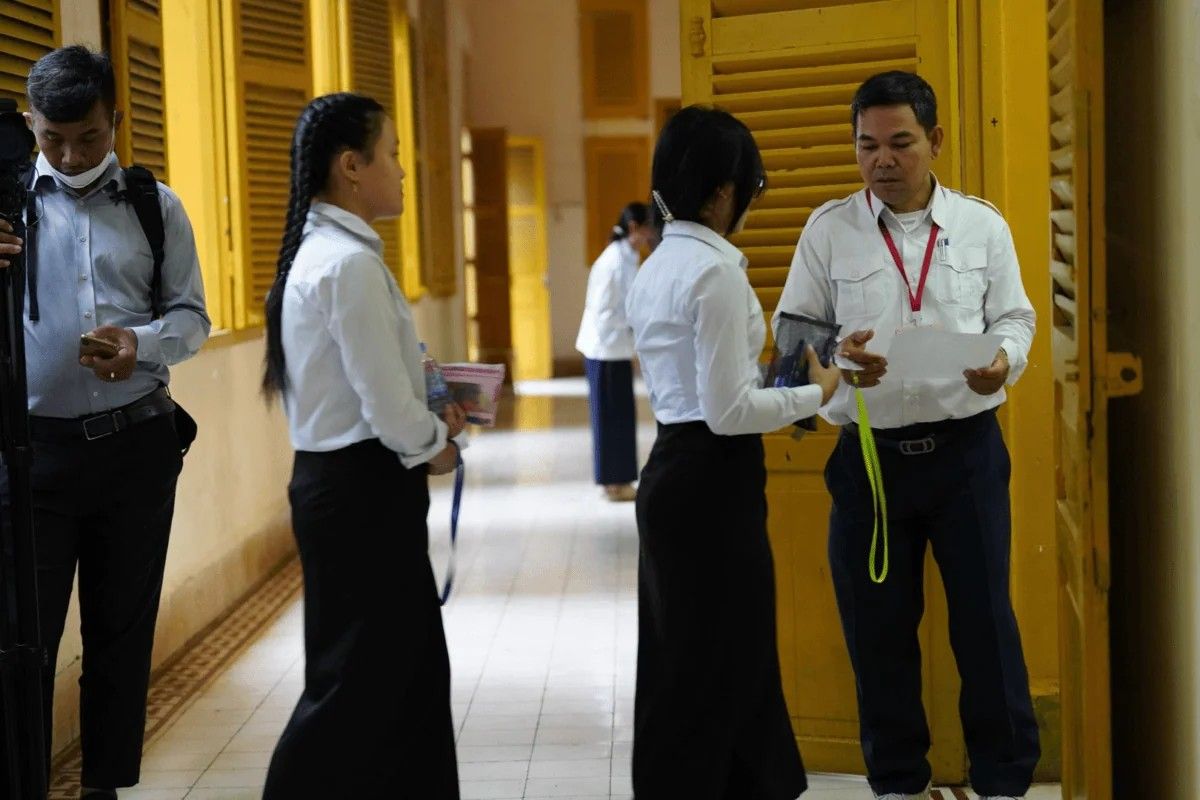
Cambodia's high school graduation examinations commenced on August 10 with over 150,000 students registered to sit the crucial assessments, yet the proceedings remain shadowed by the unresolved territorial occupation that has displaced thousands and shuttered schools across the kingdom's northern frontier. The examinations represent a return to more stable conditions compared to the previous year, when armed clashes erupted on the Cambodia-Thailand border just one month before tests were administered, creating extraordinary challenges for students and educators attempting to maintain educational continuity amid military conflict.
The examination infrastructure spans the entire country, accommodating candidates pursuing two distinct academic pathways: more than 37,000 students in the science track and over 130,000 in the social science stream. This distribution reflects the traditional educational preferences among Cambodian students, with the humanities and social sciences remaining the dominant choice for secondary school graduates. The scale of participation underscores the importance of these examinations as the gateway to higher education opportunities, making the circumstances under which they occur particularly significant for the nation's educational trajectory and future workforce development.
Education Minister Hang Chuon Naron addressed the opening ceremony in Phnom Penh, acknowledging both the progress achieved and the ongoing hardships faced by students in conflict-affected regions. His remarks underscored the distinction between this year's examination environment and the traumatic conditions of 2025, when examinations proceeded barely four weeks after the initial armed confrontation between Cambodian and Thai forces destabilised the border region. The compressed timeline from conflict to examination last year forced students and their families to navigate unprecedented disruptions to their academic schedules, exemplifying the resilience demanded of Cambodia's education system in the face of external military pressure.
The minister recounted a striking example of determination amid adversity: students in Oddar Meanchey province were forced to continue their studies from tractors as families fled military operations, yet at least one achieved exceptional academic results and successfully gained admission to a prestigious higher education institution. Such accounts, while illustrating individual triumph, also underscore the systemic disadvantages faced by communities in proximity to the disputed frontier. These students overcame not merely the standard pressures of examination preparation, but also physical displacement, psychological trauma from military conflict, and the complete disruption of normal educational infrastructure.
The most pressing unresolved issue remains the closure of 25 schools in border provinces that remain under Thai military occupation. The Cambodian government has formally demanded the return of these educational facilities to national control, enabling displaced students to resume classes in their home communities. Currently, only students from Banteay Mean Rith Lower Secondary School in Oddar Meanchey have been accommodated through temporary learning arrangements, a provisional solution that falls far short of restoring full educational access. This situation reflects the broader tensions resulting from last year's border incursion, which transformed educational governance into a diplomatic and security concern rather than purely an administrative matter.
The occupation of schools by foreign military forces creates cascading educational disadvantages that extend far beyond the examination period itself. Students attending classes in temporary camps experience disrupted curricula, inadequate learning resources, and the psychological burden of studying in emergency settings. Teachers operating under such constraints face immense pressure to maintain teaching standards despite facilities that lack basic amenities, creating a crisis not merely for individual students but for entire communities whose educational infrastructure has been compromised by external occupation.
Anticipation surrounds this year's examinations also due to widespread concerns about examination integrity that emerged during previous administrations. Last year's mathematics examination papers were reportedly leaked before administration, raising systemic questions about security protocols and the vulnerability of sensitive assessment materials. To address these vulnerabilities, the Anti-Corruption Unit has deployed more than 4,000 observers throughout examination centres nationwide, maintaining parity with deployment levels from the previous year. This observation infrastructure reflects heightened commitment to preventing irregularities, though critics argue that such measures remain insufficient without more fundamental reforms to examination administration and oversight mechanisms.
The examination security framework incorporates participation from multiple stakeholder groups beyond government officials, including civil society representatives and education sector professionals. This broader oversight arrangement represents an attempt to build confidence in examination results through transparency and shared responsibility for maintaining standards. The involvement of external observers signals recognition that examination integrity constitutes a matter of public concern transcending purely governmental authority, particularly given the high stakes involved for students whose futures depend on valid assessment of their academic achievements.
For Malaysia and the broader Southeast Asian region, Cambodia's examination challenges illuminate the vulnerability of education systems to regional security instability. The border dispute between Cambodia and Thailand, while geographically distant from Malaysia, demonstrates how military confrontations can systematically disrupt fundamental educational services. Educational discontinuity of this magnitude has long-term implications for national human capital development, workforce competitiveness, and social cohesion. Malaysian policymakers monitoring the situation recognise that protecting educational infrastructure from security threats constitutes an essential component of national resilience planning, particularly for border regions that may face similar vulnerabilities.
The persistence of closed schools under foreign occupation represents a humanitarian concern that transcends ordinary examination administration. These young people are being denied normal educational experiences during critical developmental years, accumulating educational deficits that may prove difficult to remedy through accelerated programmes or remedial instruction. The broader implications suggest that regional stability and educational access remain inextricably linked, with ramifications for the quality of human capital development across Southeast Asia. Cambodia's experience demonstrates that military conflicts, even those that do not escalate into full-scale warfare, can inflict lasting damage on educational systems and the generational cohorts relying on them for economic and social advancement.

