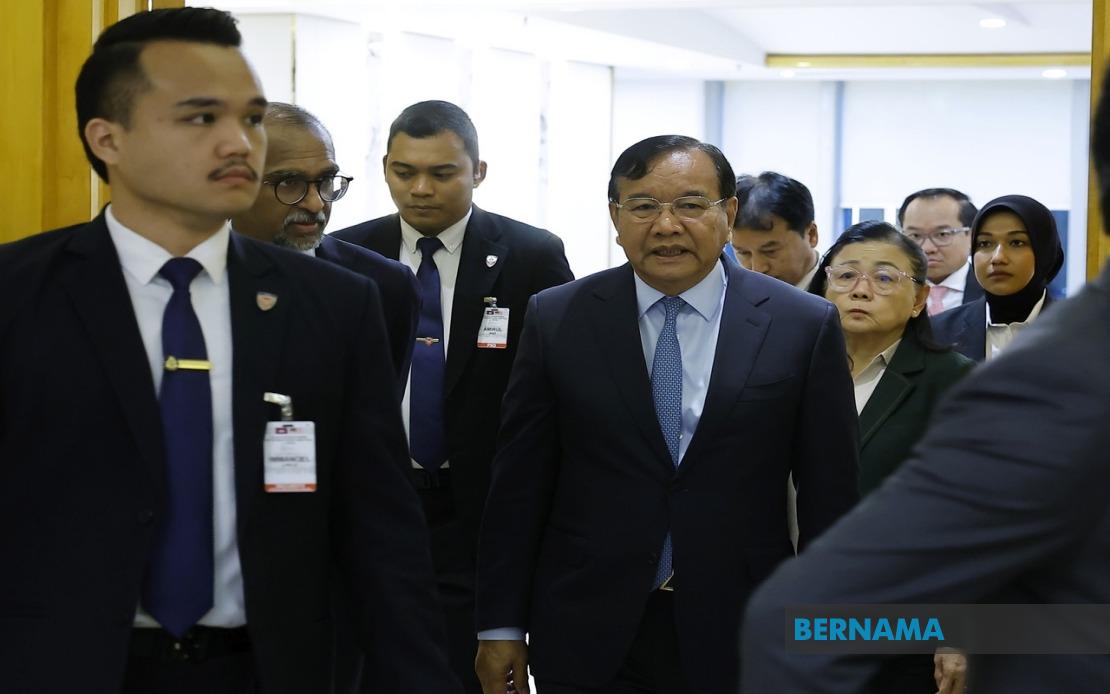
Cambodian Deputy Prime Minister and Foreign Minister Prak Sokhonn departed Malaysia on Sunday afternoon, bringing to a close a two-day diplomatic engagement that signals renewed momentum in bilateral relations between the Southeast Asian neighbours. Sokhonn and his accompanying delegation departed from Kuala Lumpur International Airport Terminal 1 at 4.45 pm on a commercial flight returning to Phnom Penh, with Datuk Rozainor Ramli, the Malaysian Government's chief ceremony officer, attending the farewell ceremony.
The visit, which commenced on Monday, carried significant symbolic weight as both nations prepare to mark seven decades of formal diplomatic ties in 2027. This preparatory engagement underscores the strategic importance Malaysia and Cambodia place on their relationship, setting the groundwork for what is expected to be a series of commemorative activities celebrating the partnership's longevity and mutual achievements.
During his stay, Sokhonn was received by Prime Minister Datuk Seri Anwar Ibrahim at the Prime Minister's Office, where the two leaders engaged in substantive discussions about the future direction of Malaysian-Cambodian cooperation. The conversation ranged across emerging economic sectors and contemporary policy challenges, with both sides expressing commitment to deepening engagement in digital transformation, artificial intelligence applications, halal industry development, food security arrangements, and investments in human capital. These thematic priorities reflect the shared understanding that regional prosperity increasingly depends on technological advancement and sustainable economic practices.
The most tangible achievement of Sokhonn's visit came through the co-chaired third Malaysia-Cambodia Joint Commission for Bilateral Cooperation meeting held in Kuala Lumpur on Sunday. This gathering marks a watershed moment for the relationship, as the bilateral mechanism had remained dormant for two decades prior to its revival. By resurrecting this institutional framework, both nations are establishing structured channels through which they can coordinate policy responses, negotiate trade arrangements, and address transnational challenges with greater consistency and formality.
Economic indicators demonstrate the growing importance of the bilateral relationship to both countries. Trade between Malaysia and Cambodia expanded substantially in 2025, climbing 27.4 per cent year-on-year to reach RM5 billion, equivalent to USD1.17 billion. This expansion reflects robust demand for Malaysian goods in the Cambodian market, with Malaysian exports contributing RM4.13 billion of the total, while Cambodian suppliers shipped RM880 million worth of goods to Malaysian importers. These figures indicate a gradually rebalancing trade dynamic where Malaysian investments and business presence have created demand for reciprocal Cambodian exports.
Beyond trade flows, Malaysia's investment footprint in Cambodia has become increasingly substantial. As of 2024, Malaysian enterprises had cumulatively invested USD3.20 billion across 162 registered projects, establishing Malaysia as Cambodia's third-largest source of foreign direct investment after China and Vietnam. This investment concentration spans multiple sectors including manufacturing, real estate development, and services, creating employment opportunities in Cambodia while generating returns for Malaysian investors. The scale of this capital deployment indicates that the economic relationship extends well beyond simple merchandise trade into longer-term productive capacity development.
The timing of the visit reflects broader regional strategic calculations. Cambodia has emerged as a pivotal player in Southeast Asian geopolitics following its assumption of ASEAN chairmanship in 2023 and its position within various regional groupings. By prioritizing this bilateral engagement and reviving dormant institutional mechanisms, Malaysia signals its commitment to maintaining influence in Cambodia while reinforcing ASEAN cohesion. For Cambodia, the visit provides an opportunity to strengthen ties with a significant economic partner and to demonstrate ongoing relationship management with regional powers.
The emphasis on preparations for the 70th anniversary of diplomatic relations suggests both nations view their connection as fundamentally enduring despite periodic lulls in formal engagement. The two-decade gap in joint commission meetings indicates that while the relationship remained stable, it had not been cultivated through systematic dialogue at the highest levels. By consciously preparing commemorative activities now, Malaysian and Cambodian leadership are signalling to their respective populations and to regional observers that this partnership warrants renewal and invigoration.
For Malaysian policymakers and businesses, the revival of the joint commission creates new pathways for addressing bilateral issues and exploring opportunities in a rapidly evolving Cambodian economy. As Cambodia continues its development trajectory and integrates further into regional value chains, Malaysian companies possess both competitive advantages and historical relationships that could position them favorably in competition with other investors. The formal mechanism provides regular opportunities to negotiate preferential treatment and to coordinate on infrastructure projects that might benefit both economies.
The visit also carries implications for broader Southeast Asian stability and cooperation frameworks. A strengthened Malaysia-Cambodia relationship contributes to regional cohesion and reduces the likelihood of bilateral disputes escalating into wider diplomatic tensions. Given the complex history of border issues and the presence of disputed maritime zones in Southeast Asia, maintaining active channels of communication and cooperation serves as a stabilizing force. The bilateral commission's reactivation thus has externalities that extend beyond the two nations themselves.
Looking forward, both nations will likely use the remainder of this decade to deepen cooperation across the identified priority sectors and to prepare substantive commemoration events for 2027. The investment figures and trade growth suggest that economic fundamentals support closer integration, and the political will demonstrated through this visit indicates that governmental leadership is committed to removing barriers to expanded cooperation. Regional observers will watch whether this renewed diplomatic activity translates into concrete institutional innovations or sectoral partnerships that could serve as models for other bilateral relationships within ASEAN.

