Cambodia's Minister of Information Neth Pheaktra has mounted a pointed response to Thailand's dismissal of territorial encroachment accusations, asserting that physical evidence of Thai military activities is now being independently verified by regional and international observers whose testimonies cannot be dismissed as mere Cambodian propaganda. Speaking on Monday following Thailand's Joint Information Center director Air Chief Marshal Prapas Sornchaidee's categorical denial of any policy to invade or occupy neighbouring territory, Pheaktra reframed the dispute as no longer a matter of competing narratives but rather documented reality observable to impartial witnesses from ASEAN, diplomatic missions and the United Nations.
The Thai military official had maintained that Bangkok's construction of roads, fortifications and other infrastructure serves legitimate defensive purposes to protect troops and civilians while safeguarding what Thailand considers its own sovereign territory. Prapas acknowledged that troop presence and security installations cannot by themselves determine international boundaries, arguing instead that territorial matters must be resolved through maps, legal evidence and the Joint Boundary Commission mechanism—a position theoretically aligned with Cambodia's own stated preference for resolving disputes through agreed technical and legal processes rather than military occupation or fait accompli.
Yet Pheaktra identified a crucial shift in the dispute's dynamics: the expansion of who is now documenting ground conditions. Where previously only Cambodian authorities reported incursions, physical barriers and displaced populations, regional and international observers are now independently verifying these claims with their own inspections and site visits. The minister emphasised that shipping containers, razor wire installations and other tangible alterations to the landscape cannot be concealed from third parties whose presence reduces the dispute to something more substantial than duelling official statements between Bangkok and Phnom Penh.
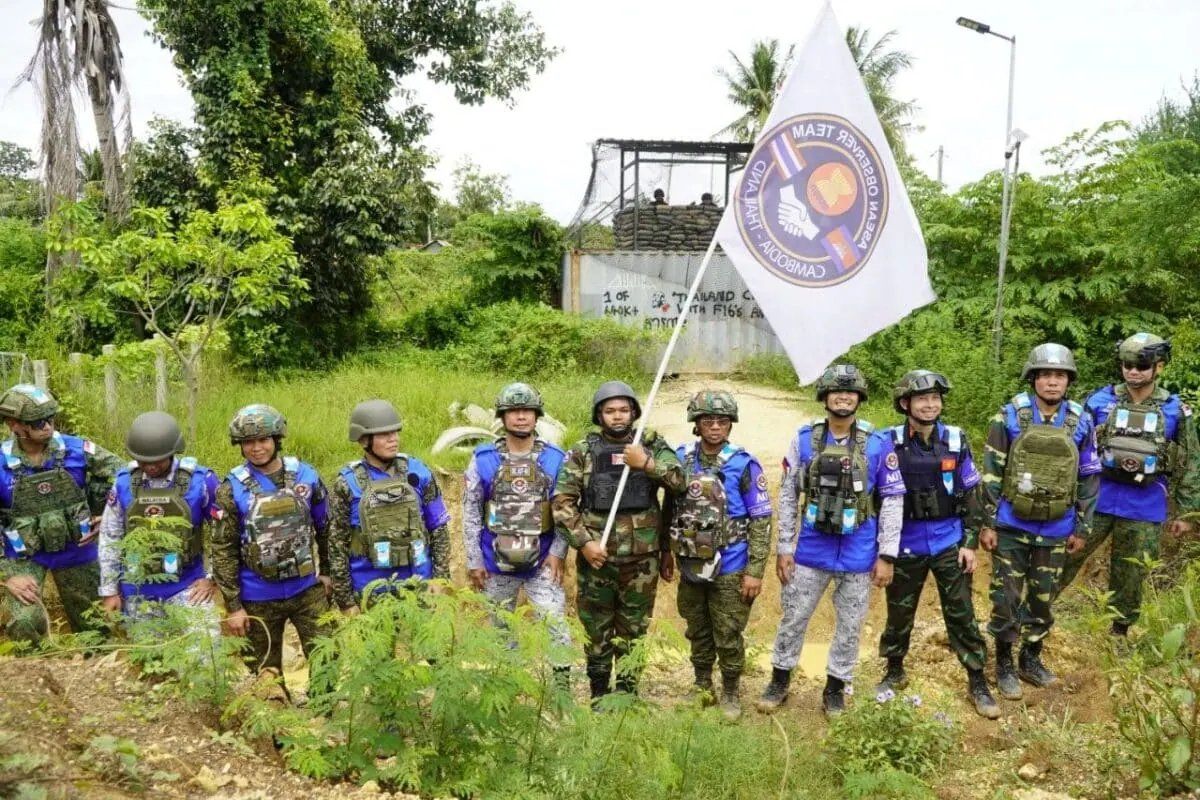
The ASEAN Observer Team in Cambodia, headed by a Philippine mission leader, recently conducted inspections across three sites in Banteay Meanchey province that exemplify the Cambodian position. At Boeung Trakuon in Thma Puok district's Kouk Romiet commune, the team documented 44 shipping containers positioned at 14 separate locations, areas where Cambodia alleges approximately 7,873 residents from 1,869 families—including 1,847 children—remain prevented from returning to their homes. Observers further inspected an additional 72 containers at Chouk Chey and Prey Chan villages across 10 distinct locations. Collectively, these three areas contain 116 containers spread across 24 positions, with Cambodia maintaining that over 13,259 people, including more than 3,400 children, cannot safely return to their residences.
These observations carry particular weight given recent visits by UN Special Rapporteur on Human Rights in Cambodia Tom Andrews, who toured displaced communities and border regions during a July mission. Andrews subsequently reported that approximately 650,000 Cambodians were displaced during the conflict period, with over 20,000 remaining unable to return home. Individuals he encountered described their inability to access properties now controlled by Thai security forces, prompting Andrews to advocate for the safe return of displaced populations. For Pheaktra, such documentation by internationally recognised human rights monitors transforms the territorial dispute from an abstract legal question into a concrete humanitarian crisis with observable victims and verifiable conditions.
Pheaktra's strategic argument rested on accumulating independent corroboration: ASEAN team inspections, diplomatic visits to affected areas and Andrews' human rights assessment collectively create a third-party record of the frontier situation that cannot be attributed to Cambodian bias or exaggeration. The minister stressed that evidence of occupation cannot be hidden when multiple independent observers are recording what they witness firsthand. However, observers should note that such third-party documentation, while politically significant, does not itself constitute formal ASEAN or UN determination of sovereignty. The ASEAN Observer Team's mandate remains limited to monitoring ceasefire compliance, while Andrews' role concerns human rights advocacy; neither organisation possesses authority to adjudicate territorial boundaries.
Cambodia's legal framework for boundary resolution encompasses the Franco-Siamese treaties and historical conventions, period maps and boundary documents, the 2000 Cambodia-Thailand Border Memorandum of Understanding, the 2003 Terms of Reference governing joint commission operations and the ongoing Joint Boundary Commission process. Pheaktra categorically rejected the notion that security requirements or military necessity could justify Thai alteration of conditions in territory Cambodia maintains belongs to its sovereignty. His formulation was pointed: shipping containers function neither as border demarcations, barbed wire lacks treaty authority, defensive trenches are not boundary documents and flag placement cannot constitute territorial title deed.
Thailand's position, articulated through Prapas, remained steadfast that neither country could unilaterally determine sovereignty through public declarations, and that Bangkok would continue protecting what it considers its territory without halting security operations merely because Cambodia demanded cessation. This fundamental disagreement persists: Thailand characterises its actions as legitimate sovereignty protection for troops and civilians, while Cambodia interprets the same activities as opportunistic military occupation disguised beneath security rhetoric. The two countries remain locked in contrasting interpretations of identical physical circumstances.
Cambodia has further linked the territorial question to Point 4 of the December 27 ceasefire agreement, which explicitly provides for affected civilians to return to homes on their respective sides without impediment and in conditions of safety and dignity. For Pheaktra, the persistent inability of thousands of Cambodian residents to return to residences effectively ringed by containers and security barriers demonstrates that the post-conflict situation remains unresolved despite official ceasefire declarations. His final formulation conveyed Cambodia's core position: a ceasefire agreement does not grant permission to create new territorial facts through military occupation and physical control over contested areas.
For regional observers and analysts, this escalating emphasis on third-party documentation signals Cambodia's strategy to internationalise the dispute beyond bilateral negotiation. By repeatedly invoking ASEAN monitors, UN officials and diplomatic witnesses, Pheaktra seeks to establish that independent verification now supports Cambodia's version of events rather than Thailand's counter-assertions. Yet this approach also carries risks: ASEAN's traditional consensus-based diplomacy typically avoids direct judgment on territorial disputes, and UN human rights mechanisms, while supportive of the displaced population's cause, cannot authoritatively determine sovereignty. Cambodia's appeal to third parties may generate diplomatic support and humanitarian attention without resolving the fundamental legal question of where the boundary actually lies according to historical treaties and boundary commissions.
The broader Southeast Asian context adds significance to this border dispute. Long-standing tensions between Cambodia and Thailand reflect deeper regional dynamics involving Chinese influence, Vietnamese strategic interests and ASEAN efforts to maintain stability among member states. Cambodia's explicit linking of the territorial question to ceasefire implementation and humanitarian returns suggests Phnom Penh views third-party involvement not merely as documentation but as potential pressure mechanism on Bangkok. Thailand's firm rejection of ceasefire conditionality indicates Bangkok will not permit international actors to dictate conditions regarding areas it considers strategically vital. The persistence of this dispute, now documented by international observers, underscores how territorial disagreements continue shaping regional security architecture despite decades of diplomatic efforts toward resolution.

