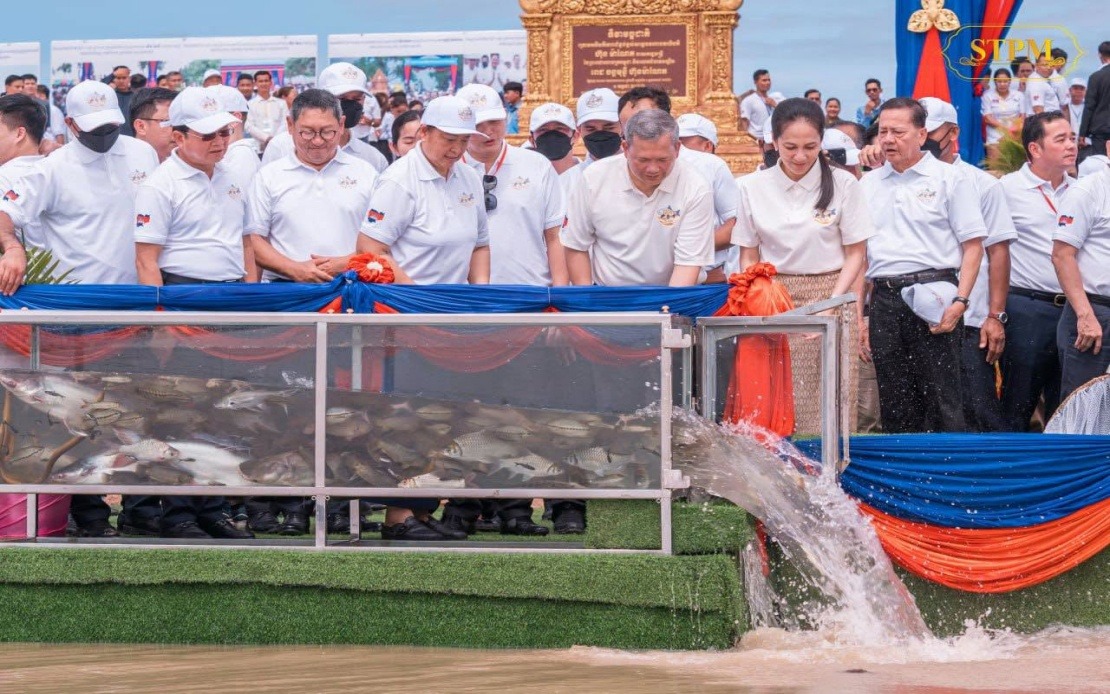
Cambodia's government has launched a comprehensive enforcement operation against illegal fishing, with Prime Minister Hun Manet personally directing military units to intensify patrols across the country's most productive aquatic zones. Speaking during National Fish Day celebrations in Svay Rieng Province, Hun Manet emphasized that protecting marine and freshwater resources from unlawful exploitation represents a national priority that directly impacts Cambodia's food security and the survival of its fishing communities.
The directive reflects growing concern about the degradation of spawning grounds and juvenile fish habitats, which form the foundation of Cambodia's fisheries sector. By concentrating military enforcement during critical breeding seasons, the government aims to reverse declining fish stocks that have threatened thousands of fishermen who depend on aquatic resources for their survival. Hun Manet acknowledged that Cambodia's waterways—particularly the vast Tonle Sap lake system—face mounting pressure from various exploitative practices that undermine the ecosystem's regenerative capacity.
The Cambodian military has been assigned expanded responsibility for combating resource crimes across both terrestrial and aquatic environments over the past two years. Hun Manet explained that this reliance on armed forces stems from a historical shortage of specialized fisheries enforcement personnel equipped with the technical expertise and legal authority to investigate and prosecute complex environmental crimes. The government recognizes that building a permanent, professional enforcement apparatus would reduce pressure on military resources currently stretched across multiple competing priorities, including border security operations that continue to demand significant troop deployments.
Among the most destructive practices targeted by the new enforcement push is large-scale clam dredging, which Hun Manet singled out for immediate cessation. Dredging operations devastate the benthic habitat where fish spawn and juveniles shelter, while also displacing small-scale fishermen who traditionally harvest clams and other bottom-dwelling species. The Prime Minister's directive to stop such activities reflects recognition that industrial-scale extraction of aquatic resources generates disproportionate damage relative to the economic value it provides, while concentrating profits among a narrow group of operators at the expense of poor fishing communities.
Cambodia's economic framework has long positioned agriculture and fisheries as interdependent pillars sustaining national food security and rural livelihoods. Hun Manet's characterization of agriculture as the nation's foundational sector and fisheries as its primary protein source underscores the strategic importance of both industries for feeding a population of roughly 17 million people. Disruption to either sector through overexploitation or environmental degradation threatens not only economic stability but also public health outcomes and social stability in rural regions where alternative employment opportunities remain severely limited.
The government's emphasis on protecting fish stocks during breeding seasons addresses a scientifically established principle that spawning periods represent windows of acute vulnerability for fish populations. Enforcement during these critical windows maximizes the conservation impact of patrol resources, as protecting breeding aggregations directly preserves the genetic diversity and recruitment capacity essential for population persistence. However, effective seasonal protection requires sustained effort before and after breeding periods to prevent compensatory increases in exploitation when enforcement attention shifts elsewhere.
To complement enforcement efforts, Cambodia released 1.5 million fish and other aquatic organisms into the Vai Ko River in Svay Rieng Province during the National Fish Day event. Such restocking initiatives serve multiple functions: they generate public awareness about fisheries conservation, provide symbolic recognition of government commitment to resource protection, and can bolster populations of commercially important species in areas where recruitment has been compromised by illegal fishing or habitat degradation. However, restocking success ultimately depends on whether environmental conditions and protection measures allow released fish to survive and reproduce.
For Southeast Asian observers and Malaysia's policymakers in particular, Cambodia's enforcement initiative offers both cautionary lessons and practical insights. The Tonle Sap lake system, which spans both Cambodia and Thailand, represents a transboundary resource where illegal fishing originating from either country can undermine conservation efforts by the other. Malaysia's own experience managing shared fish stocks in the Straits of Malacca and South China Sea demonstrates that unilateral enforcement, while necessary, proves insufficient without regional cooperation and harmonized regulations. Cambodia's reliance on military forces for environmental enforcement reflects capacity constraints that plague many developing economies, yet highlights the urgency of investing in specialized civilian institutions that can operate sustainably across decades.
The broader context reveals structural vulnerabilities in Southeast Asia's fisheries management systems. Illegal fishing operations often operate with tacit support from local officials or connected interests who benefit from resource extraction without bearing its ecological costs. Successful prosecution requires not only field enforcement capability but also coordinated action across justice systems, political will at senior levels, and alternative livelihood pathways for displaced workers. Hun Manet's personal engagement signals political commitment, yet sustained results require institutional changes that extend far beyond military patrols.
Cambodia's approach also reflects regional tensions between development pressures and conservation imperatives. Aquaculture expansion, infrastructure projects affecting water flow, and industrial fishing all generate economic benefits that create constituencies opposing stricter regulations. The government must navigate these competing interests while managing public expectations about food security and employment. Transparent data on fish stock trends and the long-term economic benefits of conservation would strengthen public support for restrictions that impose short-term costs on specific groups.

