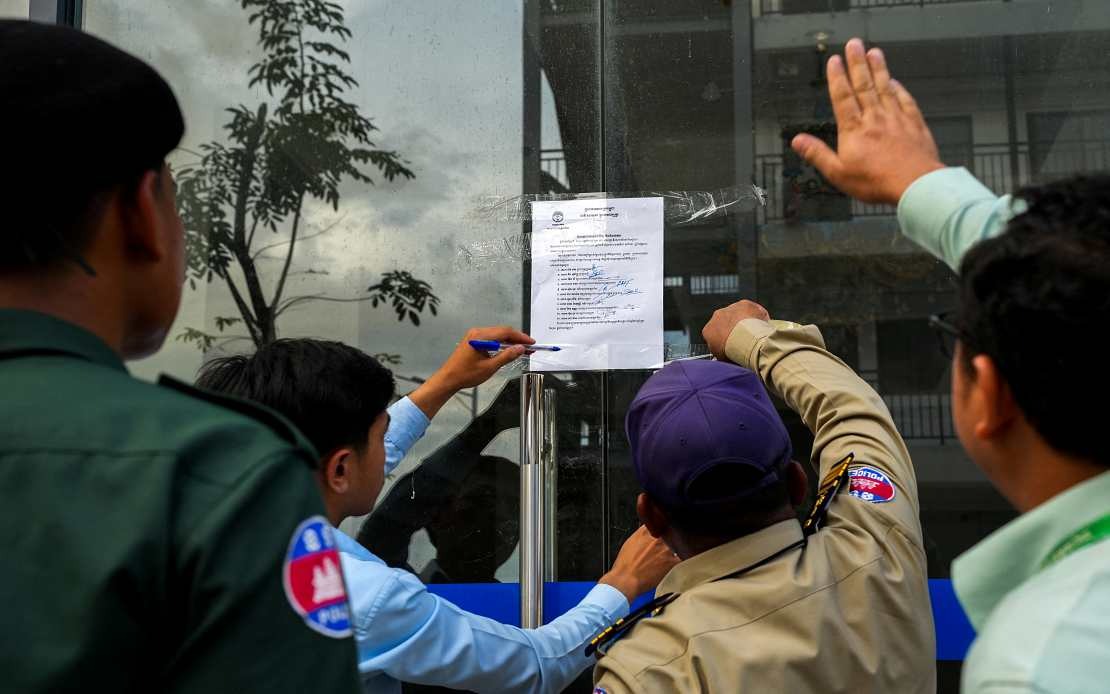
Cambodia has intensified its battle against cybercriminal networks by expelling over 16,000 foreign nationals suspected of involvement in online scams during the first half of 2026, according to Police Lieutenant General Sok Veasna, the director general of the General Department of Immigration. The figure represents a significant portion of the 45,000 total foreign deportations carried out in the same period, underscoring the kingdom's commitment to tackling what has become a persistent regional security concern. The enforcement operations have accelerated dramatically since January, reflecting heightened government attention to the issue and a recognition of the damage these criminal enterprises inflict on Cambodia's international standing.
All individuals deported for suspected involvement in cybercrime have been permanently barred from re-entering Cambodia, according to Veasna. This blanket prohibition aims to sever ties between expelled operatives and any remaining networks within the country, though observers question whether such measures alone can stem the tide of organised fraud originating from Southeast Asian territories. The deportation campaign was formally announced during a mid-year immigration review meeting on Tuesday, signalling that the government intends to maintain momentum in its enforcement efforts through the remainder of the year.
Cambodia's aggressive posture reflects the scale of the cybercrime problem that has plagued the nation. The country has become notorious as a hub for international scam operations, with criminal syndicates exploiting weak enforcement and political protection to run massive call centres targeting victims across Asia, Europe, and North America. The reputational damage extends beyond immediate victims to the broader economy, as foreign investors and tourists increasingly view Cambodia as a high-risk jurisdiction. Government officials have recognised that addressing this crisis is essential not merely for domestic security but for restoring Cambodia's credibility in the international community.
In April, the Cambodian government enacted the Law on Combating Online Scams, which introduced considerably harsher penalties for those orchestrating and leading these criminal enterprises. The legislation represents a significant legal framework shift, moving beyond simple deportation to create domestic consequences for those caught operating within Cambodia's borders. However, legal tools alone have proven insufficient in comparable jurisdictions, and observers remain sceptical about enforcement capacity and political will to prosecute high-level offenders, particularly those with connections to powerful interests.
Thong Mengdavid, deputy director at the China-ASEAN Studies Centre of the Cambodia University of Technology and Science, has cautioned that while the mass deportation campaign offers symbolic progress and tangible disruption to operational capacity, it addresses only the most visible layer of a deeply rooted problem. He argues that the deportations, though welcome and overdue in his assessment, function primarily as a temporary mitigation rather than a permanent solution. The core vulnerability lies not in the presence of foreign operatives but in the systemic conditions that allow such networks to flourish unchecked.
The persistence of these criminal networks depends fundamentally on local enablers and protection mechanisms that remain largely untouched by current enforcement efforts. Mengdavid emphasises that genuine progress requires targeting the high-level architects and kingpins who coordinate operations and generate profits, as well as dismantling the protective structures—whether corrupt officials, sympathetic business owners, or trafficking networks—that allow scam operations to function openly. Without addressing these underlying foundations, expelled operatives can simply be replaced by new recruits, and the fundamental business model remains intact and profitable.
The nexus between human trafficking and online scams represents another critical dimension that current policies have only partially addressed. Many individuals working in call centres are themselves victims of coercion, debt bondage, or false recruitment promises, trapped in conditions resembling servitude. The 16,000 deportations may have removed both perpetrators and victims from Cambodia, but without tackling trafficking networks and the desperation that makes individuals vulnerable to recruitment, fresh supplies of workers will continue flowing into the country. This human dimension complicates the straightforward security narrative that government announcements emphasise.
For regional observers, Cambodia's cybercrime problem carries implications extending far beyond its borders. The networks operate transnational scams targeting victims throughout Southeast Asia, East Asia, and globally, making the issue relevant to law enforcement authorities in Malaysia, Thailand, Vietnam, and beyond. Cross-border coordination on financial tracking, extradition agreements, and intelligence sharing remains limited, allowing criminals to exploit jurisdictional gaps. The deportations occurring in Cambodia represent only one component of a region-wide challenge that demands integrated policy responses.
The effectiveness of Cambodia's crackdown will ultimately depend on whether enforcement proves sustainable and whether the government demonstrates commitment to prosecuting protected individuals within its own power structure. Historical patterns suggest that periodic campaigns against organised crime in Southeast Asian countries often recede when international pressure diminishes or when economic interests align with tolerance of criminal activity. The next six months will provide important indicators regarding whether Cambodia intends to maintain momentum or whether the current initiative represents a temporary gesture toward international opinion.

