A coalition of twelve states led by California has moved to block one of the entertainment industry's most ambitious consolidation attempts in recent years. The lawsuit, filed in Oakland federal court, targets Paramount's proposed $110 billion acquisition of Warner Bros Discovery and represents a significant legal challenge to a deal that had already cleared scrutiny from the U.S. Department of Justice last month. The states argue that the merger would concentrate too much power in a single company, enabling it to dictate prices and content availability to consumers and business partners alike.
Paramount CEO David Ellison has framed this acquisition as essential to creating a streaming competitor capable of rivalling Netflix and Disney in the digital entertainment landscape. However, the twelve state attorneys general—all Democrats, including those from Arizona, Colorado, Connecticut, Massachusetts, Minnesota, Nevada, New Jersey, New Mexico, New York, Oregon, and Washington—contend that the deal's anti-competitive effects would outweigh any purported benefits. Their lawsuit alleges that the combined entity would capture more than a quarter of revenue generated by theatrical releases and basic cable channels across the United States, fundamentally altering the competitive dynamics of American media.
The states' complaint highlights specific market concentrations that merit regulatory concern. If approved, Paramount would control 27 percent of the film distribution market, 30 percent of blockbuster film releases, and 27 percent of basic cable channels. This consolidation would eliminate head-to-head competition between two major studios when negotiating with movie theaters for premium release dates and screen allocations, potentially leading to higher admission prices and reduced consumer choice. Television cable subscribers would similarly face diminished competition, as the merged company would command major networks including CNN, MTV, HGTV, Cartoon Network, and Nickelodeon.
Oregon Attorney General Dan Rayfield articulated the states' broader concern that federal regulatory approval had been insufficient. He stated that despite the Department of Justice's endorsement of the transaction, state-level action remained necessary to protect families, small businesses, and regional film industries from price increases and reduced competition. His statement reflects growing frustration among Democratic officials who view the Trump administration's antitrust stance as overly permissive toward corporate consolidation, particularly when politically connected figures like billionaire Oracle co-founder Larry Ellison—Paramount CEO Ellison's father—maintain relationships with the White House.
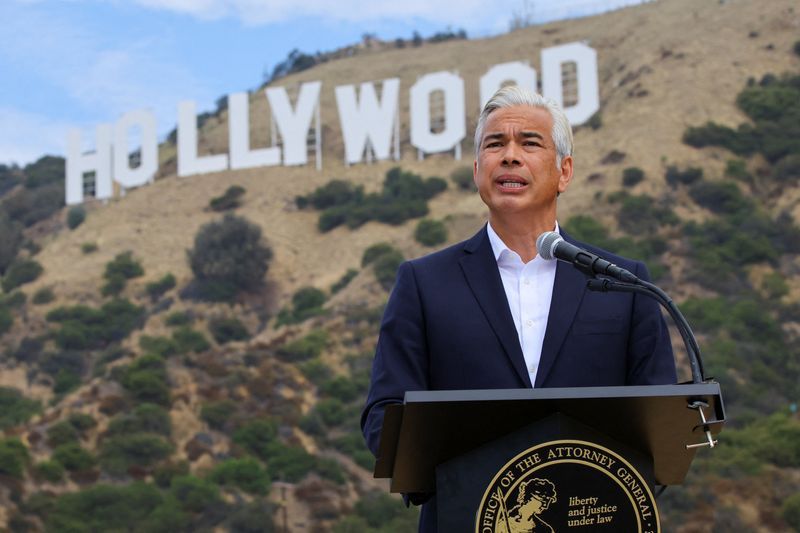
Antitrust enforcement has become increasingly politicized, with Democratic state attorneys general wielding it as a tool to challenge what they perceive as a pro-business federal administration. California Attorney General Rob Bonta used Monday's announcement to criticize the Trump administration's broader antitrust record, noting that the Justice Department has settled multiple major competition cases without aggressive enforcement. Notably, several Republican attorneys general have joined Democratic counterparts in other antitrust actions against Live Nation and Nexstar's acquisition of rival broadcaster Tegna, suggesting that some interstate antitrust coordination transcends strict partisan lines. However, their absence from this particular lawsuit has prompted Bonta to invite them to reconsider and join the coalition.
The ripple effects of this consolidation would extend far beyond corporate boardrooms and into working communities across America. Hollywood's creative workforce—writers, actors, film crews, and production staff—has expressed concern that reduced competition between studios would diminish the number of productions greenlit and filmed. Theater owners fear the combined company would release fewer films, undermining the theatrical experience that has already suffered from the shift toward streaming. These employment and economic impacts across multiple states provide legal and political foundation for the multi-state action, transcending the purely antitrust dimension of the case.
Paramount has disputed the states' allegations, asserting that their characterization distorts established antitrust law and misrepresents the actual competitive landscape within entertainment. The company has pledged that the merger would enable increased production rather than consolidation, arguing it can invest the $6 billion in savings from eliminating redundant infrastructure, marketing, and corporate functions into content creation. CEO Ellison has committed publicly to releasing thirty films annually from the combined studio operations. However, the states contend that such promises are unenforceable and that even if honoured, they would not prevent the company from raising prices to consumers or squeezing smaller competitors after the transaction closes.
The financial stakes of prolonged litigation are substantial for Paramount. The company has agreed to pay approximately $650 million in quarterly fees to Warner Bros Discovery shareholders if the deal fails to close before October, creating mounting pressure as legal proceedings unfold. A review of recent federal merger cases indicates that determining a judge's ruling typically requires eight months or longer, suggesting that even a Paramount legal victory could prove extraordinarily expensive. Any delays might force the company to renegotiate financing terms, expose it to stock market volatility, or potentially render the entire transaction economically unviable by the time litigation concludes.
For Malaysian and Southeast Asian observers, this transatlantic legal confrontation carries implications for how entertainment content is distributed regionally and priced for consumers. American media companies dominate content distribution in the Asia-Pacific region, and consolidation decisions in Los Angeles directly affect the programming available and pricing charged by Malaysian pay-TV providers and streaming platforms. Should the states succeed in blocking the merger or substantially delaying its completion, it could preserve a more competitive marketplace for content acquisition and distribution throughout the region. Conversely, if Paramount ultimately succeeds in combining with Warner Bros Discovery despite state opposition, the implications could reshape pricing and availability of premium entertainment content across Malaysia and neighbouring markets for years to come.
Stock market reactions immediately following the lawsuit announcement revealed investor confidence in Paramount's ultimate success, with the company's shares rising 2.9 percent and Warner Bros Discovery shares gaining 2.6 percent. This suggests that financial markets view the state legal challenge as a manageable obstacle rather than a deal-killer. Nevertheless, the precedent-setting nature of multi-state antitrust coordination in the streaming era cannot be dismissed, particularly as other entertainment consolidations and digital platform combinations may face similar coalition-based legal resistance. The outcome of this case will likely establish templates for how states can coordinate to challenge large media transactions regardless of federal regulatory approval.

