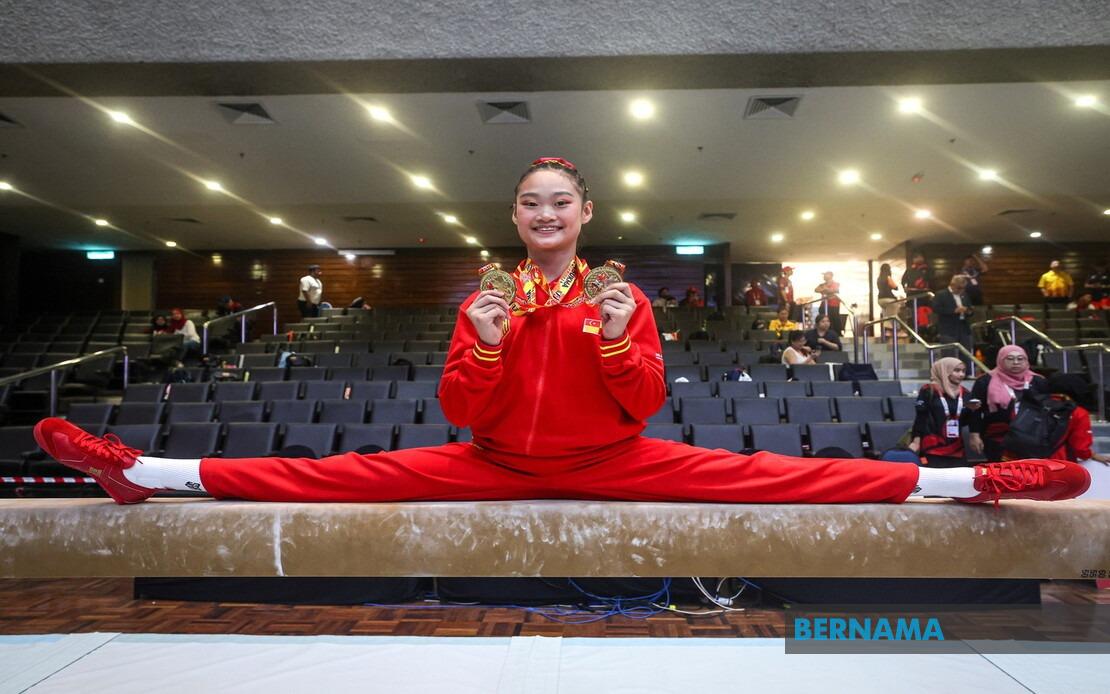
Selangor's rising star Cadence Teh Zi Qi delivered a commanding performance at the Malaysia Games 2026, securing dual gold medals in artistic gymnastics to cement her status as the nation's premier all-around talent. The 17-year-old claimed victory in the women's individual all-around competition with a commanding 48.550 points, then pivoted seamlessly to anchor Selangor's triumphant team effort at Dewan Canselor Tun Abdul Razak on the Universiti Kebangsaan Malaysia campus in Bangi. Her twin victories underscore the depth of technical mastery and mental resilience now expected at Malaysia's highest domestic sporting stage.
Cadence's all-around title defence reflected the consistency that distinguishes elite gymnasts from their regional peers. She posted 12.050 on vault, 11.400 on the uneven bars, 13.350 on the balance beam and 11.750 on floor exercise, demonstrating well-calibrated performances across the apparatus rotation. This medal haul extends her dominance at SUKMA, where she has become the benchmark against which Malaysian female gymnastics talent is measured. The spread of her scores indicates a gymnast unafraid to engage all disciplines rather than relying on a narrow array of strengths—a hallmark of international-level competitors.
Competition for the coveted all-around crown remained fierce across Malaysia's states. Sarawak's Aurin Zulkarnain claimed silver with 44.500 points, a respectable tally that fell substantially short of Cadence's benchmark. The bronze medal was shared between Federal Territories' Annabelle Ho Syin Yee and Penang's Amanda Ching Lee Wern, both finishing on 42.250 points. The gap between first and second place signals Cadence's exceptional technical capabilities, yet the competitive depth also suggests Malaysia's artistic gymnastics programme is broadening its talent pool beyond a single state or performer.
Cadence's team contribution proved equally decisive for Selangor's regional ambitions. She combined with teammates Nicole Wong Ziyi, Airisha Zuraidi, Wong Zi Qi, Leong Yee Shean and Haifa Izzazi Mohd Faizul to accumulate 169.300 points and secure team gold. Federal Territories mounted a credible challenge with 166.300 points, securing silver, while Johor rounded out the podium with 157.000 points. The team competition represents a different challenge than all-around excellence; it requires not just individual brilliance but the capacity to elevate teammates and manage collective momentum across multiple rotations—a skill increasingly valued in international gymnastics contexts.
Despite her victory, Cadence was candid about the vulnerabilities that emerged during her all-around campaign. She began on the uneven bars and stumbled early, falling once on an apparatus that typically demands precision timing and spatial awareness. The setback in her opening rotation created psychological pressure heading into subsequent events. However, rather than compounding the error, she demonstrated the mental fortitude necessary at elite levels by recalibrating her approach and executing stronger performances on the remaining apparatus. Her balance beam performance proved particularly decisive, generating the highest individual apparatus score of 13.350 and suggesting a specialisation that may define her trajectory in international competition.
Admitting to initial nerves, Cadence told reporters that her opening bars routine suffered from a disconnect between her intended movement pattern and physical execution. She noted that beam became substantially more comfortable once she moved past the uneven bars, delivering what she described as a strong return to form. Her floor exercise score aligned with her pre-competition expectations, suggesting routine rather than exceptional difficulty there. The vault apparatus saw her deliberately reduce technical complexity, choosing a Tsukahara pike rather than pursuing maximum difficulty—a pragmatic decision reflecting her focus on consistency over risk in the all-around format.
Looking ahead to the Asian Games 2026, Cadence has already begun adjusting her training regimen and competitive strategy. She has elevated her balance beam routine to the difficulty level she intends to employ at the continental championship, indicating that SUKMA serves as a developmental platform rather than merely a state-level contest. This approach aligns with how Malaysia's national sports bodies now structure talent progression, using domestic competitions to stress-test athletes and build the international profiles necessary for medal success at prestigious regional and global events.
Cadence's competitive calendar remains crowded, with apparatus finals still ahead on the competition schedule. Over the following two days, she is scheduled to compete in individual finals for the uneven bars, balance beam and floor exercise—events where her technical repertoire and consistency have previously earned recognition. These apparatus-specific competitions offer opportunities for her to accumulate additional medals and further enhance her standing within Malaysia's gymnastics ecosystem. Her ability to transition from all-around competition to apparatus-specific focus while maintaining performance standards will test her psychological preparation and physical durability.
The young gymnast has also identified clear areas requiring developmental attention as she targets international progression. She emphasised the importance of improved nervous system regulation, seeking better mind-body connection particularly on apparatus where technical execution leaves little margin for error. Maintaining competitive focus across extended rotations represents another priority, as does managing the mental load of defending titles—a challenge she has now successfully navigated at SUKMA but will face more frequently as she enters senior international circuits. These insights suggest a maturing athlete who complements technical excellence with the reflective capacity necessary for sustained improvement.
Cadence's emergence as a multi-medal performer carries implications for Malaysia's sport development strategy. Her success indicates that investment in gymnastics pathways is yielding performers capable of competing at regional standard, while her specific focus on both all-around and apparatus specialisation reflects global trends in how elite gymnasts structure their development. For Malaysian sports administrators seeking to expand medal success at the Asian Games and beyond, Cadence represents both a current asset and a template for identifying and nurturing talent in disciplines requiring high-level technical skill and mental resilience. Her twin golds at SUKMA 2026 have positioned Selangor as the dominant force in Malaysian artistic gymnastics while signalling that the national programme possesses the infrastructure to develop world-class competitors.

