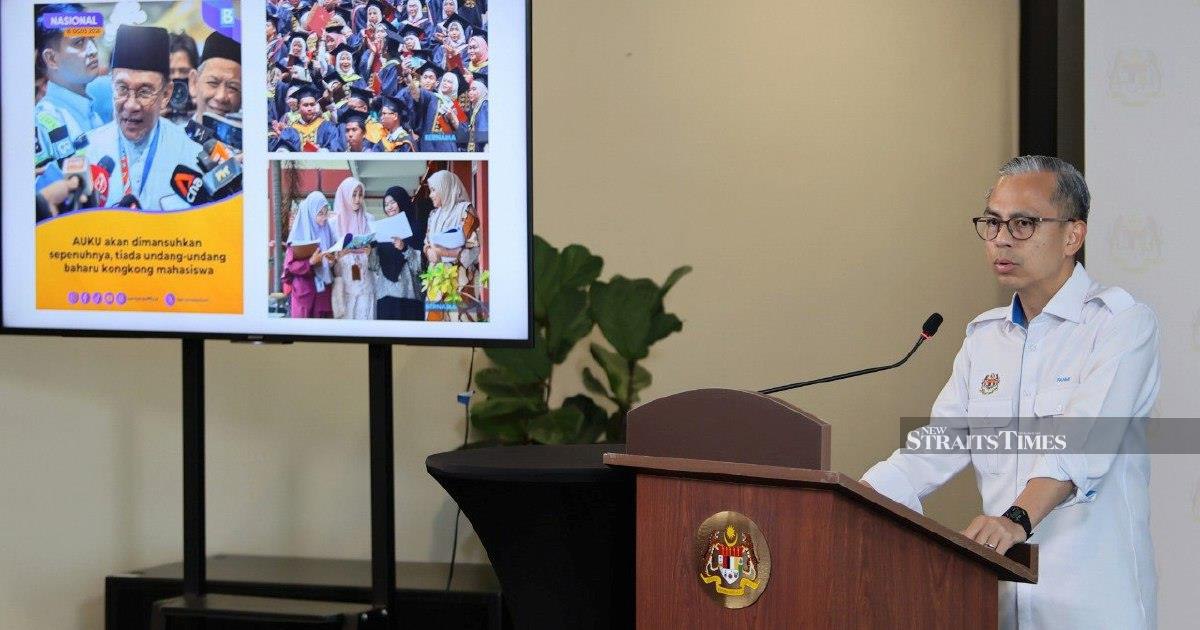
The Malaysian government has apparently chosen not to formally deliberate on Prime Minister Datuk Seri Anwar Ibrahim's recent statements regarding Taiwan, according to government spokesman Datuk Seri Fahmi Fadzil. The decision to bypass cabinet-level discussion of the matter underscores the delicate diplomatic tightrope Malaysia maintains across the Taiwan Strait, balancing its strategic relationship with Beijing against its historical ties with Taipei and broader international conventions.
Fahmi's confirmation that no formal cabinet discussion took place suggests that Putrajaya may be treating Anwar's remarks as a matter already resolved at the prime ministerial level or one deemed insufficiently significant for collective ministerial deliberation. This approach reflects the centralized nature of Malaysia's diplomatic decision-making, whereby the Prime Minister's Office exercises considerable latitude in foreign policy pronouncements without requiring full cabinet endorsement for every statement on sensitive international issues.
The absence of cabinet discussion is particularly noteworthy given that Taipei responded sharply to Anwar's comments, indicating that Taiwan took the remarks seriously enough to issue an official rejoinder. When foreign governments formally react to Malaysian statements, the customary diplomatic protocol would normally involve some form of cabinet-level review or coordination to ensure government unity and prevent further escalation. The fact that this appears not to have occurred raises questions about either the nature of Anwar's comments themselves or the Malaysian government's assessment of their diplomatic impact.
Malaysia's position on Taiwan has long remained one of the most carefully calibrated aspects of its foreign policy. As a member of ASEAN and a signatory to the UN Convention on the Law of the Sea, Malaysia maintains the fiction of adhering to the "One China" principle while simultaneously conducting robust trade relationships, shipping connections, and defense engagement with Taiwan. This balancing act requires extraordinary diplomatic finesse, and statements by the Prime Minister that trigger official reactions from Taipei invariably carry implications for Malaysia's broader regional standing.
The decision to forgo cabinet discussion also reflects contemporary Malaysian governance patterns, where ministerial meetings have become increasingly selective in scope. Rather than addressing every international incident comprehensively, the government appears to compartmentalize responses based on perceived urgency and institutional relevance. If the cabinet deemed Anwar's remarks as either clarified sufficiently already or as reflecting longstanding Malaysian policy, formal discussion might seem redundant from an administrative efficiency standpoint.
Taipei's sharp response itself deserves careful examination. Taiwan's Foreign Affairs authorities rarely issue forceful rebukes without calculating the diplomatic implications and desired outcomes of such declarations. By responding openly, Taipei signaled that it felt compelled to correct the record regarding whatever Malaysia's Prime Minister had stated, suggesting that the remarks in question touched on substantive issues rather than mere rhetorical flourishes.
For Malaysian readers and observers, this situation illustrates the ongoing tensions inherent in Southeast Asian diplomacy vis-à-vis China and Taiwan. Malaysia, like all ASEAN members except Singapore, maintains no formal diplomatic relations with Taipei, yet regional economic interdependencies mean that practical engagement continues across multiple channels. Anwar's statements, whatever their specific content, likely reflected the perpetual challenge of addressing Taiwan's role in regional affairs without appearing to legitimize independence-minded positions that Beijing vehemently opposes.
The broader context matters considerably here. Over the past several years, Taiwan-related issues have become increasingly contentious in regional and global affairs, with growing strategic competition between Washington and Beijing over Taiwan's alignment. Malaysia, despite its ASEAN membership and stated non-aligned posture, cannot entirely escape these pressures. Anwar's comments probably touched on this complicated terrain, prompting Taipei's response and ultimately contributing to an episode that the Malaysian cabinet apparently decided did not warrant formal collective examination.
From a governance perspective, Fahmi's statement essentially closes the book on any expectation of official cabinet clarification regarding Anwar's specific remarks. By confirming that no discussion occurred, the government spokesman has signaled that there will likely be no formal cabinet statement or collective policy pronouncement on the matter, suggesting that Putrajaya intends to treat the episode as essentially concluded.
For foreign observers, particularly those in neighboring nations and trading partners like Taiwan, this approach may seem unsatisfyingly opaque. The lack of visible cabinet-level engagement might be interpreted either as confidence that the issue requires no further amplification or as deliberate evasion of clarification. Either way, the incident underscores how Malaysia's diplomatic leadership navigates extraordinarily complex international waters where a single statement can generate instant responses from major regional powers with competing interests in Southeast Asia.

