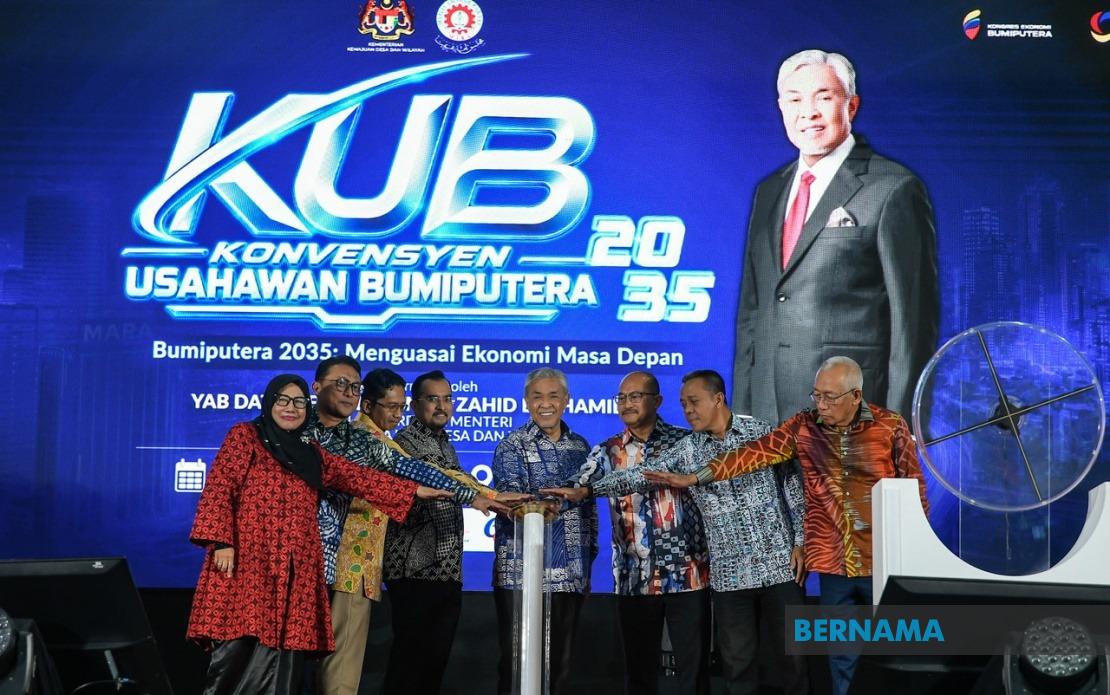
Deputy Prime Minister Datuk Seri Dr Ahmad Zahid Hamidi has called for a fundamental reorientation of Bumiputera entrepreneurship, urging business owners to transition from passive participation in the economy towards active ownership and strategic control of their enterprises. Speaking at the closing ceremony of the Bumiputera Entrepreneurs Convention (KUB) 2035 Declaration in Alor Setar on August 27, Ahmad Zahid articulated a vision that recognises decades of foundation-building through participation initiatives must now yield to a more ambitious agenda centred on scaling, consolidation, and sectoral dominance.
The Deputy Prime Minister, who also holds the portfolio of Rural and Regional Development Minister, acknowledged that successive government programmes have successfully expanded Bumiputera involvement across various economic activities. However, he argued that this participation-focused approach, whilst valuable, has become insufficient for the contemporary economic landscape. The time has arrived, he suggested, for entrepreneurs from the Bumiputera category to exercise greater agency in determining their commercial trajectories, expanding their operational footprints, and competing effectively within both domestic and international markets.
Ahmad Zahid framed the government's continuing role as supportive rather than prescriptive, pledging that policymakers would persist in creating opportunities, nurturing the business ecosystem, and broadening pathways for Bumiputera entrepreneurs to access resources and markets. Nevertheless, this institutional support, he emphasised, places corresponding responsibility on entrepreneurs themselves to embrace calculated risks, pursue aggressive expansion strategies, and generate tangible economic value. The implicit message conveyed a partnership model wherein government establishes conditions conducive to growth, whilst entrepreneurs must demonstrate the initiative and resilience necessary to capitalise on these advantages.
To realise this transformation, Ahmad Zahid outlined three interconnected structural reforms required within the Bumiputera entrepreneurship ecosystem by 2035. The first involves integrating the currently fragmented support apparatus, which operates through disparate channels for financing, skills development, and market linkages. This fragmentation, he explained, creates inefficiencies and imposes unnecessary transaction costs on entrepreneurs seeking comprehensive assistance. By consolidating these functions into a coordinated framework, the government aims to reduce friction points and enable entrepreneurs to access holistic support tailored to their evolving needs.
The second strategic shift requires a philosophical transition within support institutions, redirecting focus from the mere production of entrepreneurs towards the substantive development and maturation of existing entrepreneurs. This distinction carries significant implications. Rather than pursuing metrics emphasising the number of new Bumiputera business registrations, the revised approach prioritises the trajectory and sustainability of established enterprises, with emphasis on achieving profitability milestones, expanding employment capacity, and accumulating capital reserves. This reorientation acknowledges that entrepreneurship quality substantially outweighs quantity in generating meaningful economic contributions.
The third pillar addresses the relationship between national economic growth and local enterprise development. Ahmad Zahid stressed the necessity of ensuring that Malaysia's overall economic expansion simultaneously strengthens indigenous companies, preventing a scenario wherein rapid national growth predominantly benefits foreign investors or non-Bumiputera enterprises whilst local players remain marginalised. This perspective reflects concerns that Bumiputera participation, though numerically visible, sometimes masks a concentration of wealth and control among non-Bumiputera players, particularly in high-value sectors.
The Deputy Prime Minister's emphasis on ownership assumes particular significance within the Malaysian context, where historical structures and regulatory frameworks have shaped Bumiputera economic participation patterns. Building genuine ownership requires not merely compliance with equity requirements but substantive accumulation of productive assets, intellectual property, and managerial autonomy. This distinction matters considerably for regional observers examining whether Bumiputera entrepreneurship represents a sustainable model for inclusive growth or remains dependent on protectionist mechanisms.
The call for scaling reflects recognition that many Bumiputera enterprises, whilst operationally viable, remain constrained at micro and small-to-medium enterprise levels without successfully transitioning to larger corporate entities commanding significant market share. This scaling gap has perpetuated economic structures wherein Bumiputera participation occurs disproportionately in lower-value activities and traditional sectors, whilst commanding limited presence in technology, advanced manufacturing, and high-margin services. Addressing this limitation requires systematic interventions spanning capital access, technical expertise, market intelligence, and strategic mentorship.
Sector-specific control represents another crucial dimension of Ahmad Zahid's articulated vision. Several industries—notably construction, retail distribution, and certain financial services—feature prominent Bumiputera participation yet remain subject to external influence or ownership concentration among particular groups. Expanding Bumiputera control within these sectors and establishing dominance in emerging industries demands coordinated capacity-building, strategic capital deployment, and deliberate market positioning strategies extending beyond reactive participation.
The timing of this pronouncement reflects broader policy recalibration within the Malaysian government regarding Bumiputera economic policy. Rather than indefinitely sustaining dependency on preferential access mechanisms, officials increasingly recognise that sustainable competitive advantage derives from genuine capability development, innovation capacity, and market-driven performance metrics. This philosophical evolution carries implications for debates surrounding Malaysia's competitiveness, foreign investor attraction, and regional economic positioning relative to peers such as Singapore and Thailand.
For Southeast Asian observers monitoring Malaysia's development trajectory, Ahmad Zahid's remarks signal governmental acknowledgement that Bumiputera entrepreneurship frameworks require substantive evolution beyond their mid-twentieth-century conceptualisation. Whether policymakers can successfully bridge the gap between articulated aspirations and implementable mechanisms remains an open question, particularly given institutional fragmentation, resource constraints, and competing priorities characterising Malaysian governance structures.
The Bumiputera Entrepreneurs Convention 2035 Declaration itself represents an attempt to institutionalise this strategic reorientation, creating accountability mechanisms and establishing benchmarks against which future progress can be assessed. Subsequent implementation will determine whether Ahmad Zahid's vision translates into tangible improvements in Bumiputera enterprise scale, sectoral representation, and ownership consolidation, or whether rhetoric outpaces substantive policy reform.

