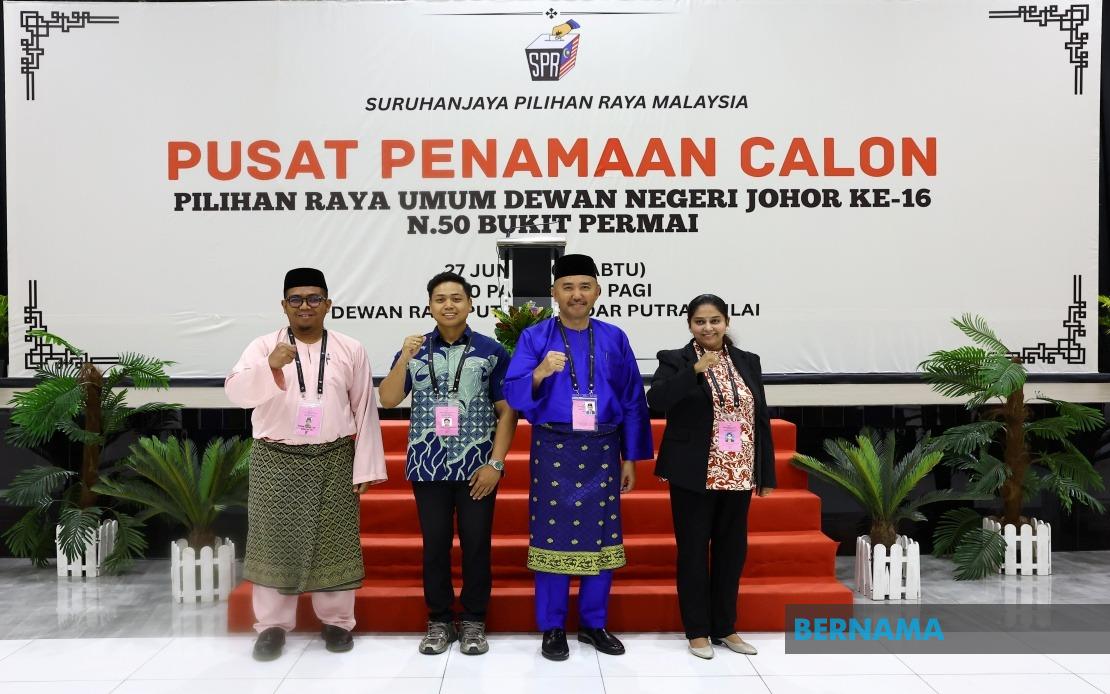
The 16th Johor state election will see an intriguing four-way battle unfold in the Bukit Permai constituency, where Barisan Nasional incumbent Datuk Mohd Jafni Md Shukor faces significant competition from three opposition and emerging party candidates. Following the close of nominations on June 27, Returning Officer Afzan Azhari confirmed the final lineup at the nomination centre in Bandar Putra, setting the stage for a competitive contest that will test the incumbent's grip on a seat he has held with relative comfort in recent elections.
Mohd Jafni's challengers represent a diverse political spectrum. Mohamad Shafwan Ani carries the colours of Pakatan Harapan, the established opposition coalition, whilst M. Lina Manoh represents Perikatan Nasional, which has emerged as a significant player in Malaysian politics following the 2022 elections. A fourth candidate, Muhammad Aidil Riduan Mohd Yusof of Parti Bersama Malaysia, completes the field. The presence of Parti Bersama Malaysia is particularly noteworthy, as the newer political vehicle has been attempting to carve out space in the electoral landscape distinct from larger coalitions. The diversity of challengers suggests that Bukit Permai voters will have a genuine range of political philosophies and party affiliations to choose from.
The Pakatan Harapan challenge received prominent attention when Johor DAP chairman Teo Nie Ching arrived at the nomination centre early on June 27 to accompany Mohamad Shafwan. This show of support from a senior party figure underscores the coalition's determination to contest vigorously in the Bukit Permai seat and signals that PH views this as a winnable constituency. The DAP's presence in Johor state politics remains significant despite the coalition's variable fortunes across the region, and their backing of the PH candidate demonstrates continued party commitment to contesting seats throughout the state.
Historical context reveals that Mohd Jafni has proven resilient in previous contests. In the 2022 Johor state election, he secured victory with a majority of 4,755 votes despite facing a four-cornered contest, indicating that he managed to consolidate support effectively across the constituency. That margin suggests a solid voter base, though the changing composition of challengers and the broader political climate could influence voting patterns. The fact that he faced four opponents in 2022 and again confronts the same situation in 2024 indicates that Bukit Permai has become a genuinely contested seat rather than one dominated by a single party.
The electoral context for Johor's 16th state election carries significance beyond individual constituencies. State elections in Malaysia frequently serve as important barometers of political sentiment, and Johor remains a strategically significant state both economically and politically. The composition of contests across different constituencies, including multipolar fights like that in Bukit Permai, will help determine the overall balance of power in the state assembly. For the Pakatan Harapan coalition, which has struggled to maintain momentum since the 2022 federal election, winning additional state seats remains crucial to demonstrating continued relevance. For Perikatan Nasional, contests like this provide opportunities to expand their presence beyond their strongholds.
The timing of the election proceedings reflects a structured schedule. The Election Commission has designated July 7 as the date for early voting, allowing those unable to vote on polling day to exercise their franchise. The actual polling day will occur on July 11, providing voters across Johor with a fortnight to make final decisions following the nomination closure. This schedule is consistent with previous Malaysian electoral practice and allows candidates sufficient time for campaigning and voter engagement.
For Malaysian political observers, the Bukit Permai race exemplifies the increasingly complex electoral dynamics at state level. Rather than straight fights between BN and opposition coalitions, constituencies like this now feature multiple contenders, fragmenting the vote and creating less predictable outcomes. The presence of Parti Bersama Malaysia demonstrates how newer political entities are attempting to compete for voter attention, though their organisational capacity and resources typically lag far behind established parties. Such developments suggest that Malaysian electoral politics continues evolving, with voters presented with broader choices even in individual constituencies.
The broader implications for Johor politics should not be overlooked. If opposition and emerging party candidates collectively receive substantial vote shares even whilst losing to Mohd Jafni, it could signal growing dissatisfaction with BN governance or increasing voter appetite for alternatives. Conversely, if the incumbent wins decisively with a substantial majority, it would demonstrate continued voter confidence in BN representation in Bukit Permai. The cumulative results across all contested seats will ultimately determine the composition of the Johor state assembly and the political direction of the state government.
For Malaysian voters in Bukit Permai specifically, this four-cornered contest offers genuine choice. The established opposition in the form of PH provides one path toward change, whilst Perikatan Nasional offers an alternative approach to challenging BN dominance. The emergence of Parti Bersama Malaysia, despite its smaller size and resources, adds another voice to the mix. The incumbent brings continuity and an established track record of representation. This range of options means that voter decision-making will likely be nuanced, based on local issues, personality factors, and broader political considerations.
The campaign period ahead will determine whether Mohd Jafni can replicate his 2022 success against a refreshed set of opponents, or whether the political landscape in Bukit Permai has shifted sufficiently to produce a different outcome. The four-cornered nature of the contest means that victory margins could prove different from previous elections, with votes potentially distributed across multiple candidates rather than concentrated among two or three main contenders. As Johor prepares for its 16th state election, contests like Bukit Permai will provide crucial insights into how Malaysian state-level politics is evolving.

