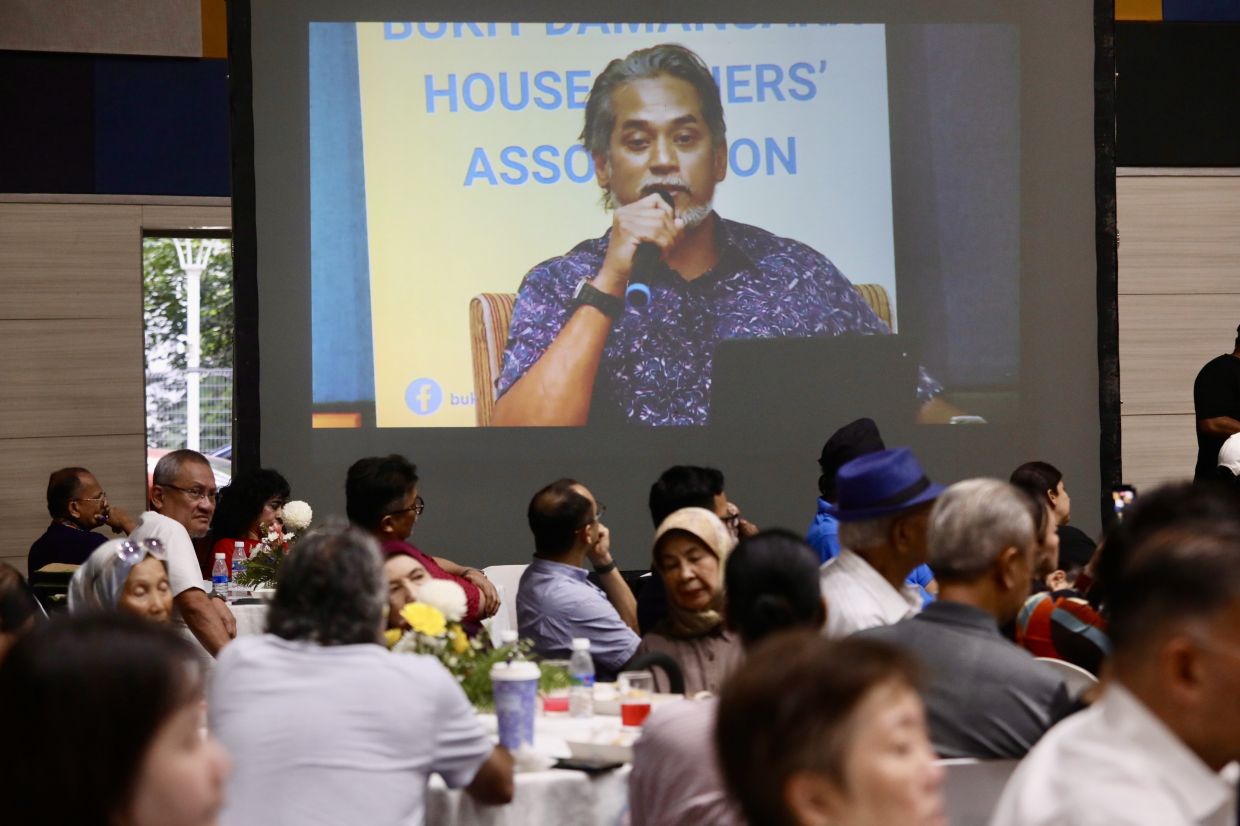
Residents of Bukit Damansara have escalated pressure on Kuala Lumpur City Hall to revoke a building permit for the controversial renovation of a semi-detached property, with nearly 400 community members attending a town hall dialogue to voice their opposition. The project, which seeks to convert a double-storey semi-detached home into a three-storey structure, has sparked significant concern among the neighbourhood, with residents arguing that the development process lacked proper community consultation and has already caused visible damage to adjacent properties.
The gathering at Pusat Komuniti Bukit Damansara marked the inaugural town hall under newly elected Bukit Damansara Home Owners' Association president Khairy Jamaluddin, who took office in early August. The three-hour session, titled "Your Voice Matters," drew substantial attendance and brought together officials from Kuala Lumpur City Hall's Planning Department and the Brickfields police headquarters to address community grievances directly.
Resident A. Zakki described the renovation as fundamentally incompatible with the established character of the residential area. He emphasised that the original architectural harmony of the semi-detached row would be disrupted by the addition of an extra storey, transforming what was once a standardised double-storey design into an outlier within the streetscape. More troublingly, Zakki noted that construction work has already triggered structural cracks in neighbouring residences, raising safety concerns that extend beyond mere aesthetic objections.
The project's chronology reveals a pattern of regulatory inconsistency that has fuelled resident frustration. City Hall initially granted approval in December 2025 for the floor addition, prompting community opposition. By January 2026, authorities issued a stop-work order in response to resident complaints. However, just two months ago in June, the project received renewed approval and has since progressed to approximately ten percent completion, with structural pillars already installed. This reversal, without apparent explanation to affected residents, has intensified the dispute and deepened trust concerns regarding the municipality's decision-making process.
Zakki highlighted that a signature campaign has mobilised 19 immediate neighbours in formal opposition to the development, establishing substantial documented community consensus against the project. The residents have collectively demanded that City Hall withdraw the construction permit with immediate effect, framing their position as one rooted in neighbourhood preservation and resident protection rather than obstructionism. This grassroots mobilisation underscores the strength of local sentiment and suggests that the issue has transcended individual grievance to become a neighbourhood-wide governance matter.
Planning Department town planner executive director Rosli Nordin acknowledged that City Hall recognises the difficulties created by the renovation for surrounding residents, though he stopped short of committing to specific remedial action. The measured response suggests institutional reluctance to reverse an approved permit, even in the face of documented community opposition, raising questions about how municipal authorities weigh individual resident concerns against investor interests in a rapidly developing metropolis like Kuala Lumpur.
Beyond the renovation dispute, the town hall revealed several interconnected challenges affecting daily life in Bukit Damansara. Traffic congestion in the vicinity of SK Bukit Damansara and Stella Maris International School Damansara occurs predictably during morning drop-off hours between 7 and 7.30 am and afternoon pick-up between 2 and 4 pm. Supt Ahmad Firdaus Mustafia Kamal from the Brickfields police headquarters indicated that authorities are monitoring the situation, though his statement provided limited detail regarding enforcement measures or timeline for improvement.
SK Bukit Damansara's Parent-Teacher Association chairman Ameirul Azraie Mustadza disclosed that the school association has consistently reminded parents about the importance of orderly vehicle drop-off and pick-up procedures to mitigate congestion. The association explored enlisting Rela, a civil volunteer corps, to assist with traffic management but concluded that funding constraints made this infeasible. Ameirul appealed for daily police presence during peak hours rather than intermittent enforcement, suggesting that current traffic management remains inadequate to prevent the congestion episodes that disrupt school operations and neighbourhood flow.
Additionally, residents pressed Air Selangor to conduct comprehensive inspections of the water pipeline infrastructure serving Bukit Damansara following repeated pipe burst incidents. An Air Selangor representative acknowledged awareness of these failures and indicated that the company has formulated plans to systematically replace the aging pipeline network, though no specific timeline was provided. Pipeline deterioration and resultant burst incidents represent a chronic maintenance issue in many older Malaysian residential areas, affecting both water security and property integrity.
Khairy characterised the town hall as a mechanism for directly transmitting community concerns to decision-makers, positioning the dialogue as a bridge between residents and municipal authorities. He committed to follow-up action aimed at accelerating problem resolution across the spectrum of issues raised, from the semi-detached renovation through traffic management to water infrastructure renewal. This supervisory role, if executed effectively, could establish a template for proactive community engagement in addressing the compound governance challenges facing inner-city neighbourhoods undergoing simultaneous pressures from development, infrastructure aging, and population density.
The Bukit Damansara episode illustrates broader tensions within Malaysian urban governance between resident-driven preservation impulses and market-driven development incentives. The permit reversal in June, occurring without transparent community consultation, highlights administrative processes that may inadequately account for affected resident input once initial approval has been granted. For other Malaysian residential communities facing similar development conflicts, the Bukit Damansara residents' organised response demonstrates the potential efficacy of collective action, though the extent to which such pressure ultimately influences municipal decision-making remains unclear.

