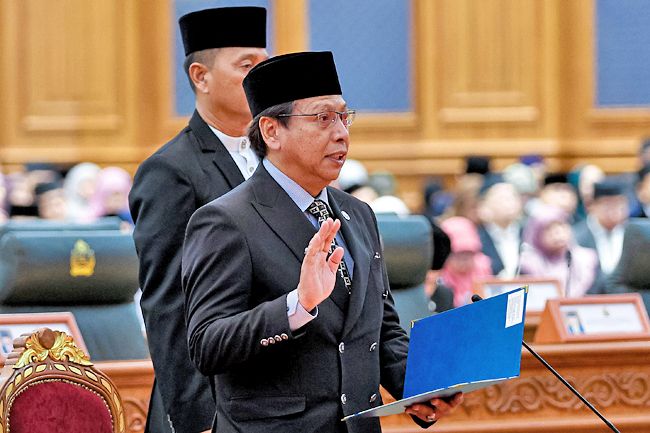
Brunei's government has expanded its representation in the Legislative Council with the formal swearing in of four new Cabinet ministers on Monday at the opening of the Second Meeting of the 22nd Legislative Council Session in Bandar Seri Begawan. The ceremony, conducted according to provisions in the 1959 Brunei Constitution governing the appointment of ex-officio members, underscores the constitutional framework through which executive officials gain legislative seating, a practice common across several Commonwealth-influenced jurisdictions in Southeast Asia.
The four newly sworn ministers represent key portfolios across the sultanate's government infrastructure. Datuk Seri Setia Awang Sufian Sabtu assumes his position as Minister at The Prime Minister's Office overseeing Security and Law matters, a critical appointment reflecting the nation's emphasis on security governance. His counterpart, Datuk Seri Setia Awang Mohamad Azmi Mohd Hanifah, takes up the Energy portfolio within the Prime Minister's Office, addressing upstream and downstream energy sector management—a significant consideration given Brunei's petroleum-dependent economy and ongoing efforts to diversify revenue sources in a volatile global energy market.
Religious affairs and transport infrastructure rounded out the ministerial appointments. Pengiran Datuk Seri Setia Mohammad Tashim Pengiran Hassan was sworn in as Minister of Religious Affairs, a position of considerable importance in Brunei's Islamic governance framework and social policy landscape. Completing the quartet is Datuk Seri Setia Awang Mohammed Riza Datuk Paduka Mohammed Yunos, who assumes leadership of the Transport and InfoCommunications Ministry—a dual portfolio reflecting modern governance priorities encompassing both physical and digital infrastructure essential for regional connectivity and economic competitiveness.
The constitutional mechanism through which these appointments were formalized demonstrates Brunei's adherence to established parliamentary conventions. The ex-officio system, whereby Cabinet members automatically gain legislative seats through their ministerial appointments, creates an institutional overlap between executive and legislative branches. This approach ensures direct government representation in parliamentary proceedings and facilitates streamlined legislative implementation of ministerial policy initiatives. Such arrangements, while potentially concentrating executive influence within the legislature, are justified by proponents as enhancing governmental efficiency and policy coordination.
For Malaysian observers and regional analysts, these appointments offer insight into Brunei's governance architecture and bureaucratic reorganization. The simultaneous elevation of four ministers suggests a cabinet reshuffle or restructuring aimed at addressing specific policy priorities or responding to administrative requirements. Energy sector representation through dedicated ministerial focus reflects Brunei's continued reliance on hydrocarbon revenues despite acknowledged long-term economic diversification imperatives. The parallel emphasis on transport and information communications indicates strategic recognition of infrastructure modernization as essential to maintaining regional economic relevance and attracting investment.
The swearing-in ceremony was presided over by Pehin Orang Kaya Seri Lela Datuk Seri Setia Awang Abdul Rahman Datuk Setia Mohamed Taib, serving as LegCo Speaker. The formality of the occasion, conducted at the legislative opening, signals institutional solemnity and constitutional propriety surrounding these appointments. Such ceremonial affirmation of ministerial legislative membership reinforces constitutional legitimacy and the rule of law within Brunei's administrative system.
For Southeast Asian governance observers, Brunei's Legislative Council structure warrants consideration as a distinct model within the region's varied democratic and quasi-democratic systems. Whereas Malaysia's Parliament comprises elected representatives alongside appointed senators and constitutional officials, and Singapore's Parliament consists primarily of elected members, Brunei's LegCo incorporates both appointed and ex-officio elements within a framework that emphasizes executive-legislative coordination under constitutional monarchy principles. This institutional design reflects the sultanate's particular constitutional inheritance and contemporary governance preferences.
The appointment of ministers as ex-officio legislators also raises considerations regarding legislative oversight and institutional checks and balances. While direct ministerial presence in the chamber facilitates rapid policy communication and implementation, questions persist among governance scholars regarding the adequacy of parliamentary scrutiny when executive representatives significantly populate legislative benches. The balance between executive efficiency and legislative independence remains an ongoing consideration within Brunei's constitutional framework.
These ministerial appointments arrive as the Legislative Council undertakes its second formal meeting of the current session, suggesting a full legislative calendar addressing multiple policy domains. The breadth of the appointed portfolios—spanning security, energy, religious affairs, and transport-communications—indicates comprehensive governmental engagement across multiple priority sectors requiring coordinated legislative action and resource allocation.

