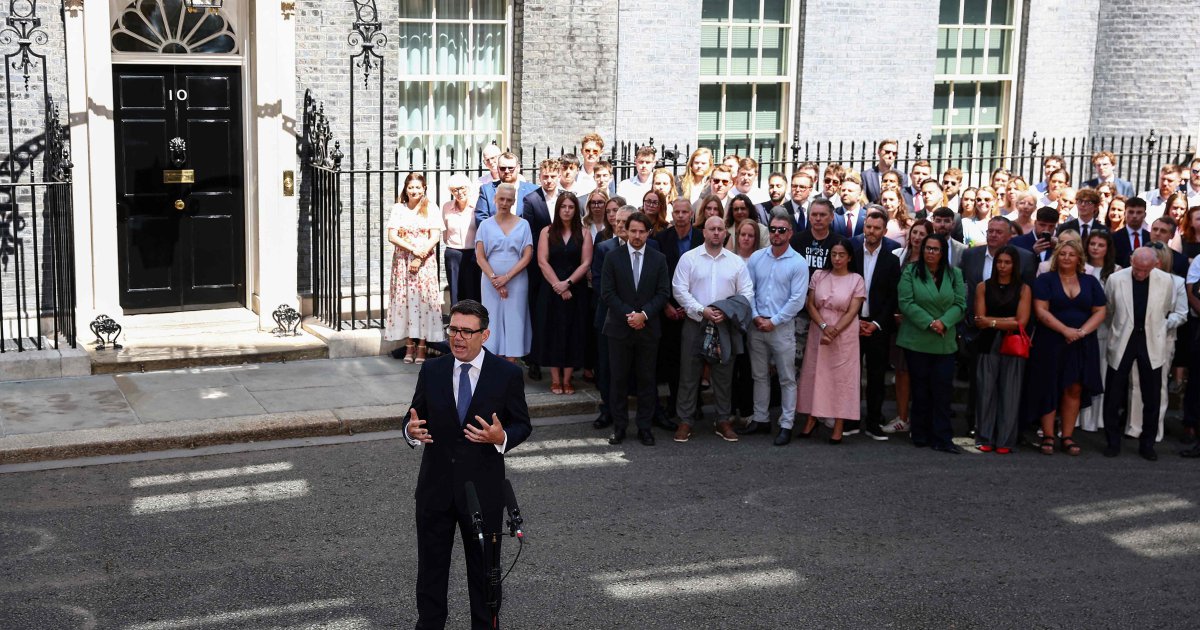
The appointment of Andy Burnham to 10 Downing Street on Monday marks a stark turning point in British politics, underscoring the nation's descent into what observers describe as an era of institutional chaos. The sentiment echoing through British households was perhaps best captured by Claire Walker, whose resigned "Not another one" encapsulates a broader exhaustion settling across the electorate. This seventh change of leadership since early 2016 represents not merely a statistical curiosity but a fundamental erosion of political stability that has left voters increasingly cynical about Westminster's capacity to govern effectively.
The velocity of prime ministerial turnover in recent years stands without modern precedent in British constitutional history. Between Boris Johnson's ascension in 2019 and Burnham's assumption of office, the office of Prime Minister has become almost a revolving door—a trajectory that began with Theresa May's struggles to navigate Brexit negotiations, accelerated through Johnson's turbulent tenure marked by scandal and resignation pressure, and continued through Liz Truss's historically brief occupancy and subsequent Conservative administrations. Each transition promised renewal and fresh direction, yet each delivered disappointment and continuity of crisis management rather than substantive policy progress.
The psychological toll on British voters manifests in declining trust toward political institutions and diminishing confidence in democratic processes. What began as shock at the pace of change has calcified into indifference and resignation. Polling organisations report that citizens increasingly perceive Westminster as disconnected from their lived realities—struggling with cost-of-living pressures, healthcare delays, and infrastructure decay while Prime Ministers ascend and fall with bewildering regularity. This disconnect breeds a particular type of civic disengagement, wherein voters view electoral participation as a gesture of futility rather than democratic agency.
The international implications of Britain's political instability deserve consideration, particularly for Commonwealth nations and regional allies including those across Southeast Asia. Malaysia and other regional powers have historically calibrated their diplomatic and trade relationships with Britain partly on the assumption of stable, predictable governance and consistent policy implementation. Repeated shifts in Prime Ministers introduce uncertainty into bilateral negotiations, treaty obligations, and strategic partnerships. When the government effectively changes leadership every few years, business confidence wavers and long-term collaboration becomes increasingly difficult to coordinate.
Burnham's background as Mayor of Manchester and his track record in local governance offered some counternarrative to Westminster's dysfunction, yet his appointment simultaneously represents a tacit admission that traditional Conservative Party leadership could not provide the stability electorate demanded. The Labour Party, after years in opposition, faces expectations not merely to govern differently but to restore confidence in institutional competence itself—a challenge that transcends conventional policy platforms. Restoring voter faith requires demonstrating that government can execute programs consistently, that ministers understand the challenges facing ordinary citizens, and that political transitions occur within orderly constitutional frameworks rather than through crisis-driven upheaval.
The underlying structural factors driving this instability persist regardless of which party holds power. Brexit remains incompletely resolved, its economic consequences continuing to reshape Britain's relationship with Europe and global markets. Public services face acute funding pressures, particularly the National Health Service, which struggles with waiting times and staffing shortages. The cost-of-living crisis that peaked during previous administrations has modulated rather than resolved, leaving millions facing difficult choices between heating and eating. These substantive challenges demand sustained attention and multi-year implementation strategies—precisely what rapid leadership transitions undermine.
For Malaysian observers of British politics, the cautionary lesson extends beyond simple schadenfreude about Westminster dysfunction. Developing democracies require institutional maturity that prioritises predictable governance over personality-driven leadership cycles. Britain's difficulties illustrate how even established democracies with centuries of constitutional tradition can experience deterioration when political parties prioritise factional advantage over institutional stability. The capacity of a political system to self-correct, to enforce internal discipline, and to maintain confidence in democratic processes depends not merely on institutional design but on political actors' commitment to those institutions' integrity.
Burnham enters office with a mandate constrained by exhaustion rather than enthusiasm. Voters have expressed less a desire for his specific agenda than a desperate hope that leadership churn might finally cease. This represents a diminished form of democratic legitimacy—not the enthusiastic endorsement that enables bold policy initiatives but rather permission to govern granted provisionally pending evidence of competent administration. Rebuilding public confidence demands that his government deliver tangible improvements in public services, demonstrable economic management, and a visible return to orderly, predictable governance.
The phenomenon also reflects deeper questions about the Westminster model itself. Fixed-term parliaments, adopted briefly then abandoned, represented one attempted reform. Electoral reform and proportional representation remain debated alternatives that might alter coalition dynamics and leadership stability. Yet constitutional engineering alone cannot remedy the political will required to maintain institutional discipline. Britain's current predicament stems less from institutional design flaws than from political parties willing to sacrifice long-term credibility for short-term advantage, a choice available to politicians in any system.
Moving forward, Britain faces both immediate and structural challenges. Immediate priorities include demonstrating administrative competence across health, education, and economic policy. Structurally, Westminster must reconstruct the cross-party consensus that once characterised British governance, restoring confidence that regardless of electoral outcomes, institutions would function according to established norms. The seventh prime minister since 2016 symbolises how thoroughly that consensus has fragmented. Whether Burnham can restore it remains the central question confronting not merely British voters but observers worldwide watching democracies navigate contemporary pressures.
The decade-long cycle of premier revolving has extracted costs measurable in lost productivity, deferred investment, and eroded democratic participation. Restoring stability demands more than an individual leader's competence—it requires recommitment from political actors to institutional values over factional advantage. Only then can Britain transition from its current position as a cautionary tale of democratic dysfunction to a functioning polity capable of addressing the challenges its citizens face.

