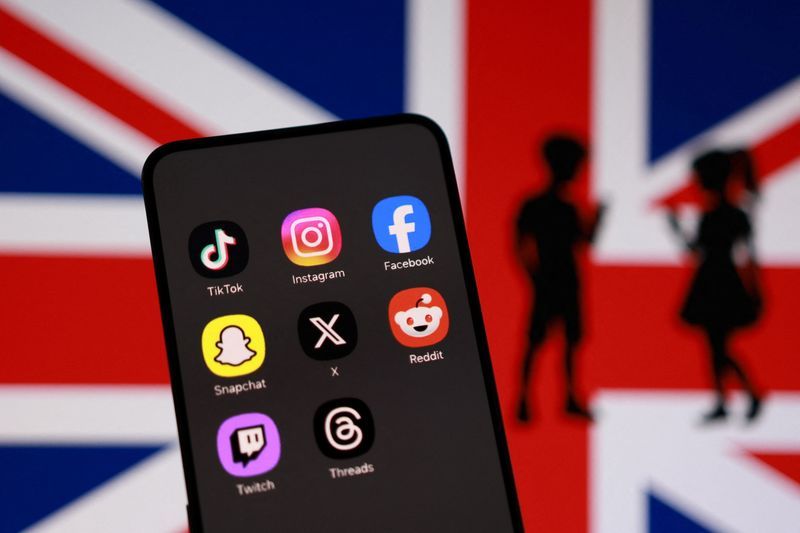
Britain's government has unveiled plans to impose a mandatory overnight curfew on social media usage for teenagers aged 16 and 17, requiring the platforms to lock users out between midnight and 6 a.m. unless young people actively change their default settings. The move represents the government's second major intervention in teen social media use within a month, coming shortly after it announced intention to introduce a blanket prohibition on social media access for anyone under 16 years old. Under the new framework, technology companies will also be required to disable addictive features designed to encourage continuous scrolling during these overnight hours.
The regulatory push reflects intensifying global anxiety regarding the psychological toll of social media on developing adolescents. Governments, parents, and mental health professionals have raised alarms about sleep disruption, anxiety, depression, and poor body image among young users exposed to endless streams of content optimised for engagement rather than wellbeing. By positioning sleep protection and academic focus as central policy objectives, the British government is attempting to reframe the debate around teenage internet use as a public health matter rather than purely a commercial or freedom-of-speech issue.
Technology Minister Liz Kendall framed the initiative as essential infrastructure for adolescent development, arguing that the measures would enable young people to obtain adequate rest, concentrate on their studies, and strengthen family relationships through offline time. This rhetoric aligns with broader parental concerns about screen dependency and its documented links to declining sleep quality among teenagers. The government's argument essentially treats social media platforms as agents of harm that require governmental intervention to counteract their built-in incentive structures.
Online Safety Minister Kanishka Narayan emphasised that technology companies will face legal obligations to implement the curfew, rejecting the notion that voluntary compliance or industry self-regulation offers sufficient protection. Speaking to LBC Radio, he indicated that firms failing to execute proper age verification—a critical prerequisite for enforcing any age-based restrictions—would face severe regulatory penalties. This hardline stance signals that the government intends to treat non-compliance seriously and views corporate resistance as unacceptable.
The proposed regulations present a fundamental implementation challenge that extends beyond Britain. Australia's experience with social media restrictions has already revealed critical weaknesses in age verification systems. The team that advised Australia on implementing the world's first outright social media ban for minors discovered that major platforms struggled at the elementary stage of verifying users' actual ages, undermining the entire legislative framework before it even took effect. This precedent suggests that Britain may face identical technical and enforcement hurdles when attempting to verify that 16 and 17-year-old users are genuinely switching off the curfew intentionally rather than having access exploited through fraudulent means.
Meta, ByteDance, and Google, the corporations behind Instagram, TikTok, and YouTube respectively, have not publicly commented on the proposals, maintaining conspicuous silence while the framework develops. This reticence may reflect either confidence that the measures will prove unenforceable, calculation that engagement with hostile political environments provides no strategic advantage, or internal assessment of compliance costs. Notably, these platforms have faced mounting legal and regulatory pressure across multiple jurisdictions, with Google and TikTok recently settling separate lawsuits brought by a minor in the United States who claimed that the platforms' algorithmic systems caused mental health damage.
The Conservative Party's education spokesperson Laura Trott has criticised the proposals as conceptually incoherent, arguing that optional curfews represent a compromised policy stance. If authorities genuinely believe 16 and 17-year-olds should not access social media at all, she contends, then permitting easy circumvention through settings changes achieves nothing meaningful. Her critique identifies a central tension in the government's approach: the curfew operates on the assumption that teenage autonomy should be preserved while simultaneously acknowledging that platforms cause sufficient harm to warrant restrictions. This middle ground may satisfy neither those demanding comprehensive prohibition nor industry advocates favouring minimal intervention.
The government has indicated that initial regulatory legislation will reach parliament by the end of the current year, with implementation expected during spring 2027. This extended timeline reflects the complexity of developing workable enforcement mechanisms and suggests that the government recognises substantial obstacles remain. The eighteen-month implementation window also allows time for legal challenges and industry lobbying to influence final rules, though the government's forceful rhetoric suggests determination to proceed despite corporate resistance.
For Malaysia and Southeast Asian policymakers monitoring international approaches to youth digital safety, Britain's strategy offers both instructive lessons and cautionary signals. The government's acknowledgement that industry self-regulation has failed provides political cover for governments considering more assertive intervention. However, the Australian precedent demonstrates that technical implementation challenges can render even well-intentioned restrictions ineffective if age verification systems remain inadequate. Southeast Asian nations developing their own social media safeguarding frameworks would be wise to examine whether infrastructure exists to verify ages reliably before committing to age-based restrictions. The British approach—mandatory defaults with opt-out provisions—represents a lighter-touch alternative to outright bans, potentially offering greater political feasibility while still reducing teenage late-night usage through friction rather than complete prohibition.

