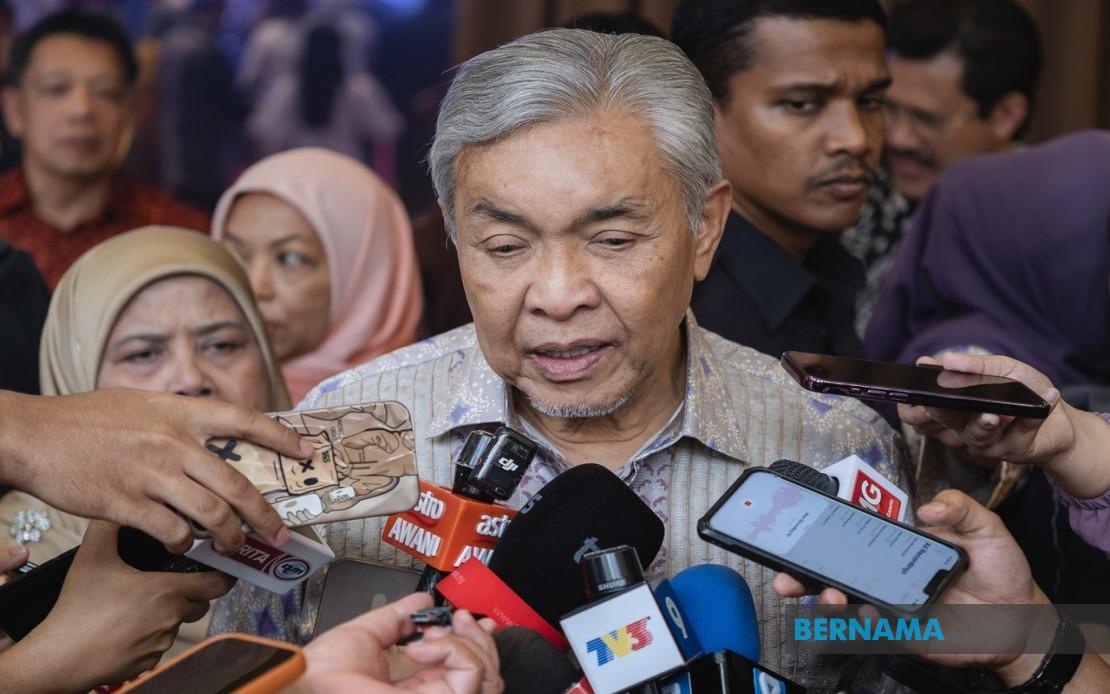
Deputy Prime Minister Datuk Seri Dr Ahmad Zahid Hamidi has given an explicit undertaking that Barisan Nasional will maintain distance from institutional and legal affairs in Negeri Sembilan as the coalition mobilizes for the upcoming state election on August 1. The assurance came during remarks to journalists following his attendance at a Ministry of Rural and Regional Development ceremony in Kuala Lumpur, and reflects a careful calibration of BN's political positioning ahead of what party leaders anticipate will be a substantially different electoral contest from the previous ballot.
As both Deputy Prime Minister and president of UMNO, Ahmad Zahid underscored that the coalition's strategic approach centres on respecting constitutional boundaries, particularly those demarcating the role of the royal institution and judicial frameworks. His emphasis on remaining "outside of that sphere" suggests BN's recognition that entanglement with sensitive matters involving the Negeri Sembilan palace or the Dewan Rakyat Undang-Undang (DKU)—the council charged with advising on legal and administrative matters—could complicate the coalition's electoral narrative and public standing.
The timing of this declaration carries particular significance given the fluid political landscape in Negeri Sembilan, where institutional dynamics have occasionally intersected with electoral cycles. By publicly committing to non-interference, BN appears to be establishing a clear distinction between legitimate campaign activities and institutional overreach, a boundary that Malaysian voters increasingly scrutinize. This posture also reflects broader trends across Southeast Asia where political coalitions face mounting pressure to demonstrate respect for institutional safeguards and separation of powers.
Ahmad Zahid identified internal party cohesion as BN's immediate operational priority. The coalition must achieve alignment among its leadership cadre and grassroots membership across all organizational tiers to contest the 36 state seats effectively. This emphasis on unity underscores the competitive pressures BN faces, as fragmentation—whether ideological, factional, or strategic—could undermine vote consolidation in constituencies where margins may be narrow.
The forthcoming Negeri Sembilan contest represents a tactical departure from the 15th state election, when BN worked collaboratively with Pakatan Harapan component parties. This time, the coalition will contest independently, without the cooperative framework that characterized the previous ballot. The shift signals either a hardening of BN's strategic stance or a recalibration based on assessment that the previous arrangement no longer served coalition interests or reflected evolving voter preferences.
For Malaysian political observers, the distinction between this election and its predecessor illuminates the dynamic nature of coalition politics in the country. BN's willingness to adjust its organizational approach suggests pragmatism, yet it also raises questions about the durability of cross-coalition arrangements that may have been forged under specific contextual pressures now altered by intervening developments.
The composition of BN's competing forces in Negeri Sembilan comprises multiple component parties whose relative influence and ambitions require careful management. Ahmad Zahid's stress on unity likely reflects awareness that individual parties within the coalition may harbour divergent expectations regarding seat allocations, campaign resources, and candidate selection. Achieving consensus on these matters while simultaneously conducting a vigorous campaign requires sustained leadership attention and institutional discipline.
Negeri Sembilan's electoral significance extends beyond the state itself. As a relatively compact contest with clearly defined parameters, the August 1 polling serves as a barometer for broader trends in Malaysian politics—testing the viability of BN's restructured approach, the resonance of opposition messaging, and the extent to which institutional and governance questions influence voter choice. The 36-seat legislature means that outcome patterns can be analyzed with granular precision, offering insights into demographic and geographic voting behaviour.
From a regional perspective, Negeri Sembilan's election carries implications for understanding political dynamics across Southeast Asia more broadly. Malaysia's experience with coalition formation and reformation, institutional navigation, and the interplay between national and state-level politics offers lessons relevant to other democracies in the region contending with similar organizational challenges and constitutional complexities. The commitment to respecting royal and judicial institutions reflects Malaysia's particular constitutional architecture, where the sovereignty and dignity of the institution are deeply embedded in the social contract and political culture.
Ahmad Zahid's framing of the election campaign also suggests BN's recognition that voter sentiment has shifted toward greater expectation of institutional probity and professional governance. The explicit commitment to non-interference may thus serve dual purposes: reassuring constituencies concerned about political overreach while simultaneously positioning BN as a responsible custodian of Malaysia's constitutional order—a narrative advantage in contests where governance and institutional integrity feature prominently in voter calculations.
The practical implementation of BN's non-interference pledge will merit observation during the campaign period. Party discipline at all organizational levels will determine whether this commitment remains consistent throughout the contest, or whether pressures arising from competitive dynamics might tempt tactical violations. The credibility of BN's institutional positioning could hinge on maintaining visible distance from matters properly residing within royal and judicial domains.

