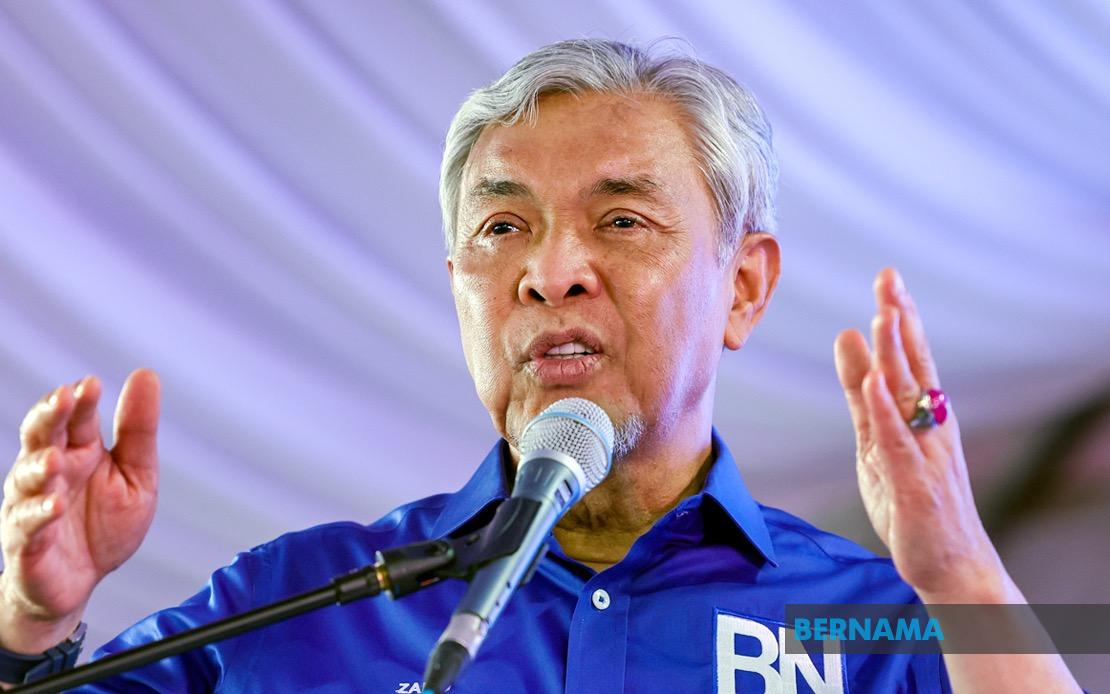
Barisan Nasional chairman Datuk Seri Dr Ahmad Zahid Hamidi has given his word that the coalition will honour every commitment contained in its election manifesto should Johor voters return it to power in this Saturday's state election. Speaking during an engagement session with Johor Village Development and Security Committees in Kluang on July 9, the Deputy Prime Minister framed manifesto fulfilment as a fundamental responsibility rather than an optional aspiration, underscoring the coalition's conviction in the feasibility and importance of its proposed agenda for the state.
The assurance reflects growing pressure on political coalitions across Malaysia to demonstrate concrete delivery on electoral promises, particularly after several election cycles in which voters have expressed frustration with unfulfilled pledges. Ahmad Zahid's emphasis on turning manifesto commitments into tangible reality addresses a persistent credibility gap between campaign rhetoric and post-election performance that has reshaped Malaysian electoral dynamics. By positioning manifesto implementation as a "top priority," BN signals that development continuity and public welfare improvements will anchor its governance approach if returned to office, a messaging strategy designed to appeal to voters evaluating whether the ruling coalition warrants another term.
The BN chairman acknowledged that merely articulating promises holds no value unless accompanied by genuine implementation mechanisms and sustained political will. He stressed that the party leadership would assume an active supervisory role in tracking progress across all manifesto pledges, rejecting the notion that such commitments could be treated as aspirational rhetoric to be conveniently abandoned post-election. This assertion carries particular weight given Ahmad Zahid's dual position as both BN chairman and Deputy Prime Minister, positioning him as accountable for both state-level and federal-level coordination in delivering outcomes that voters expect.
Ahmad Zahid further contextualised the election within a framework of social unity and collective responsibility, cautioning against interpreting electoral victory as a licence for arrogance or complacency. The invocation of "Bangsa Johor" as a unifying concept suggests BN's recognition that electoral mandates must translate into inclusive governance that benefits diverse constituencies across the state. This rhetorical move attempts to broaden BN's appeal beyond its traditional support base by framing electoral success not as factional triumph but as a collective mandate to serve all Johor residents, regardless of their voting preferences.
The timing of these assurances coincides with the 16th Johor state election, which represents a significant political battleground in Malaysia's ongoing electoral realignment. The contest has drawn 172 candidates vying for 56 state seats, engaging a registered voter population of 2.7 million. The scale of participation and the number of candidates standing suggest that voters harbour genuine interest in alternative governance models, making BN's need to articulate credible delivery mechanisms even more acute. In competitive electoral environments, promises unmoored from demonstrated capacity for implementation can erode rather than enhance political positioning.
For Malaysian and Southeast Asian observers, the Johor election carries implications extending beyond state-level politics. Johor remains economically significant and strategically important, serving as a major commercial and industrial hub within the broader region. The state's political direction influences investor confidence, infrastructure development priorities, and cross-border economic integration with Singapore. Should BN secure victory, its ability to deliver on stated development commitments will shape perceptions of the coalition's governance competence ahead of eventual federal electoral contests, establishing a track record against which voters will measure future pledges.
Ahmad Zahid's commitment to monitor manifesto implementation "at the national level, together with other party leaders" indicates that BN intends to establish systematic accountability mechanisms rather than leaving implementation to ad-hoc administrative processes. This framing acknowledges that many policy areas—infrastructure, education, healthcare, economic development—require coordination between state and federal authorities. By explicitly invoking this multi-level governance approach, Ahmad Zahid attempts to preempt criticism that BN might use institutional constraints as excuses for non-delivery, instead positioning such coordination as a deliberate management strategy integral to manifesto realisation.
The election occurs within Malaysia's broader political context of coalition fragmentation and voter volatility. Recent electoral cycles have demonstrated that traditional assumptions about voting patterns no longer hold reliably, with swing voters increasingly responsive to perceived competence, delivery records, and inclusive governance practices. BN's emphasis on manifesto fidelity reflects adaptation to this environment, where electoral legitimacy depends upon demonstrable performance rather than historical brand loyalty. For Johor specifically, the state has witnessed significant demographic changes and economic shifts that have altered voter expectations regarding development priorities, necessitating BN's explicit connection between campaign promises and post-election action.
Polling day's location in Kluang, an area with distinct economic and demographic characteristics, further highlights the granular nature of contemporary Malaysian politics. Campaign engagement in specific towns and villages signals BN's effort to build locally-rooted relationships with constituent communities, moving beyond centralised, top-down messaging. By conducting engagement sessions with Village Development and Security Committees—organisations with direct influence over grassroots sentiment—Ahmad Zahid aimed to cultivate perception of attentiveness to local concerns and willingness to incorporate community input into governance priorities.
The 2.7 million registered voters in Johor represent a substantial portion of Malaysia's total electorate, making the state election consequential for national political trends. Voter turnout rates and demographic breakdowns in this election will provide early indicators of whether BN retains capacity to mobilise traditional support bases or whether realignment continues accelerating. Ahmad Zahid's public commitment to manifesto delivery carries implicit recognition that BN cannot rely upon historical voting patterns but must instead earn renewed electoral endorsement through convincing articulation of future performance capacity.
Looking forward, Ahmad Zahid's pledges will establish benchmarks against which BN's actual performance in Johor will be measured over coming years. Should the coalition claim victory, systematic tracking of policy implementation across education, infrastructure, healthcare, and economic development will determine whether these assurances translate into tangible improvements visible to ordinary Johor residents. In Malaysia's increasingly competitive electoral landscape, the gap between campaign promises and governmental delivery has emerged as a primary factor shaping voter behaviour and political legitimacy.

