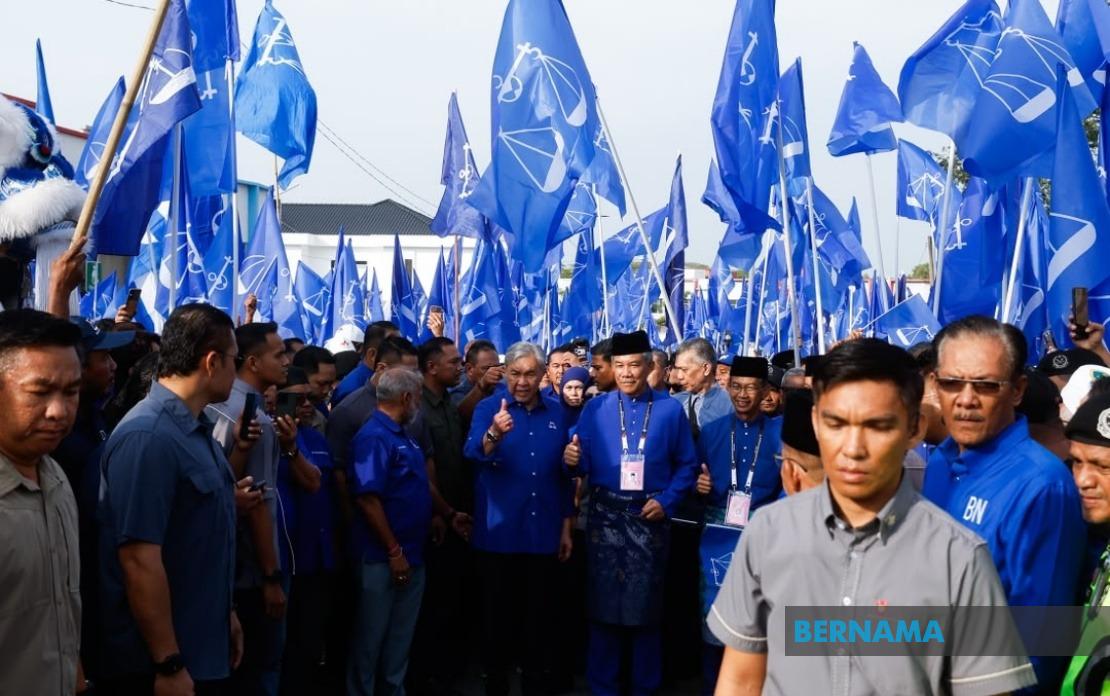
The machinery of Barisan Nasional swung into high gear this morning as senior party figures fanned across Negeri Sembilan to support their candidates during the official nomination period for the state's forthcoming election. The coordinated show of leadership strength underscored BN's determination to retain control of a state it has long held, even as the coalition faces ongoing pressure from rival blocs in electoral contests nationwide.
At the Dewan Seri Rembau nomination centre in Rembau, BN chairman Datuk Seri Dr Ahmad Zahid Hamidi arrived at 8.40 am alongside his deputy, Datuk Seri Mohamad Hasan, to witness Mohamad's filing of nomination documents for the Rantau state seat. The seat represents a crown jewel in BN's portfolio in Negeri Sembilan, having been in Mohamad's hands continuously since 2004. Such longevity speaks to the depth of BN's entrenchment in certain constituencies, though it also raises questions about whether two decades of incumbency has blunted the party's responsiveness to emerging local concerns.
The decision by Ahmad Zahid, who simultaneously holds the presidency of UMNO, to appear personally at the nomination centre sends a clear signal about party priorities. Beyond the symbolic value of a top-tier leader's presence, the move serves practical purposes: it energises the campaign apparatus at a critical juncture, provides photo opportunities for local media coverage, and demonstrates to the grassroots that headquarters is invested in success. For observers tracking intra-coalition dynamics, the visible cooperation between Ahmad Zahid and Mohamad Hasan also suggests stable internal relations within BN's dominant component party.
Across the eight nomination centres that opened simultaneously at 9 am and operated for a single hour, similar scenes played out as other senior BN figures shepherded their endorsed candidates through the bureaucratic formalities. In Port Dickson, BN secretary-general Datuk Seri Dr Zambry Abd Kadir accompanied Datuk Mohd Faizal Ramli, who seeks the Linggi state seat, while UMNO vice-president Datuk Seri Johari Ghani stood beside Suhaimizan Bizar, a contestant for the Gemencheh seat located within the Tampin parliamentary constituency. These pairings reflect the hierarchical nature of Malaysian political organisation, where senior party figures serve as gatekeepers and validators for emerging candidates.
UMNO's own secretary-general, Datuk Dr Asyraf Wajdi Dusuki, bore responsibility for three separate candidacies in the Jempol parliamentary area. His shepherding of Datuk Mustapha Nagoor, Datuk Mohd Zaidy Abdul Kadir, and Chong Fui Ming—contesting Palong, Jeram Padang, and Bahau respectively—illustrates how senior officials function as administrative hubs, coordinating party resources and ensuring smooth candidate registration. The multiplication of leadership appearances across different constituencies also allows the party to saturate media coverage and project an impression of organisational vigour.
Remarkably, parties outside the BN coalition also deployed their hierarchies strategically. PAS president Tan Sri Abdul Hadi Awang attended to ensure his party's candidate, Mohd Fairuz Mohd Isa, successfully filed nomination papers for the Serting seat, demonstrating that even smaller players in the Malaysian political ecosystem recognise the symbolic importance of leadership presence during formal electoral processes. The appearance of Parti Orang Asli Malaysia (ASLI) president Rashid Ka alongside Dayana Dal, who contests the Jeram Padang seat, indicates that even niche political formations view nomination day as an occasion warranting executive participation.
The compression of all nominations into a single one-hour window represents an Election Commission procedure designed to prevent last-minute manoeuvring and ensure procedural transparency. This tight timeline creates strategic pressure for parties and candidates, necessitating precise logistics and advance coordination. The fact that major coalition players arrived early and managed multiple candidacies within this narrow window speaks to the organisational infrastructure these entities maintain during campaign seasons.
Negeri Sembilan's electoral calendar now moves toward a critical phase. Polling is scheduled for August 1, with early voting slated for July 28, providing a four-week campaign window for parties to mobilise support and refine messaging. The state legislature itself was formally dissolved on June 5 following the consent of Tuanku Muhriz Tuanku Munawir, the Yang Dipertuan Besar, marking the official commencement of the campaign period under electoral law.
For Malaysian political observers and Southeast Asian analysts tracking regional democratic patterns, the Negeri Sembilan election offers valuable insights into how established ruling coalitions maintain competitive advantage through institutional control, leadership coordination, and hierarchical candidate management. The visible prominence of BN's uppermost tier in nomination proceedings suggests confidence in the party's electoral prospects, though victory cannot be taken as assured given the volatility that has characterised Malaysian politics in recent years.
The state represents economically important territory, encompassing the Port Dickson parliamentary constituency and multiple high-value seats. Control of the state assembly carries implications beyond local governance, as it influences BN's national narrative and provides a platform for showcasing developmental programmes ahead of the next general election cycle. The apparent enthusiasm of top leadership for this particular contest thus reflects calculations about both immediate state-level dynamics and longer-term political positioning.

