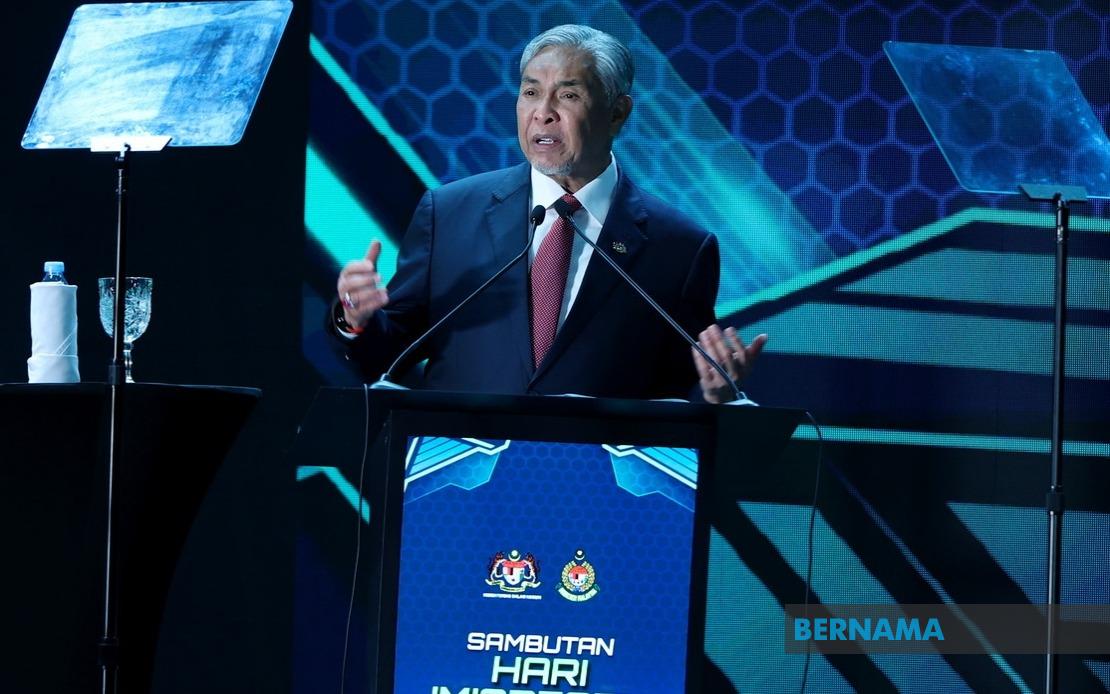
Barisan Nasional has reaffirmed its dedication to the Unity Government arrangement, with party chairman Datuk Seri Dr Ahmad Zahid Hamidi emphasizing that the commitment reflects a formal resolution passed at UMNO's latest General Assembly. Speaking at an event in Cyberjaya on July 21, Ahmad Zahid, who holds the concurrent positions of UMNO president and Deputy Prime Minister, stressed that the decision carries the weight of the party's highest deliberative body and should not be questioned by either internal or external observers.
The affirmation becomes particularly significant given Malaysia's complex political landscape, where coalition stability remains crucial for governmental continuity. The General Assembly represents UMNO's supreme decision-making forum, and Ahmad Zahid's invocation of its authority underscores that BN's participation in the current federal arrangement has secured broad party consensus. This public endorsement aims to quell speculation about potential fractures within the ruling coalition, which has faced periodic tensions since its formation after the 2022 general election.
Ahmad Zahid's statement carries implicit messaging to party members and grassroots leaders, signaling that dissent on the Unity Government question should be treated as deviation from established party policy. By framing the matter as settled at the highest institutional level, he effectively circumscribes further debate within UMNO ranks. This approach reflects a broader coalition management strategy designed to present a united front to voters and international observers during a politically sensitive period.
In a related development that sheds light on the dynamics within the government, Ahmad Zahid acknowledged Prime Minister Datuk Seri Anwar Ibrahim's absolute prerogative to make personnel decisions affecting the Cabinet. The Deputy Prime Minister's statement followed reports that Anwar had warned ministers and office-holders against using their governmental positions to attack Unity Government coalition partners during state-level election campaigns. This warning addressed a persistent challenge in Malaysian coalition politics: the tension between partisan electoral interests and the need to maintain inter-party courtesy within the government.
The Prime Minister's directive essentially establishes consequences for ministers who contravene coalition protocols during campaigning. Anwar's threat to demand resignations from those who weaponize their official positions against coalition allies addresses a real governance problem. During state elections where BN components or Pakatan Rakyat partners contest, individual ministers might be tempted to campaign aggressively against government partners to bolster their own party's prospects. Such conduct undermines cabinet solidarity and creates public perceptions of governmental dysfunction.
Ahmad Zahid's deference to Anwar's cabinet authority reflects the formal hierarchy within the government structure, where the Prime Minister holds exclusive discretion over ministerial appointments and dismissals. By publicly acknowledging this constitutional reality, Ahmad Zahid demonstrates understanding that BN's partnership in the Unity Government requires accepting that the PM exercises executive power without requiring consensus from coalition partners. This pragmatic acceptance of power distribution prevents disputes over individual ministerial matters from escalating into broader coalition crises.
The statement also carries implications for how BN and its constituent parties navigate the delicate balance between coalition participation and electoral autonomy. State elections often pit different coalition components against one another, creating pressure on ministers to prioritize party interests over government cohesion. Anwar's warning and Ahmad Zahid's endorsement of that warning signal that such pressures cannot override coalition discipline. Ministers who choose to campaign divisively do so at the risk of their positions, establishing a clear cost-benefit calculation.
For Malaysian politics more broadly, the exchange illustrates how coalition governments manage the inherent tension between unity and competition. The Unity Government itself represents a relatively novel arrangement in Malaysian federal politics, bringing together UMNO, Pakatan Rakyat, and other partners in a configuration that previous governments avoided. Maintaining such an arrangement requires constant negotiation and periodic reaffirmation that partners remain committed to the overarching coalition framework.
Ahmad Zahid's emphasis on respecting the General Assembly's decision also serves a domestic BN audience. UMNO members from various factions hold different views on coalition participation, with some traditionalists preferring the party to operate independently or within a Malay-centric coalition. By repeatedly anchoring BN's commitment to resolutions passed at formal party gatherings, Ahmad Zahid provides legitimacy for the coalition arrangement against potential internal critics who might question whether BN has compromised its interests.
The timing of these remarks, delivered during an Immigration Day celebration, suggests that while specific coalition management issues dominated discussion, Ahmad Zahid seized the platform to reinforce broader political messaging. Coalition governments require constant public reaffirmation of commitment precisely because they lack the natural stability of single-party governments. Without ongoing declarations of loyalty and resolve, speculation and doubt can accumulate, gradually weakening the political glue that holds partners together.
Looking forward, the framework Ahmad Zahid articulated—BN's continued participation contingent on respecting General Assembly resolutions, and Anwar's parallel authority to enforce coalition discipline through ministerial accountability—provides a mechanism for managing inevitable tensions. However, this framework's durability depends on whether future disputes can be resolved within these established parameters or whether circumstances might emerge that challenge the foundations of coalition commitment themselves.

