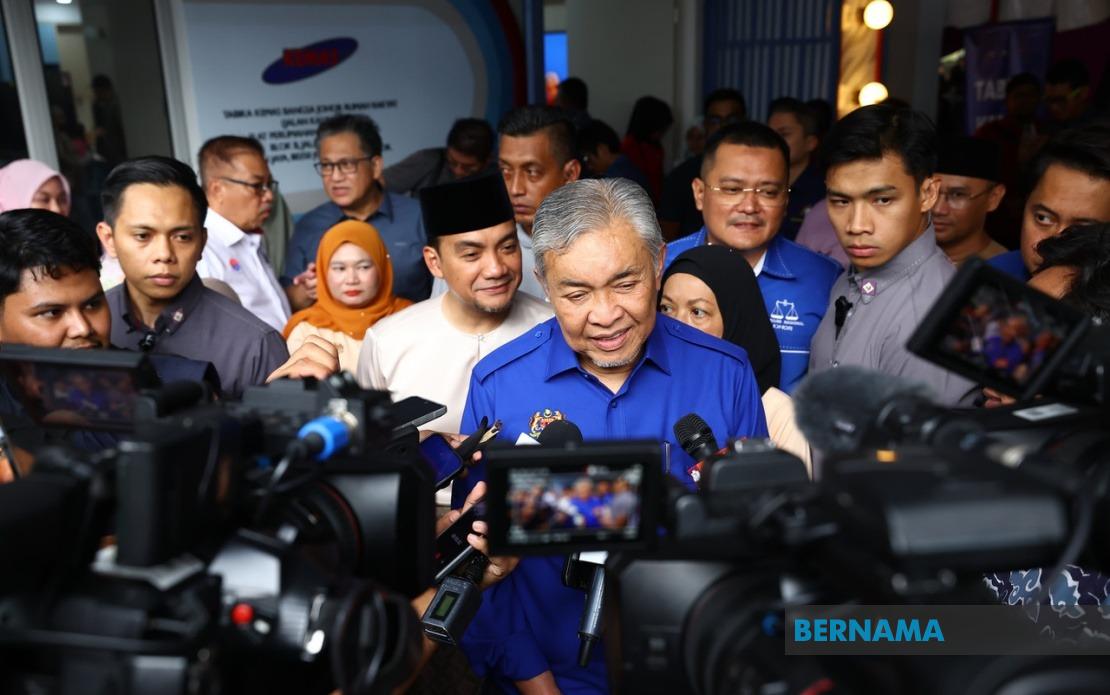
Barisan Nasional Chairman Datuk Seri Dr Ahmad Zahid Hamidi has publicly commended Pakatan Harapan's campaign promises for the upcoming Johor state election, signalling that despite competitive tensions, the country's major political coalitions maintain mutual respect for electoral processes. Speaking in Johor Bahru following an engagement session with parents at Tabika Kemas Bangsa Johor, Ahmad Zahid stressed that BN, as the sitting government, welcomes substantive policy proposals from opposition parties as part of healthy democratic discourse. His remarks underscore how Malaysia's political system, despite recent turbulence, continues to operate on principles of institutional respect even during periods of intense rivalry.
The BN Chairman's acknowledgement came shortly after Pakatan Harapan unveiled a ten-point manifesto for Johor voters, showcasing the opposition coalition's vision for addressing healthcare accessibility, housing affordability, youth economic empowerment, and educational advancement. The PH proposals include launching a state-level health scheme, providing financial assistance to first-time property buyers, allocating RM500 million specifically for youth development programmes, and implementing reforms to strengthen the education system. These commitments signal PH's strategy of competing on concrete delivery promises rather than political grandstanding, mirroring a broader trend in Southeast Asian opposition politics where policy specificity increasingly determines electoral competitiveness.
Ahmad Zahid's measured response reflects BN's confidence in its own electoral position in Johor, a state that has historically been a stronghold for the ruling coalition. Rather than dismissing PH's agenda, he chose instead to emphasise BN's proven governance record, noting that the coalition fulfilled more than 90 per cent of its previous manifesto commitments. This approach serves multiple purposes: it legitimises the democratic process while simultaneously arguing that voters should reward proven performance over future promises. For Malaysian political observers, this rhetorical strategy reveals how incumbent coalitions increasingly compete on execution records when facing organised opposition with credible policy platforms.
The BN manifesto, according to Ahmad Zahid, distinguishes itself through comprehensive coverage spanning all demographic segments and life stages. The framework encompasses expectant mothers and newborns, primary and secondary school students, university candidates, and single-parent households. Crucially, Ahmad Zahid emphasised the principle of universal benefit within Johor regardless of ethnic or religious background, framing welfare policy through an inclusive citizenship lens rather than communal identity. This rhetorical positioning becomes particularly significant in Malaysian politics, where careful calibration of inclusive messaging while maintaining communal representation remains essential for coalition stability.
The Johor state election represents a significant electoral test with 172 candidates competing across 56 state seats, scheduled for July 11 with early voting commencing on July 7. The scale of this election reflects Johor's importance within Malaysian federalism—as the largest state by Peninsular territory and home to approximately 4.2 million residents, election outcomes here frequently signal broader national trends. For BN, securing another strong Johor result would consolidate its recovery following the 2022 general election, while for PH, competitive performance would demonstrate capacity to challenge ruling coalitions in traditionally secure constituencies.
Ahmad Zahid's dual role as BN Chairman and Rural and Regional Development Minister adds weight to his election campaign assertions. His ministerial portfolio allows him to point to infrastructure projects, development schemes, and rural connectivity initiatives as tangible proof of BN's commitment to comprehensive national development. This institutional linkage between party leadership and government administration, while common in Malaysia's Westminster-influenced system, creates structural advantages for incumbent coalitions that opposition parties must actively work to overcome through credibility-building exercises and evidence of alternative governance capacity.
The presence of Johor Menteri Besar Datuk Onn Hafiz Ghazi at the engagement session underscores the state government's central role in BN's campaign machinery. Onn's position as the chief executive responsible for implementing state-level policies makes him a crucial validator of BN's performance claims and a key advocate for continued electoral support. The inclusion of Larkin state seat candidate Mohd Hairi Mad Shah similarly demonstrates how BN structures campaign events to connect national leadership statements with local constituency-level representatives, facilitating message penetration across electoral hierarchies.
The emphasis on community engagement through Tabika Kemas Bangsa Johor, Malaysia's pre-school programme for underprivileged children, reveals strategic campaign focus on early childhood development and poverty alleviation. This choice of venue communicates BN's concern for foundational social policy even as the coalition advances broader economic development narratives. For Malaysian voters increasingly focused on cost-of-living pressures and educational access, such targeted engagement addresses genuine policy concerns beyond abstract political messaging.
For Southeast Asian observers studying competitive authoritarianism and electoral dynamics in developing democracies, the Johor contest offers insights into how ruling coalitions maintain electoral competitiveness when facing organised opposition. Malaysia's experience demonstrates that institutional advantage, proven performance records, and administrative control remain significant electoral assets even in increasingly competitive environments. Simultaneously, PH's ability to present detailed policy alternatives indicates how opposition coalitions can graduate from symbolic protest towards substantive governance proposals capable of attracting swing voters and undecided constituencies.
The broader implication of Ahmad Zahid's respectful acknowledgement extends beyond immediate electoral competition. It signals that Malaysian politics, despite significant ideological differences and occasional institutional tensions, retains commitment to democratic procedures and peaceful electoral contestation. This institutional resilience becomes particularly important given regional contexts where electoral competition sometimes generates violent conflict or institutional breakdown. Malaysia's 2024 Johor election thus represents not merely another state-level contest but a reaffirmation that established political rules and democratic norms continue to structure political behaviour even amid fierce coalition rivalry.

