Prime Minister Narendra Modi's Bharatiya Janata Party has launched a pointed challenge against the Cockroach Janta Party, the activist group that orchestrated major student demonstrations in New Delhi last month, accusing it of abandoning its supposed commitment to youth causes in the eastern state of Jharkhand. The allegation raises uncomfortable questions about the consistency of India's emerging protest movements and whether grassroots activism is becoming increasingly polarized along partisan lines.
BJP spokesperson Keya Ghosh leveled the criticism on Tuesday, characterizing the Cockroach Janta Party as a "mute spectator" to the escalating agitation now gripping Jharkhand. Ghosh's remarks suggest that the party views the group's shift in focus as evidence that its primary objective during the New Delhi demonstrations was to undermine the Modi administration rather than champion genuine student interests. The accusation strikes at the heart of broader debates about protest authenticity in contemporary Indian politics, where distinguishing between legitimate grievance-led movements and politically motivated campaigns has become increasingly difficult.
The Cockroach Janta Party, which emerged as a satirical movement before evolving into an organized pressure group, became a household name after mobilizing students across New Delhi to challenge examination irregularities. Their activism proved consequential, culminating in the resignation of Education Minister Dharmendra Pradhan, a significant political scalp. However, following Pradhan's departure, the group suspended its protests in the capital, a timing that BJP officials now cite as suspicious given the subsequent eruption of similar demonstrations in Jharkhand without comparable organizational involvement from the party.
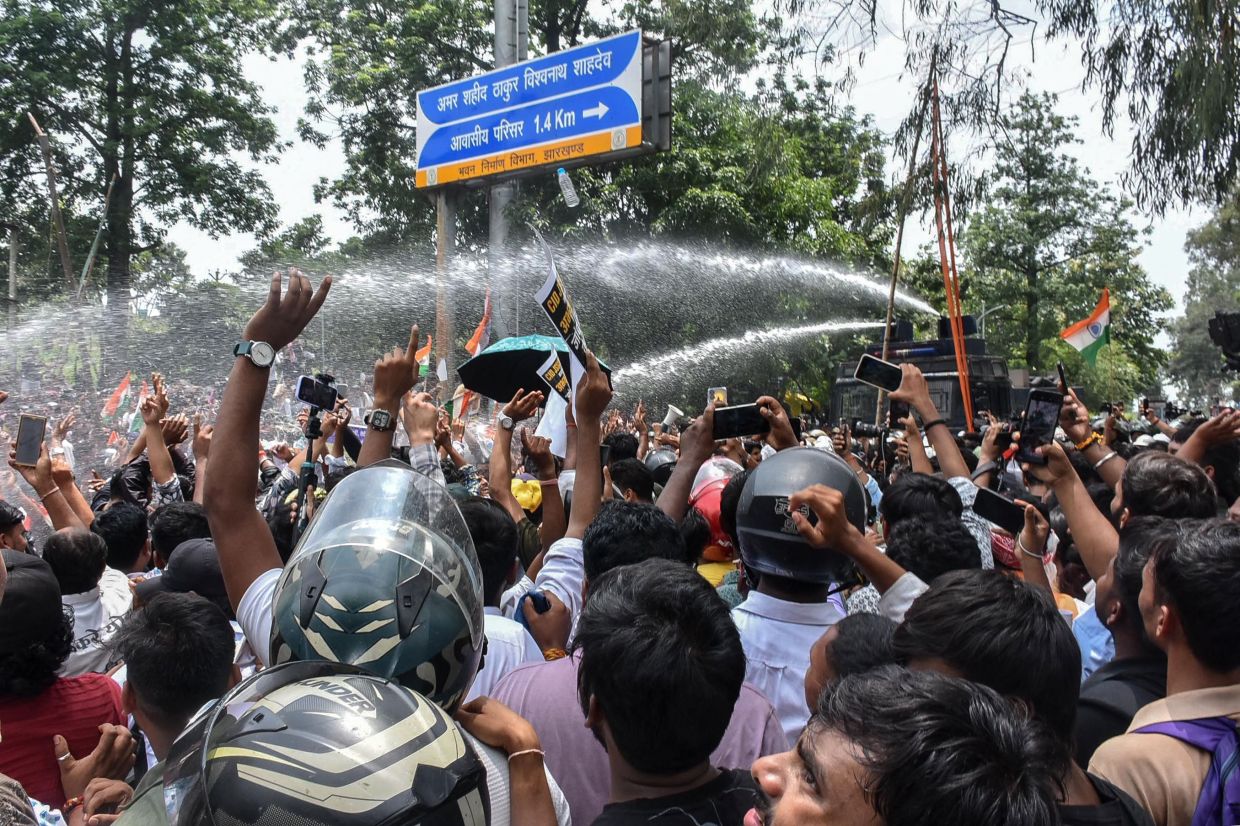
The Jharkhand situation presents a markedly different landscape from the New Delhi protests. Students and aspiring civil servants in this mineral-rich eastern state have mounted their own largely autonomous demonstrations demanding a federal investigation into alleged irregularities in state-level recruitment examinations. These protests have drawn momentum from local grievances and employment anxieties rather than coordinated national activism. While the Cockroach Janta Party has offered rhetorical support for the Jharkhand demonstrators' demands and condemned police actions, its operational involvement remains limited compared to its intensive mobilization efforts in the capital.
Dharmendra Pradhan's removal represented a significant victory for protest movements in New Delhi, yet it also marked a potential inflection point in the Cockroach Janta Party's trajectory. The question now is whether the group's reduced presence in Jharkhand reflects tactical reorientation, logistical constraints, or waning commitment to student welfare as a principle. Some party members have participated in Jharkhand demonstrations, with national coordinator Akshay Shinde affirming their commitment to remaining engaged until all student demands are addressed. Yet this scattered participation stands in stark contrast to the coordinated national campaign witnessed in New Delhi.
The BJP's criticism carries particular political weight given Jharkhand's governance structure. The state operates under a coalition government led by the Jharkhand Mukti Morcha, which includes the Indian National Congress, with the BJP functioning as the principal opposition force. This dynamic creates an uncomfortable paradox for the opposition Congress, whose national leader Rahul Gandhi has publicly supported student protest rights in both locations while conspicuously avoiding visits to either protest site. This apparent contradiction has invited scrutiny from BJP officials questioning whether coalition sensitivities are superseding genuine advocacy for affected students.
Gandhi's position illustrates the complex political calculations surrounding student movements in India. He has condemned police violence against demonstrators in both locations, emphasizing that peaceful protest constitutes a fundamental democratic right and that dialogue represents the only viable path to resolution. Yet his physical absence from both movements arguably undermines the force of his rhetorical support and creates openings for opposition attacks about selective commitment. The Congress leader's approach reflects the precarious balancing act required when supporting protests that challenge both the central government and one's coalition partners at state level.
The Jharkhand protests themselves represent legitimate economic anxiety among youth in a region where employment generation remains chronically inadequate. Allegations of irregularities in recruitment examinations touch upon employment justice—a fundamental concern that transcends partisan political boundaries. Students demanding transparent, merit-based selection processes articulate grievances rooted in material realities rather than ideological positioning. Yet the tendency for organized political groups to instrumentalize such genuine movements complicates the landscape considerably.
For Malaysian observers, these dynamics offer instructive parallels regarding the relationship between grassroots activism and political party structures in large South Asian democracies. The challenge of maintaining movement authenticity while engaging with institutional politics remains as relevant here as it is throughout Southeast Asia. The Cockroach Janta Party's evolution from satirical movement to political pressure group mirrors trajectories seen in other regional contexts, where initial spontaneity encounters the pressures of scaling, sustainability, and inevitable political entanglement.
The BJP's accusations, regardless of their validity, underscore a fundamental tension within contemporary Indian politics: the difficulty of separating genuine youth mobilization from political instrumentalization. Whether the Cockroach Janta Party's reduced Jharkhand involvement reflects strategic calculation, resource constraints, or genuine commitment to causes regardless of political utility may ultimately matter less than what such criticism reveals about political culture's evolution. The incident suggests that student activism in India increasingly occurs within increasingly polarized political frameworks where proof of consistency and ideological purity becomes essential to maintaining credibility.
Moving forward, the Jharkhand protests will likely continue driven primarily by local students and job aspirants, with or without coordinated support from organized activist groups. Yet the BJP's public challenge has ensured that questions about the Cockroach Janta Party's future trajectory and operational principles will persist. These questions extend beyond one group's specific commitments to engage with deeper issues about how sustained social movements develop, how they navigate relationships with political institutions, and ultimately, whether authentic grievance-led activism can maintain independence in increasingly polarized democratic environments.

