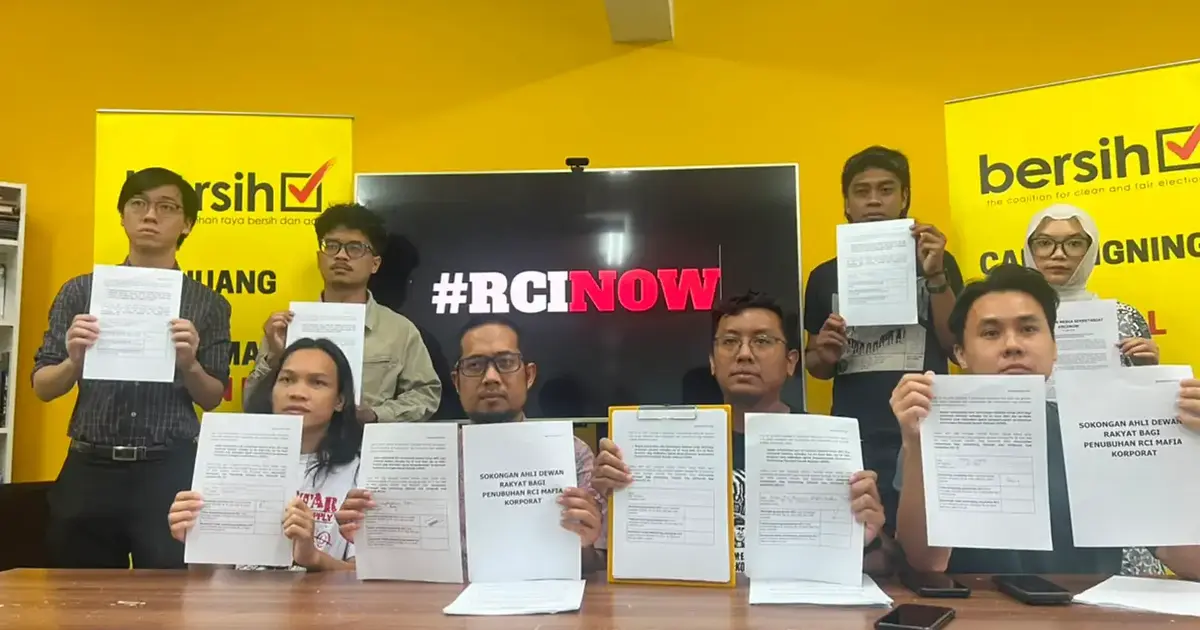
The electoral watchdog organisation Bersih has announced that it has secured backing from 34 members of parliament for establishing a Royal Commission of Inquiry to investigate what it characterises as systematic corporate misconduct. The lawmakers span several political parties, representing a cross-party consensus on the issue that transcends Malaysia's typical partisan divisions. This development signals growing parliamentary interest in a formal investigation mechanism to address corporate governance failures that have drawn public scrutiny.
Among the supporting parliamentarians are representatives from PKR, PAS, DAP and Umno, demonstrating that the push for the inquiry enjoys backing from both government-aligned and opposition benches. The diversity of party affiliation underscores how corporate accountability has emerged as an issue capable of uniting legislators across ideological lines. In a political landscape often fractured by competing interests, this alignment around governance concerns reflects constituent anxiety about corporate conduct affecting ordinary Malaysians.
Bersih's initiative comes amid heightened public concern about corporate practices that operate beyond effective regulatory oversight. The framing of these issues as stemming from a "corporate mafia" suggests Bersih views the problems as systemic rather than isolated, pointing to patterns of interconnected misconduct spanning multiple sectors. Such framing resonates with Malaysians who have witnessed high-profile corporate collapses and questionable business dealings that escaped serious consequences.
The Royal Commission of Inquiry mechanism represents one of Malaysia's most powerful investigative tools, capable of compelling testimony and examining documentary evidence with greater authority than parliamentary inquiries or standard regulatory bodies. Establishing an RCI signals parliament's intent to move beyond conventional oversight mechanisms toward a more intensive examination. The gathering of cross-party support suggests legislators believe the scope and complexity of alleged corporate misconduct justifies this elevated level of investigation.
For Malaysia's business environment, such an inquiry could have significant implications. Enhanced scrutiny of corporate governance practices may force Malaysian companies to strengthen internal controls and compliance frameworks. Foreign investors watching Malaysia's commitment to corporate accountability could view an RCI as either reassuring evidence of governance improvement or as concerning instability. The outcome will likely depend on how impartially the commission operates and whether its findings translate into meaningful regulatory reform.
The timing of this push remains significant within Malaysia's political context. Economic recovery has featured prominently in the government's agenda, yet corporate scandals can undermine investor confidence and drag on growth. Balancing the need for rigorous investigation against business community concerns about excessive regulation presents a delicate challenge. The RCI could serve as a mechanism for addressing past misconduct while establishing clearer boundaries for future corporate conduct.
Bersih's role in driving this agenda reflects the organisation's evolution beyond purely electoral concerns. While the watchdog initially focused on election administration and voting access, it has expanded its purview to encompass broader governance issues affecting democratic health. Corporate accountability intersects with democratic principles insofar as unchecked corporate power can distort political processes and undermine public trust in institutions.
The 34-MP threshold, though representing support from less than a quarter of parliament, nonetheless indicates sufficient momentum to keep the issue on the legislative agenda. Whether this support translates into formal parliamentary motion or government action remains to be seen. Malaysia's legislative process requires navigating both procedural requirements and political will, making the conversion of backbench enthusiasm into concrete action uncertain.
Regional observers note that corporate accountability has become increasingly prominent across Southeast Asia, with several countries implementing enhanced governance frameworks and investigating past corporate misconduct. Malaysia's consideration of an RCI reflects regional trends toward stricter corporate oversight, suggesting domestic political pressures align with broader trends in the region's development trajectory.
For ordinary Malaysians, the potential investigation carries personal implications. Corporate misconduct frequently harms employees through wage theft or unsafe working conditions, consumers through fraudulent practices, and investors through scheme collapses. An inquiry that identifies systemic problems and recommends preventive measures could materially improve protections for vulnerable populations caught in corporate failures.
The composition of the cross-party coalition backing the RCI suggests that Malaysian lawmakers recognise corporate accountability as a legitimate national interest transcending traditional political competition. This recognition, if sustained through the legislative process, could establish a precedent for addressing governance failures through non-partisan mechanisms.
The path forward depends on whether this parliamentary support crystallises into formal action. Cabinet approval and prime ministerial endorsement remain necessary steps before an RCI could commence operations. The apparent legislative appetite for investigation must now navigate the executive decision-making process, where competing priorities and potential opposition from business interests could prove influential in determining whether the inquiry proceeds.

