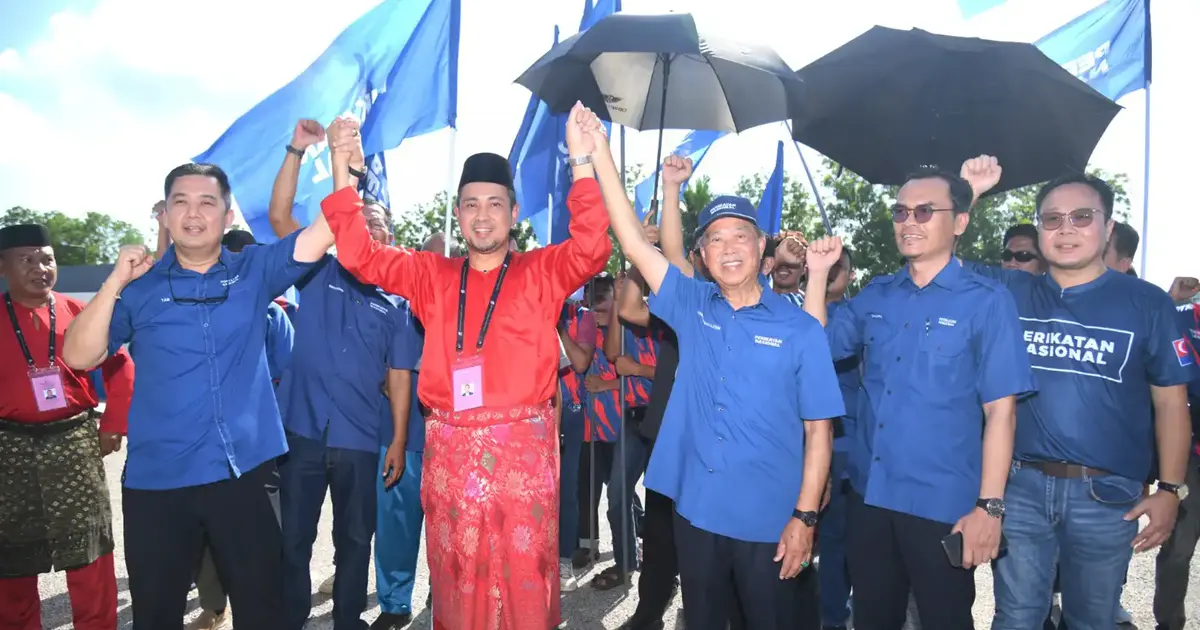
Bersatu's leadership has adopted a measured stance following PAS's rejection of a request to deploy party resources and organisational support, with party president Muhyiddin Yassin framing the matter as a routine aspect of coalition dynamics. The apparent friction highlights the delicate balance required to maintain cohesion within the Perikatan Nasional bloc, where member parties juggle individual interests alongside collective political objectives.
Muhyiddin's measured response reflects a deliberate strategy to avoid escalating the dispute into a public confrontation that could undermine the broader Perikatan Nasional alliance. Rather than portraying PAS's decision as a rejection or snub, the Bersatu president characterised it as a choice entirely within PAS's purview, emphasising that no party should feel obligated to extend assistance beyond what it voluntarily determines to offer. This rhetorical framing serves multiple purposes: it prevents the incident from becoming a festering grievance, maintains face for both organisations, and subtly reinforces the principle that coalition membership should not create hierarchical relationships.
The refusal by PAS to mobilise its machinery on behalf of Bersatu or other Perikatan Nasional partners raises substantive questions about the practical coherence of the coalition. Party machinery—encompassing grassroots networks, organisational capacity, and voter mobilisation structures—represents one of the most valuable assets in Malaysian electoral politics. When a coalition partner declines to share such resources, it necessarily limits the bloc's ability to present a unified front during campaigns and political mobilisation efforts. Yet PAS's restraint may also reflect its own calculations about preserving resources for internal priorities or managing its base expectations.
The Perikatan Nasional arrangement, which unites Bersatu, PAS, and other smaller parties, operates on formal principles of mutual cooperation and reciprocal support. These foundational commitments are meant to distinguish the coalition from looser electoral arrangements and demonstrate genuine ideological alignment or strategic partnership. However, the gap between formal principles and practical implementation frequently becomes apparent in real political scenarios, where individual party interests diverge and resource allocation decisions require negotiation. Muhyiddin's comments inadvertently expose this recurring tension.
Bersatu's position as the Perikatan Nasional convenor carries implicit responsibilities but limited mechanisms for enforcement or compulsion. The party cannot simply demand that other members subordinate their interests to collective objectives without risking the voluntary consensus upon which coalition structures depend. Malaysia's political landscape has repeatedly demonstrated that forced or deeply resented power-sharing arrangements tend toward instability and eventual collapse. This historical context likely informs Muhyiddin's careful choice of language and his explicit disavowal of any intention to compel assistance from partner parties.
The machinery dispute also reflects broader questions about how Perikatan Nasional intends to present itself to voters. A coalition that genuinely functions as an integrated political force should theoretically deploy its collective resources strategically across critical contests. Conversely, if individual parties guard their assets protectively, the coalition's coherence becomes predominantly rhetorical. PAS's decision to maintain independent control over its organisational capacity suggests the party values autonomy and flexibility over complete integration with Bersatu's strategic planning.
Regional dynamics within Perikatan Nasional further complicate machinery-sharing arrangements. PAS maintains particularly strong organisational networks in Peninsular Malaysia, especially across northern and eastern states. These regions represent crucial battlegrounds in electoral competition, and PAS may legitimately calculate that deploying machinery toward other parties' objectives could dilute its capacity to maximise its own electoral performance. In Malaysian politics, where parliamentary dominance turns on relatively narrow margins in specific constituencies, such calculations carry genuine strategic weight.
Muhyiddin's remarks also contain an implicit acknowledgment that cooperation cannot be coerced indefinitely. His statement that Bersatu will not compel other parties to assist essentially codifies what Malaysian political actors already understand: that coalitions function only as long as member parties perceive participation as beneficial to their individual interests and collective objectives. Once that calculus shifts, even formal institutional arrangements prove fragile. By accepting PAS's position gracefully, Muhyiddin preserves the possibility of continued partnership while avoiding the rhetoric of entitlement that might provoke deeper alienation.
The incident illuminates a persistent challenge facing any broad Malaysian coalition: reconciling the imperative for unified action with the reality that member parties retain substantial independence and diverging interests. Bersatu and PAS each maintain substantial political bases, distinct organisational cultures, and particular electoral strongholds. These factors create legitimate reasons for each party to maintain independent control over critical resources, even within a formal alliance framework. The question is whether Perikatan Nasional can function effectively without systematic resource-sharing, or whether the coalition's utility depends precisely on such integration.
For observers monitoring Malaysian coalition politics, Muhyiddin's equanimous acceptance of PAS's decision suggests confidence that the Perikatan Nasional arrangement can survive such disagreements. Alternatively, it may reflect a pragmatic recognition that pushing confrontation would accomplish nothing productive. Either interpretation points toward a coalition that manages partnership through flexibility and acceptance of asymmetry rather than through rigorous enforcement of binding obligations. How this approach translates into electoral performance and governance capability remains an open question with implications for Malaysia's political trajectory.

