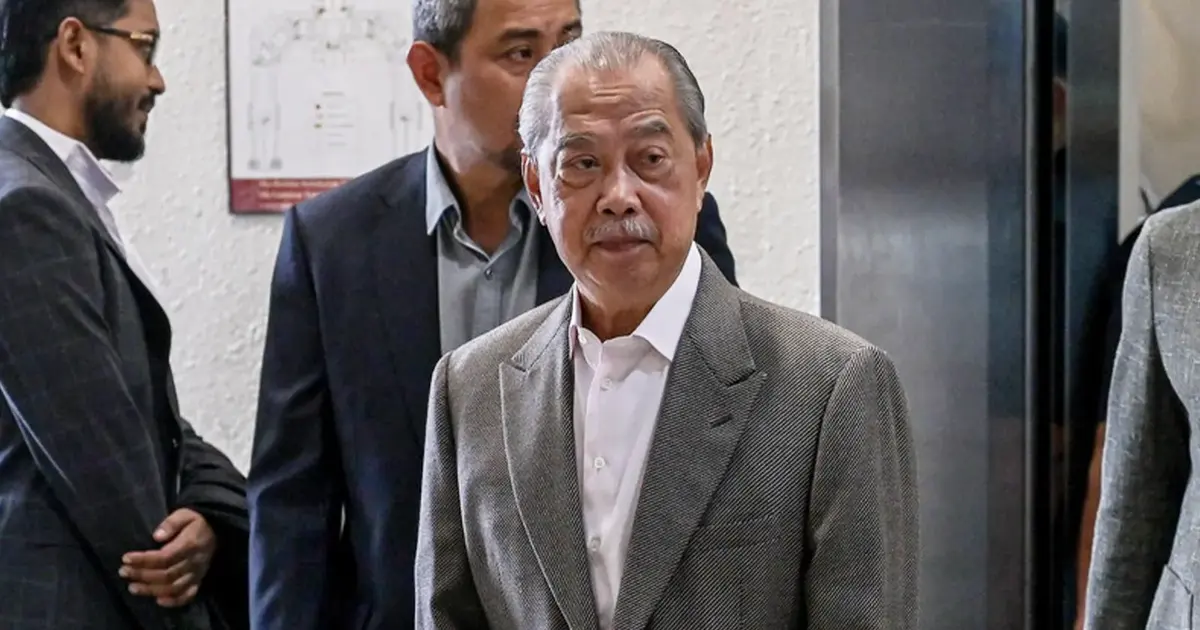
A significant development in ongoing legal proceedings has emerged with Bersatu's financial officer providing testimony that contradicts suggestions of concentrated financial authority within the party. Zulhelmi Zaulkafly appeared before the High Court to clarify the mechanisms governing the Bersatu political party's monetary management, presenting a structured institutional account that challenges narratives of personalised control.
The testimony assumes particular importance given the Democratic Action Party's implicit questioning of former Bersatu chairman Muhyiddin Yassin's role within the party hierarchy. By characterising Muhyiddin as potentially a mere figurehead, the DPP's line of inquiry suggests they are examining whether decision-making authority genuinely rested with the party chairman or whether structural arrangements placed real power elsewhere. Zulhelmi's evidence directly addresses this concern by establishing that financial oversight operated through institutional mechanisms rather than individual discretion.
For Malaysian political observers, the distinction carries weight beyond procedural technicality. The question of how power concentrates or disperses within political parties touches on governance accountability and internal democracy. Opposition parties in particular have criticised Malaysian political structures for personalised control that bypasses formal institutional channels. The testimony therefore provides a window into whether Bersatu, despite its relatively recent founding, has developed institutional safeguards against concentrated personal authority.
Bersatu emerged from the political realignment following the 2018 general election and has occupied a fluid position within Malaysia's coalition landscape. Initially aligned with Pakatan Harapan, the party subsequently pivoted through multiple coalition arrangements, reflecting both strategic recalculation and internal factional dynamics. Understanding the party's actual decision-making structures illuminates how these pivots occurred and whether they reflected coherent party positions or rather shifts in dominant personalities' preferences.
Zulhelmi's assertion that no individual wielded exclusive control over finances establishes an important factual baseline. This suggests that financial decisions required some form of collective endorsement or followed established protocols rather than emanating from unilateral executive authority. Whether such protocols were consistently followed or whether informal influence supplemented formal procedures remains a distinct question that further testimony might address.
The High Court proceedings themselves warrant scrutiny from governance perspectives. Malaysian courts have increasingly become venues for resolving intra-party disputes that might in other democracies remain contained within party structures. This reflects both the political stakes of party conflicts and questions about the adequacy of internal party mechanisms for dispute resolution. The visibility of such proceedings can educate the public about political party operations while simultaneously raising questions about judicial involvement in what some consider fundamentally political matters.
For Southeast Asian regional analysis, the Bersatu case illustrates broader patterns in Malaysian politics where personality-driven leadership remains prevalent even as formal institutional structures proliferate. The tension between charismatic authority and institutional governance pervades numerous Malaysian political organisations across the ideological spectrum. This case provides empirical evidence about whether structural checks function in practice or whether they represent aspirational governance on paper only.
The implications extend to coalition stability and predictability in Malaysian politics. If individual personalities exercise disproportionate influence over party resources and direction, coalition arrangements become hostage to personality changes and interpersonal ruptures. Conversely, if institutional mechanisms genuinely constrain individual actors, coalitions can maintain consistency despite personnel changes. Zulhelmi's testimony thus bears indirectly on whether Bersatu can function as a reliable coalition partner or whether its behaviour remains contingent on individual leadership preferences.
Additionally, financial accountability in political parties remains underdeveloped across Malaysia despite regulatory frameworks requiring disclosure. The testimony about Bersatu's internal controls contributes modestly to public understanding of whether parties maintain meaningful auditing functions or whether fundraising and expenditure remain opaque. Given ongoing concerns about political financing and potential conflicts of interest, evidence that parties maintain institutional oversight mechanisms—even imperfect ones—represents a modest positive development.
The DPP's line of questioning simultaneously reflects opposition strategies for discrediting rival parties. By suggesting Muhyiddin functioned as a rubber stamp, the DPP implies both that he lacked genuine authority and that real power concentrated elsewhere in potentially unaccountable hands. This rhetorical move attempts to undermine both the credibility of Muhyiddin's political standing and Bersatu's institutional legitimacy. However, Zulhelmi's testimony, if accepted, undermines the rubber stamp characterisation by establishing institutional distribution of authority.
Moving forward, the significance of this testimony depends on how it relates to underlying substantive disputes. If the legal proceedings concern specific financial decisions or resource allocations, the question becomes whether the institutional framework Zulhelmi described actually governed those particular decisions or whether they occurred outside formal channels. The evidence establishes that institutional structures existed; subsequent testimony must establish whether they functioned in practice.
For Malaysian voters and political observers, the proceedings highlight the importance of scrutinising internal party mechanisms. Political parties wielding governmental power operate constrained by public accountability through elections, but internal party operations remain largely invisible to voters despite their influence on public policy. Greater transparency about how parties make decisions, allocate resources, and resolve conflicts would strengthen democratic accountability. The High Court testimony contributes incrementally to this transparency by documenting at least some aspects of Bersatu's internal governance, though much remains unrevealed about actual decision-making practices.

