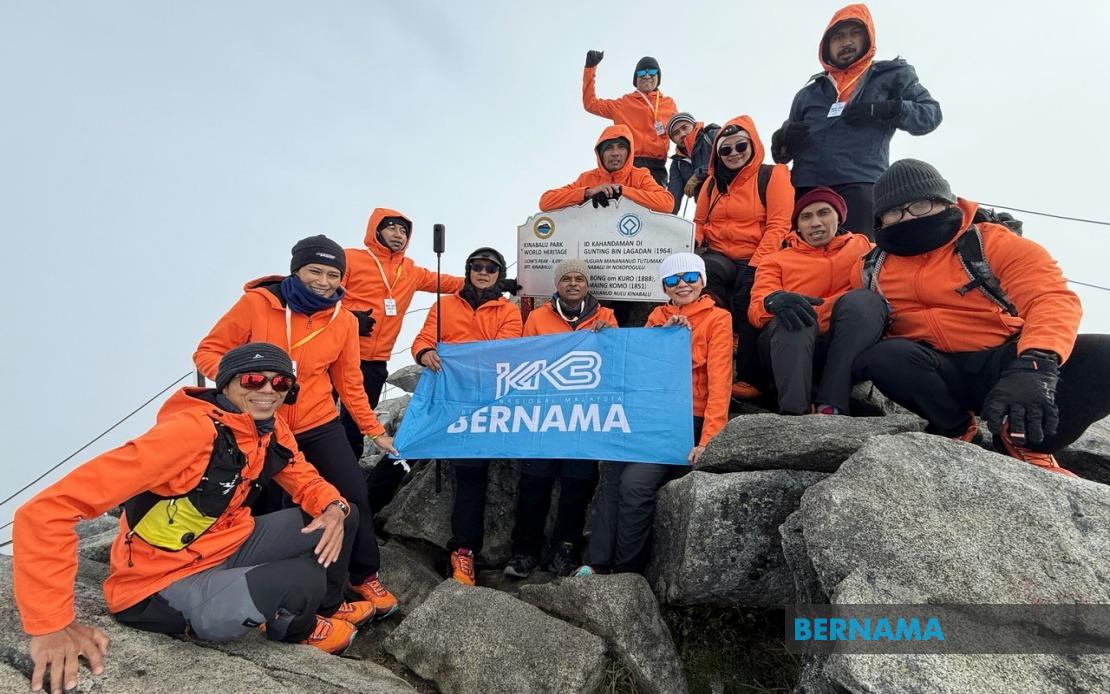
A team of 23 journalists and support staff from the Malaysian National News Agency (Bernama) reached the summit of Mount Kinabalu on July 1, marking a significant milestone in the organization's commemoration of HAWANA 2026, the annual National Journalists' Day celebration. The expedition, which began at Timpohon Gate the previous day at 10 am and involved an overnight camp at Panalaban before the final ascent starting at 2.30 am, successfully navigated challenging environmental conditions including heavy rainfall, dense fog, and powerful winds to reach the 4,095.2-metre peak at approximately 7.20 am.
Bernama Editor-in-Chief Arul Rajoo Durar Raj spearheaded the climbing expedition and simultaneously achieved a personal distinction as the first Bernama Editor-in-Chief to successfully conquer Southeast Asia's highest mountain. Beyond this symbolic accomplishment, the expedition was deliberately designed to pursue two separate entries in the Malaysia Book of Records: recognition as the largest media organization contingent ever to climb Mount Kinabalu as a single group, and acknowledgment as the first media organization to produce and broadcast news coverage in four distinct languages from the mountain's summit.
The diverse composition of the climbing party reflected the breadth of Bernama's operational structure. Alongside field reporters and photographers were sub-editors, television production crew members, and administrative personnel, creating a cross-functional team that embodied the organization's multidisciplinary approach to news gathering and distribution. This inclusive structure underscored the initiative's dual purpose: while pursuing record-setting achievements, the expedition simultaneously functioned as a comprehensive team-building exercise for the national news agency.
The mountaineering venture was coordinated by the Bernama Staff Club (KKB), which organized the climb for the first time as part of its efforts to revitalize HAWANA 2026 celebrations across the organization. The organizers framed the expedition within a broader wellness and personnel development philosophy, positioning the demanding physical challenge as a mechanism for cultivating resilience, fostering interpersonal bonds among employees, and promoting health consciousness throughout the agency's ranks. Such initiatives reflect an emerging trend among Malaysian government and quasi-government organizations to integrate wellness programmes with strategic brand-building activities.
The logistical success of the undertaking depended substantially on partnerships with both commercial and institutional stakeholders. International sportswear manufacturer BMAI provided equipment and technical expertise, while domestic airline Batik Air and beverage company 100PLUS offered material support. Additional backing came from EHH Food Industry Sdn Bhd, Saloma Bistro, Malaysia Airports, Malaysia Insight, UFL, Sabah Parks, and Marathon Baker, demonstrating the extensive corporate ecosystem required to execute such an ambitious expedition involving two dozen participants across multiple altitude zones.
Mount Kinabalu's significance extends considerably beyond its status as the tallest peak in maritime Southeast Asia. The mountain stands at the geographical and ecological heart of Kinabalu Park, a protected area encompassing 754 square kilometres of biodiverse terrain. The park itself forms a cornerstone of the broader Kinabalu UNESCO Global Geopark initiative, which represents Malaysia's commitment to international conservation frameworks and geological education. The mountain's designation as a UNESCO World Heritage Site reflects recognition of its exceptional natural value and its importance as a site of scientific study and cultural significance for indigenous communities.
For Malaysian media professionals and industry observers, the Bernama expedition carries multiple layers of significance. Institutionally, it demonstrates the national news agency's capacity to mobilize resources and coordinate complex logistics beyond conventional newsroom operations. From a broader industry perspective, the record-pursuit dimension reflects a calculated strategy to generate earned media coverage and enhance Bernama's public profile during a period when traditional news agencies globally face mounting competitive and financial pressures. The multilingual broadcast capability from the summit also showcases the organization's technical sophistication and its reach across Malaysia's diverse linguistic communities.
The timing of this expedition coincides with evolving conversations within Malaysian journalism about professional identity and organizational morale. The National Journalists' Day framework, within which HAWANA 2026 sits, provides institutional scaffolding for celebrating journalism as a profession while simultaneously addressing wellness concerns endemic to newsroom environments. The Bernama expedition thus functions as both symbolic gesture and practical intervention, using an extraordinarily demanding physical undertaking to demonstrate organizational solidarity and institutional investment in employee wellbeing.
From a regional perspective, Malaysia's emphasis on record-setting expeditions and UNESCO heritage sites reflects broader Southeast Asian trends toward adventure tourism and experiential marketing that blend environmental stewardship with institutional brand development. The successful summiting of Mount Kinabalu by a large, organized group from a single organization, while simultaneously producing content for multiple language markets, represents a form of integrated communications strategy that leverages geographical assets for institutional narrative construction.
The expedition's success in achieving the summit despite adverse weather conditions speaks to both the physical preparation of participants and the technical competence of supporting teams. The ascent from Timpohon Gate through to Panalaban and thence to the summit required navigation through multiple ecological zones, each presenting distinct physiological and meteorological challenges. The completion of this journey by personnel drawn from across Bernama's organizational structure—from frontline reporters to administrative support staff—suggests that the organization's personnel development frameworks have fostered a culture capable of executing ambitious, coordinated objectives beyond routine operational parameters.
The Malaysia Book of Records applications emerging from this expedition will likely take several months to adjudicate, as the organization verifies claims regarding group composition, organization affiliation, and multilingual content production specifications. The outcome of these applications will have implications not merely for Bernama's institutional prestige but also for how Malaysian media organizations collectively position themselves within national and regional conversations about professional excellence and institutional achievement.

