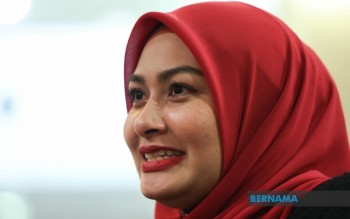
Lembaga Tabung Haji (TH) must work towards financial independence by reducing its heavy reliance on income from Urusharta Jamaah Sdn Bhd (UJSB) sukuk, which currently supplies nearly 26 per cent of the institution's total annual revenue, according to Bentong Member of Parliament Young Syefura Othman. Speaking during a special sitting of the Dewan Rakyat today to debate the Minister in the Prime Minister's Department (Religious Affairs) Dr Zulkifli Hasan's briefing on the Royal Commission of Inquiry (RCI) Report into TH's affairs, the Pakatan Harapan legislator flagged the financial vulnerability that such concentrated income sources create.
Young Syefura's intervention reflects growing parliamentary concern about TH's structural weaknesses, particularly the degree to which the pilgrimage fund depends on a single revenue stream. The RCI Report, which examined the institution's tumultuous financial trajectory, identified this sukuk dependency as a material risk requiring urgent attention. With nearly a quarter of TH's income flowing from UJSB instruments, the fund lacks the diversification typically expected of an institution managing billions of ringgit in assets belonging to Malaysian pilgrims. The government, she stressed, must therefore present a transparent roadmap detailing both the timeline and mechanisms for progressively reducing this exposure.
Fundamentally, Young Syefura's emphasis on strengthening TH through portfolio resilience rather than rescue packages reflects a shift in parliamentary discourse around the institution's recovery. Rather than focusing narrowly on balance-sheet repairs, she positioned the case for making TH structurally robust and self-sustaining. Her assertion that "we want TH to stand strong because of the strength of its portfolio and governance" encapsulates this philosophy. This demand for enduring institutional capacity signals recognition that quick fixes have repeatedly failed TH in the past, and that genuine restoration requires tackling underlying vulnerabilities in investment strategy and operational discipline.
The Bentong MP also demanded clarity on the government's approach to early redemption of the problematic sukuk arrangements, suggesting that accelerated exit strategies may be necessary to break TH's financial entanglement with UJSB. Early redemption would require substantial capital, raising questions about where such funding would originate and what opportunity costs might flow from deploying resources in this manner. Nevertheless, her insistence on exploring this option indicates parliamentary impatience with the status quo and appetite for bolder restructuring measures than those previously attempted.
Beyond the sukuk question, Young Syefura brought renewed scrutiny to the 14 major investment decisions flagged by the RCI for forensic auditing. These ventures—spanning TH Plantations Bhd, TH Properties, FGV Holdings, and various other commercial undertakings—accumulated what the RCI characterised as significant asset depreciation, resulting in material losses. She pressed the government to disclose the total quantum of these losses and the current recovery prospects. This insistence on granular disclosure serves multiple purposes: it establishes baseline accountability for past mismanagement, creates a record against which future performance can be measured, and potentially identifies pathways for recoverable value if assets can be restructured or divested strategically.
The forensic audit process itself emerged as a focal point of her questioning. Young Syefura sought confirmation regarding the audit's progress, scope, and timeline, underlining parliamentary concern that forensic findings translate into concrete consequences. Her explicit reference to the need for identifying "elements of negligence, abuse of power, or breach of trust" signals that she and potentially broader constituencies in parliament view TH's decline not merely as a product of market conditions or poor investment timing, but as potentially rooted in governance failures requiring personal accountability. This framing has significant implications for how the government approaches remedial action, as it moves beyond institutional reform toward potential prosecution of individuals identified as culpable.
Young Syefura advocated for a comprehensive overhaul of TH's oversight architecture, proposing that Bank Negara Malaysia and the Securities Commission Malaysia assume more active supervisory roles. This recommendation reflects international best practice in institutional governance, whereby specialist financial regulators provide ongoing monitoring and early warning of emerging risks. Malaysian readers familiar with regulatory frameworks across the financial sector will recognise this as consistent with how other sensitive institutions—pension funds, insurance schemes, and investment vehicles—operate under multiple layers of scrutiny. Extending such oversight to TH would represent a material strengthening of governance, though it would also require legislative amendments to formalise these institutions' expanded mandates.
The proposal for independent risk assessment preceding all material investments addresses a critical governance gap that the RCI Report highlighted. Under a strengthened framework, major capital commitments would undergo rigorous stress testing and external validation before board approval, rather than post-hoc justification of investments already executed. Coupling this with mandatory due diligence processes creates multiple checkpoints where weak propositions might be arrested before capital is deployed. Such procedural tightening, while imposing costs and potential delays on investment execution, fundamentally shifts the burden of proof from recovery specialists to deployment gatekeepers.
Furthermore, Young Syefura's emphasis on applying "fit and proper" standards to board appointments and senior management selection targets a root cause of institutional dysfunction that permeated TH's history. The fit and proper test, applied rigorously, would require demonstrating relevant expertise, financial probity, and absence of conflicts of interest before assuming stewardship roles. Implementation requires establishing clear criteria, independent vetting mechanisms, and genuine authority to reject unsuitable candidates regardless of political patronage considerations. For Malaysian readers accustomed to concerns about political influence in institutional appointments, this represents a demand for genuine professionalisation of TH's leadership cadre.
The parliamentary intervention by Young Syefura occurs within a broader political context where TH's management has become scrutinised by multiple actors. The RCI Report itself represented an extraordinary acknowledgment of institutional failure, effectively validating years of external criticism. Now, with parliament's investment committees and individual MPs raising pointed questions, the political cost of slow or inadequate remedial action is rising for whichever administration oversees TH's recovery. Young Syefura's specific, technically informed line of questioning—requesting data on depreciation amounts, recovery timelines, and forensic audit progress—establishes metrics against which government performance can be measured and judged.
For Malaysian pilgrims and their families, whose savings have been progressively eroded through TH's investment failures, these parliamentary interventions carry existential weight. The question of whether TH becomes a reliable custodian of pilgrimage savings or remains a cautionary tale about institutional mismanagement will depend partly on whether recommendations like those advanced by Young Syefura gain political traction and translate into binding reforms. Her emphasis on structural robustness rather than temporary bailouts suggests a longer-term orientation aligned with restoring genuine public confidence in the institution.

