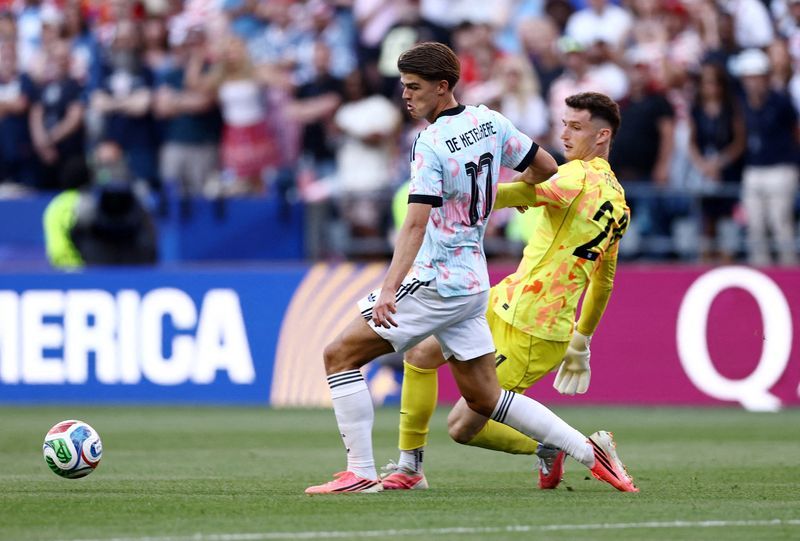
Belgium has discovered a potent new formula for World Cup success—one that shelves its most celebrated names in favour of a more cohesive, aggressive midfield setup. Coach Rudi Garcia's bold decision to bench Kevin De Bruyne, Jeremy Doku, and Romelu Lukaku produced immediate dividends in a commanding 4-1 dismantling of co-hosts the United States on Monday in Atlanta, signalling a remarkable turnaround for a team that seemed destined for early elimination just days earlier.
The transformation is all the more striking given Belgium's precarious position heading into the knockout rounds. Against Senegal in the preceding round, the Red Devils teetered on the brink of exit, trailing by two goals with only five minutes of regular time remaining before mounting an improbable comeback. That narrow escape prompted Garcia to undertake a comprehensive overhaul of his selection strategy, introducing fresh faces and reimagining how Belgium would attack and control matches. The gambit appeared reckless on paper—dropping the playmaking brilliance of De Bruyne, a figure who has long anchored Belgian football—yet the American encounter revealed a team playing with newfound purpose and coordination.
Charles De Ketelaere emerged as the centerpiece of Garcia's tactical recalibration, repositioned as a centre forward and rewarded with two first-half goals that effectively settled the contest before half-time. Nicolas Raskin, Amadou Onana, and Dodi Lukebakio filled roles previously occupied by De Bruyne, Doku, and Hans Vanaken, restructuring Belgium's midfield into a more assertive, possession-dominant unit. This reshuffling complemented captain Youri Tielemans's elevated positioning, allowing him to contest aerial duels and win turnovers at a frequency that suffocated American resistance. The hosts, by contrast, appeared visibly disorganised and overwhelmed, unable to counter Belgium's territorial dominance or exploit defensive vulnerabilities that had been evident in earlier matches.
Garcia's strategic emphasis on controlling space—particularly across the flanks—exposed fundamental weaknesses in the American defensive structure. Rather than relying on De Bruyne's individual brilliance to unlock congested defences, the Belgian system prioritised quick transitions and width-oriented play that stretched an inflexible rearguard. This approach generated sustained attacking pressure whilst maintaining defensive solidity, allowing Belgium to accumulate commanding possession statistics and limit genuine scoring opportunities for the opposition. The tactical discipline demonstrated on the field suggested careful preparation and team-wide buy-in to the new framework, reinforcing the notion that Garcia's late-minute adjustments were the product of conviction rather than desperation.
When Amadou Onana departed with a knee injury early in the second half, the potential for Belgian momentum to dissipate seemed real. Yet the introduction of Hans Vanaken into Onana's midfield duties proved seamless, reflecting Garcia's flexibility and the robustness of his underlying tactical structure. At 33 years old, Vanaken scored in the encounter—a remarkable achievement at a World Cup stage for a player whose recent international career had been intermittent. Garcia's evident satisfaction with this development hinted at deeper planning; the coach had constructed a system flexible enough to absorb injuries without fundamental collapse, a feature that could prove decisive in a knockout competition where fatigue and unavailability become increasingly common.
Garcia revealed post-match that his selection remained fluid until hours before kickoff, a reflection of his analytical approach and willingness to adapt based on opponent analysis and player condition. His stated intention—to deploy De Bruyne only if tactical necessity demanded—demonstrated confidence in his chosen formation and demonstrated restraint against the temptation to rely habitually on star power. The decision proved vindicated; once Belgium established a commanding lead through De Ketelaere's goals, the need to introduce the Manchester City midfielder evaporated entirely. This restraint carries important implications for Belgium's deeper tournament ambitions, suggesting that Garcia has developed a framework that does not depend on individual genius but rather collective function and shape.
Belgium's journey to this point had been characterised by turbulence and frustration. In the group phase, draws against Morocco and Croatia preceded a comprehensive 5-1 demolition of New Zealand that propelled them to first place. Yet neither the indifferent results nor the analytical narratives surrounding Belgium's decline as a force appeared to damage Garcia's confidence in his vision for the team. Against Senegal, their continued vulnerability in defence and difficulty converting opportunities nearly proved fatal. The penalty secured in extra time represented fortuitous rather than eloquent qualification—a lifeline that Garcia has now leveraged to fundamentally reshape his tactical approach.
The psychological implications of this transformation cannot be overlooked. Belgium's football establishment has long been wedded to a particular vision of attractive, technically proficient attacking football centred on its abundance of creative midfielders. Garcia's willingness to subordinate that aesthetic preference to functional efficiency suggests a maturation in thinking that supersedes traditional narratives about Belgian style. Players accustomed to prominent roles have been asked to embrace supporting positions; the squad's apparent acceptance of this recalibration speaks to either Garcia's persuasive authority or a genuine recognition among the playing group that this iteration offers superior tournament prospects.
Looking ahead, Belgium must now navigate a quarter-final confrontation against Spain in Los Angeles, where their newly calibrated approach will face a more sophisticated and technically assured opponent. Spain's midfield control and patient possession game will present an entirely different challenge from the chaos-vulnerable American team. Whether Garcia's tactical innovations can sustain their impact against opponents capable of matching Belgium's possession and tactical sophistication remains the critical question. Nonetheless, the demolition of the hosts has transformed the narrative around Belgian prospects. What seemed a tournament characterised by decline and underperformance has been reframed as an opportunity for experimentation and collective redefinition. Whether this experiment can produce a deep tournament run will determine whether Garcia's bold benching of his superstars represents visionary coaching or merely a fortunate tactical interlude.

