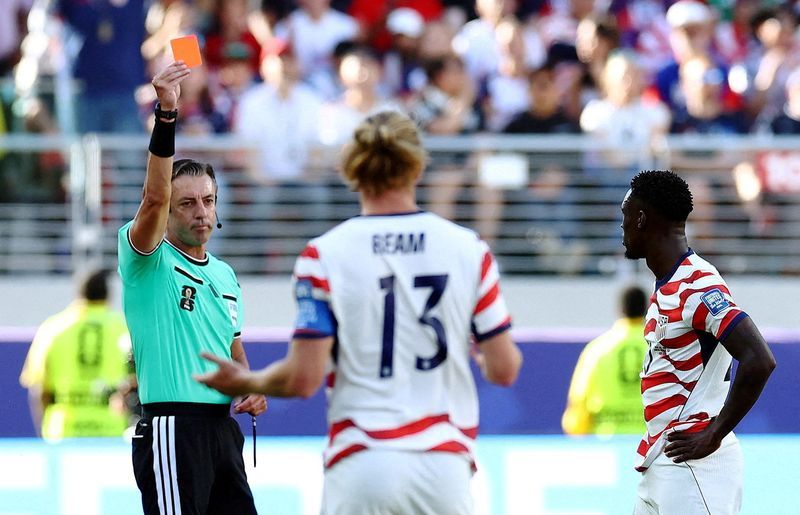
The question of whether political power should ever intersect with sporting discipline has erupted into a contentious row on the eve of Belgium's knockout-stage World Cup encounter against the United States, with influential voices in Brussels questioning how a presidential phone call could apparently overturn what appeared to be a settled disciplinary matter. Reports that U.S. President Donald Trump personally contacted FIFA President Gianni Infantino to secure the lifting of a red-card suspension for a prominent American player have triggered a wave of criticism that extends far beyond the football pitch, touching on fundamental questions about the integrity of global sport and the boundaries of executive power.
The controversy centres on FIFA's decision to suspend the ban that had originally barred the striker from competition. Trump's reported intervention—characterized by observers as unprecedented in its directness—prompted FIFA's subsequent reversal, an action that has been met with considerable scepticism and dismay in Belgium, where the national team prepares for the high-stakes match scheduled for Seattle. The timing of the decision, coming just days before the two nations collide in a fixture where squad composition could prove decisive, has amplified perceptions that the outcome was influenced by factors wholly unrelated to the merits of the case or the consistency of FIFA's disciplinary code.
Belgian public sentiment reflects deep frustration with the situation. Therese Kpooubie, a Brussels resident interviewed about the developing row, articulated a widely shared perspective on what the reversal means for the foundational logic of sporting discipline. She pointed out that red cards exist precisely because they mark serious infractions by players, and questioned how such infractions could be erased through mechanisms other than the established appeals process. Her rhetorical inquiry—whether the referee had made an error in issuing the original card—went to the heart of the objection: if the initial decision was correct, what justification could possibly support its reversal through extraordinary means?
Kpooubie's concerns were framed not merely as a complaint about competitive disadvantage, but as a matter of principle. She suggested that permitting such interference would constitute a betrayal of the sport itself, describing any political influence as "simply shameful." Her comments reflected a sentiment common among supporters of the Belgian national team, who view the decision not as a sporting question to be debated on technical grounds, but as a troubling precedent that undermines the impartiality of international competition.
Other observers in the Belgian capital struck a different tone, though their underlying concern remained evident. Bastien Noel suggested that whatever the rights or wrongs of FIFA's decision, Belgium's response should be to channel any sense of grievance into heightened competitive focus. Noel framed the situation as a potential motivational tool, arguing that the "Red Devils" could use the controversial decision to steel their resolve and demonstrate that extraneous pressures would not diminish their commitment to the tournament. This perspective acknowledged the disquiet surrounding the reversal whilst arguing for a response grounded in performance rather than protest.
The political establishment in Belgium has been less diplomatic. Maxime Prevot, the country's Deputy Prime Minister, issued a statement expressing incredulity at the sequence of events. Prevot's language was notably direct: should the reports of Trump's intervention prove accurate, he contended, such action would constitute a flagrant violation of sport's most basic governing principles. His characterization of the decision as "incomprehensible" reflected an official posture that this was not merely a matter of competitive concern but a breach of international sporting governance that demanded acknowledgement at the highest levels of government.
The American position has been articulated through diplomatic channels. Bill White, the U.S. Ambassador to Belgium, issued a statement via Instagram denying any presidential interference. White's formulation was notably narrow: he asserted that Trump would never interfere with FIFA's internal operations and suggested instead that the president had merely expressed thanks to the organization following their decision. This framing attempts to position Trump as a grateful observer rather than an active agent in securing the outcome, though it does not directly address the substance of the Belgian concerns about the timing and circumstances of the reversal.
The episode sits uncomfortably at the intersection of geopolitics and sport, raising questions about how international sporting bodies maintain independence when confronted by pressure from powerful national leaders. FIFA's autonomy and credibility rest substantially on perceptions of impartial enforcement of its own rules. When a major competitor's head of state can apparently secure favorable disciplinary outcomes through direct presidential intervention, the organization's standing as an impartial arbiter comes into question. For smaller nations like Belgium, whose influence over such processes is limited, the dynamic feels particularly unbalanced.
For Malaysian and Southeast Asian observers, the episode offers instructive lessons about the vulnerability of international institutions to great-power pressure, particularly when high-stakes competition is involved. The World Cup remains one of the planet's most watched sporting events, and decisions made at its highest levels reverberate globally. This controversy underscores how political relationships and sporting merit can become dangerously entangled, threatening the legitimacy of outcomes that fans and nations invest with enormous symbolic significance. Southeast Asian football enthusiasts, accustomed to smaller nations seeking to compete fairly against larger powers, have particular reason to note how even established international bodies can struggle to resist pressure from politically dominant actors.
The match between Belgium and the United States will proceed on Monday, but the context has been fundamentally altered by these developments. What might otherwise have been a straightforward knockout encounter has become shadowed by questions about competitive fairness and institutional integrity. Whether the lifting of the suspension proves decisive, and whether Belgium's response mirrors Noel's prescription for competitive focus or channels broader frustration with the process, remains to be seen. What is clear is that FIFA's handling of this matter will inform perceptions of its governance for years to come, particularly among smaller footballing nations skeptical of their influence over the institutions that govern global sport.

