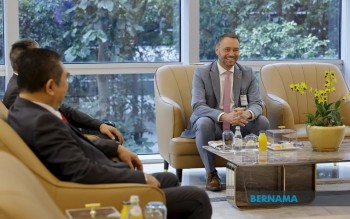
Belgium's Deputy Prime Minister and Minister of Foreign Affairs, European Affairs and Development Cooperation, Maxime Prévot, has emphasised his country's commitment to completing the Malaysia-European Union Free Trade Agreement, framing the deal as essential to unlocking deeper commercial engagement and fostering sustainable growth across both economies. During discussions with Malaysian officials, Prévot underscored that finalising the MEUFTA remains a strategic priority for Brussels and Belgium individually, signalling that Europe views Malaysia as a crucial partner in Southeast Asia for expanding its trade footprint in a region of growing economic importance.
The agreement represents far more than a conventional trade pact for Belgium, which operates as one of Europe's most export-dependent economies despite its modest population of 11.77 million people. With exports accounting for approximately 85 per cent of the country's gross domestic product, Belgium has built its prosperity on open markets and seamless commercial access to global supply chains. The MEUFTA would further cement this outward-looking approach by removing tariffs and regulatory barriers with Malaysia, allowing Belgian firms—particularly in pharmaceuticals, machinery, chemicals, and specialty manufacturing—to access a nation that increasingly functions as a gateway to Southeast Asian consumers and production networks.
For Malaysia, the agreement carries equally significant implications. The country sits at the intersection of major global trade routes and serves as a manufacturing and logistics hub for multinational corporations seeking supply chain diversification away from China and other concentrated sources. An EU agreement would strengthen Malaysia's position as an attractive destination for European investment and technology transfer, particularly in high-value sectors where European expertise and capital can drive productivity gains. The framework would also potentially ease access for Malaysian palm oil, electronics, and automotive components into European markets, provided environmental and sustainability standards are adequately addressed—a key consideration given growing European scrutiny of tropical commodity production.
Negotiations on the MEUFTA are progressing toward completion, with officials projecting that substantive conclusions could be reached within the next few months or by early next year. This timeline reflects both parties' desire to capitalise on current political momentum and economic circumstances. From the EU's perspective, securing trade agreements in dynamic Asian markets becomes increasingly urgent as competition from China and other regional players intensifies. Malaysia, meanwhile, benefits from expanding its trade agreement network beyond ASEAN frameworks and existing bilateral arrangements, offering domestic businesses and multinational operations based in Malaysia enhanced certainty and preferential access to the 450-million-strong European consumer market.
The prospective deal is widely anticipated to generate tangible economic benefits through job creation, investment attraction, and sectoral growth across both territories. European manufacturers seeking to establish or expand operations in Southeast Asia view Malaysia's stable political environment, relatively developed infrastructure, and skilled workforce as compelling advantages. Enhanced market access would incentivise European firms to deepen commitments in research and development, manufacturing, and services delivery within Malaysia, translating into higher-wage employment and technology diffusion across the local economy. Similarly, Malaysian exporters would gain competitive advantages by securing preferential tariff treatment in EU markets, allowing them to compete more effectively against suppliers from other regions.
PreVot's two-day working visit to Malaysia, his first since assuming his ministerial portfolio in February of the previous year, reflects the importance both governments attach to strengthening bilateral ties. The agenda extends well beyond trade mechanics to encompass several domains critical to Malaysia's long-term development strategy. Scheduled discussions with Deputy Prime Minister Datuk Seri Fadillah Yusof, who also holds responsibility for Energy Transition and Water Transformation, will address cooperation in renewable energy technologies—a sector where European expertise and investment capacity can support Malaysia's transition toward cleaner power generation. Rare earth elements represent another crucial focus, reflecting Malaysia's strategic mineral resources and Europe's dependency on stable supplies for electronics, defence systems, and green energy technologies. The halal industry dimension acknowledges Malaysia's position as a global centre for Islamic financing and halal certification, an increasingly significant market segment that European companies seek to penetrate.
Bilateral commerce between Malaysia and Belgium has demonstrated robust growth and structural depth. In 2025, total trade reached RM9.74 billion, with Malaysia exporting goods valued at RM6.85 billion while importing RM2.89 billion in Belgian products and services. This trade balance reflects Malaysia's strength in labour-intensive and resource-based sectors, while Belgium's exports tend toward high-value-added manufactures and specialty chemicals. The ratio suggests complementarities that could be further exploited through tariff elimination and harmonised standards under a formal trade agreement. Beyond merchandise trade, Belgian companies have already demonstrated confidence in Malaysia's business environment through direct investment.
Belgium-linked projects approved in Malaysia as of 2025 total 67 ventures representing RM5.1 billion in committed capital investment and projected job creation exceeding 4,600 positions. These figures illustrate that European capital is already flowing into Malaysia, yet formalised trade rules and reduced business uncertainty through an FTA could substantially accelerate both the quantity and quality of investment flows. Belgian investors span diverse sectors including petrochemicals, pharmaceuticals, food processing, and advanced manufacturing, each contributing to Malaysia's industrial diversification and technological upgrading. The MEUFTA would provide these investors greater assurance regarding market access and regulatory stability, reducing the risk premium typically applied to emerging market ventures.
The agreement also carries strategic implications for Malaysia's broader positioning within global trade architecture. By diversifying its trade partnership network beyond traditional relationships and ASEAN frameworks, Malaysia strengthens its negotiating leverage with other major trading partners and reduces economic vulnerability to supply chain disruptions or geopolitical tensions concentrated in any single region. An EU agreement sends signals to other developed economies about Malaysia's commitment to open trade, good governance, and compliance with international standards—positioning the country as a reliable partner for longer-term commercial relationships. This is particularly valuable given mounting protectionism in certain developed markets and the ongoing restructuring of global supply chains following pandemic disruptions and geopolitical tensions.
The MEUFTA negotiations must overcome several substantive challenges common to EU trade agreements, including environmental protection standards, labour rights enforcement, intellectual property protections, and government procurement transparency. European negotiators increasingly embed comprehensive standards addressing climate commitments, deforestation, and labour practices into trade agreements, reflecting constituent pressures and evolving policy priorities within member states. Malaysia will need to ensure that commitments undertaken in these domains align with domestic capacities and development objectives, avoiding agreements that impose costs exceeding anticipated benefits. Nevertheless, both parties appear committed to finding pragmatic solutions that accommodate each other's core interests while establishing a framework for sustained commercial expansion.
The timing of Prévot's visit and the ongoing momentum toward concluding negotiations reflect recognition on both sides that the bilateral relationship has reached an inflection point. Belgium's emphasis on job creation, economic growth, and market access directly addresses constituencies within Malaysia concerned about employment, industrial competitiveness, and export opportunities in an increasingly challenging global environment. Similarly, Belgian and European stakeholders view Malaysia as essential to their strategies for maintaining market access, supply chain resilience, and geopolitical influence in Southeast Asia. The MEUFTA represents the institutional expression of these mutual interests, offering a framework through which both parties can realise tangible benefits while contributing to broader regional stability and prosperity.

