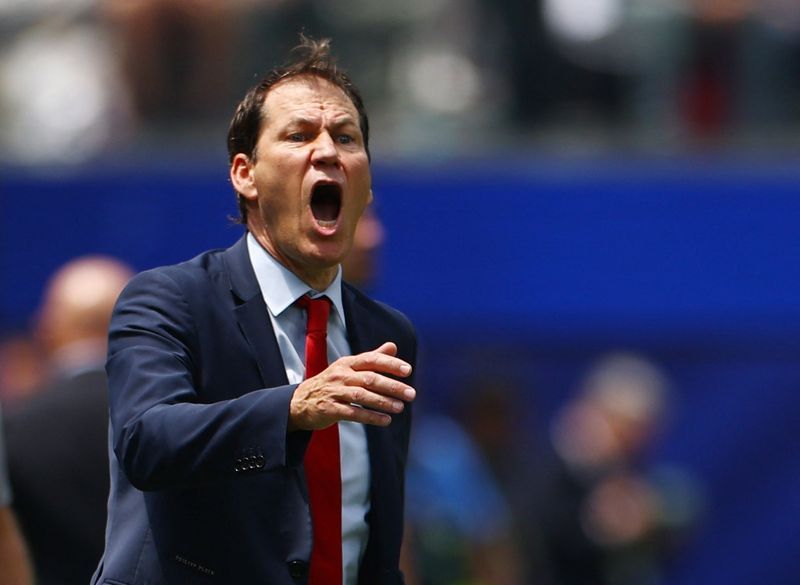
Belgium coach Rudi Garcia finds himself at a crossroads following his team's World Cup quarter-final exit at the hands of Spain on Friday, with his controversial decision to replace goalkeeper Thibaut Courtois becoming the focal point of intense scrutiny. The substitution in the 71st minute, made despite Courtois' belief that he could continue playing through a minor leg injury, proved consequential when replacement goalkeeper Senne Lammens fumbled a low drive from Pau Cubarsi just 15 minutes later, allowing Mikel Merino to tap in the decisive goal in Spain's 2-1 victory.
The incident has reignited broader doubts about Garcia's tactical judgment and management approach at a critical juncture for Belgian football. His contract with the Belgian federation expires at month's end, and federation officials will conduct a comprehensive review of his tenure that is now unlikely to be a formality. Since taking over in early 2025 with a mandate to restore stability and competitiveness following Domenico Tedesco's departure—a reign widely regarded as demoralizing and ineffective—Garcia has overseen qualification for the World Cup and ensured Belgium maintained their elite Nations League status. Yet these organizational achievements may struggle to outweigh the perception that he lost a winnable knockout match through questionable in-game management.
Garcia's rationale for the substitution centred on his stated principle that only players operating at full physical capacity should remain on the pitch during major tournaments. He acknowledged that Courtois' ability to deliver long diagonal passes—a crucial element of Belgium's attacking strategy, particularly for playmaking to forwards Charles De Ketelaere and Romelu Lukaku—was integral to the team's tactical approach. The coach argued that protecting the goalkeeper from potentially worsening his injury took precedence over the immediate competitive advantage of retaining his experience and shot-stopping quality. This philosophy has merit in a tournament context where player welfare extends across multiple matches, yet the application in a knockout stage, where there are no future matches to protect players for, struck many observers as rigid and poorly calibrated to circumstances.
Belgian football media and analysts reacted with palpable exasperation to the decision. Commentator Peter Vandenbempt, speaking on Belgian radio, articulated the sense of disbelief that permeated the country's football establishment, questioning how a coach could remove what he termed the world's best goalkeeper from a World Cup quarter-final simply because the player could no longer execute long passes effectively. Vandenbempt's critique pointed to an apparent tension between Garcia's inflexible fitness protocols and the reality that elite athletes like Courtois possess intimate knowledge of their own physical capabilities and limitations. The implication was that by substituting Courtois without the goalkeeper's full agreement, Garcia had overridden the judgment of a player whose experience at the highest club level—he plays for Real Madrid—gives him substantial credibility regarding what he can and cannot do.
Garcia's managerial record during his tenure offers mixed evidence for his suitability to lead Belgium toward the 2028 European Championship, the federation's stated next major objective. His record across 20 international matches stands at 12 victories, six draws, and two defeats—a respectable win percentage that masks underlying concerns about consistency and tactical adaptability. Belgium's World Cup campaign illustrated this volatility; the team advanced to the quarter-finals despite an unconvincing group stage that saw them draw with Egypt and Iran before narrowly topping their bracket against New Zealand. Their round-of-16 encounter against Senegal proved particularly instructive regarding both Garcia's strengths and weaknesses: trailing 2-0, he withdrew his key attacking players, a bold substitution that contributed to Belgium's remarkable comeback, though whether tactical adjustment or defensive collapse on Senegal's part deserves credit remains debatable.
Yet Garcia has demonstrated an eye for development and renewal within the squad. His integration of younger talents such as Nathan Ngoy and Nicolas Raskin proved successful, with both players delivering standout performances throughout the tournament. The devastating 4-1 victory over co-hosts the United States showcased Belgium's potential when playing with coherence and intensity, suggesting that the squad possesses sufficient quality to mount a competitive challenge at future tournaments. These accomplishments suggest Garcia understands how to build and refresh a team, an essential skill for a federation considering whether to invest further in his leadership.
The timing of this crisis is particularly awkward for Belgian football governance. The federation must determine whether Garcia's organizational competence—maintaining Nations League status and achieving World Cup qualification—outweighs doubts about his tactical decision-making in high-pressure situations. His appointment represented a deliberate attempt to move beyond Tedesco's tumultuous tenure, which had corroded team morale and player confidence. Garcia was tasked with creating a positive, professional environment alongside competitive success. In that broader context, one substitution decision, however controversial, should perhaps not overshadow an otherwise stable and functionally competent tenure.
However, the substitution debate also reflects legitimate questions about Garcia's overall tactical philosophy and flexibility. Multiple observers have questioned whether his approaches to both in-game adjustments and longer-term team balance have kept pace with the evolution of modern football. The loss to Spain was narrow and could have gone either way—Belgium created chances and mounted considerable pressure—yet the manner in which the team conceded the decisive goal will haunt Garcia and the federation. In knockout football, such marginal decisions and moments often determine outcomes, and Garcia's choice to remove his best goalkeeper, whatever the theoretical justification, will be remembered as the tactical error that cost Belgium a semi-final place.
Looking ahead, the federation faces a consequential decision. Retaining Garcia would signal confidence in his ability to learn from this experience and rebuild around established principles. His dismissal would reflect a judgment that Belgium requires a coach better suited to the tactical unpredictability and pressure management that modern tournament football demands. The upcoming contract review will hinge not merely on the Spain defeat but on whether federation officials believe Garcia can evolve his approach and provide the stable, forward-thinking leadership Belgium requires as it seeks to mount a credible challenge for the 2028 European Championship. The Courtois substitution may ultimately prove the decisive moment in determining Garcia's fate.

