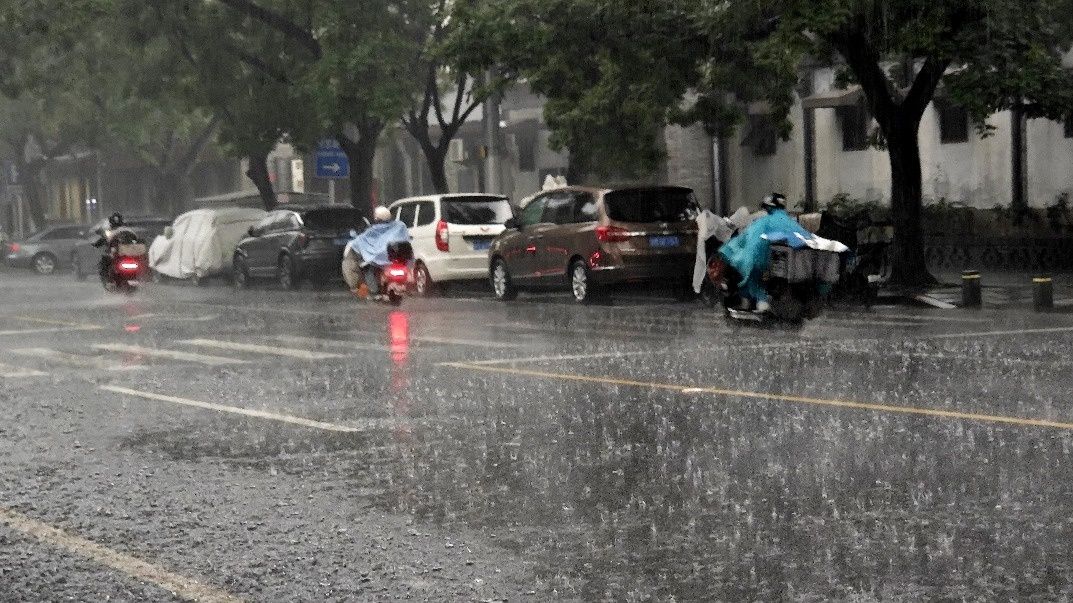
The Beijing meteorological observatory raised an orange-level rainstorm alert on Thursday afternoon, marking the initial major weather warning since the city entered its seasonal flood period in 2026. Authorities simultaneously elevated flood control measures to Level-II emergency status, indicating significant potential impact across multiple districts. The dual activation signals that meteorological conditions are deteriorating sufficiently to warrant heightened public caution and institutional preparedness.
Forecasters predict a sustained period of heavy precipitation commencing Friday afternoon and extending through Sunday morning, with the most intense rainfall concentrated in the districts of Huairou, Miyun, Pinggu, Shunyi and Fangshan. These areas, which include both peripheral urban zones and transitional terrain between the capital and surrounding provinces, face the greatest risk from concentrated water accumulation. In particularly vulnerable locations, hourly rainfall rates are projected to exceed 70 millimetres, a threshold that rapidly overwhelms drainage infrastructure and creates flash-flood conditions. Twenty-four hour cumulative totals could surpass 150 millimetres, equivalent to a substantial portion of some regions' entire monthly precipitation falling within a single weekend.
Mountainous and hilly terrain presents heightened meteorological risks that extend beyond simple waterlogging concerns. Sustained heavy rainfall in elevated areas can trigger landslides, debris flows and slope failures, especially where terrain is steep or geological substrates have been weakened by prior weather events or development activities. The combination of saturated soil conditions and gravitational forces creates hazardous conditions that can develop with minimal warning. Simultaneously, low-lying urban and rural areas face inundation from runoff channelling downslope, with underground facilities and basement-level commercial spaces particularly vulnerable to rapid water ingress.
The Beijing flood control office has implemented a comprehensive response framework addressing both immediate public safety and broader institutional operations. Residents have been explicitly advised to minimise time spent outdoors, particularly avoiding any activities near waterways, drainage channels, mountains or locations historically prone to geological instability. Those planning to travel have been encouraged to utilise public transportation systems rather than private vehicles, reducing congestion on potentially hazardous roads and concentrating evacuation capacity within municipal control. Weather monitoring remains essential, with authorities urging continuous attention to updated forecasts and official guidance rather than relying on outdated or unofficial information.
Commercial enterprises and government institutions have received guidance to implement operational flexibility during the warning period. Flexible work arrangements and staggered commuting schedules can distribute transportation demand across extended periods, reducing peak-hour congestion and accident risk. This distributed approach acknowledges that while severe weather makes travel dangerous, complete cessation of economic activity inflicts substantial costs. By spreading movement and work patterns temporally, authorities aim to maintain essential functions whilst minimising concurrent exposure to hazardous conditions.
Educational institutions face particularly complex decision-making during weather emergencies. Schools have been authorised to suspend classes, cancel in-person training programmes and postpone field teaching activities based on real-time conditions rather than predetermined schedules. This flexibility recognises that weather systems evolve unpredictably and that local conditions vary significantly across Beijing's expansive metropolitan area. A rainfall event severe in Fangshan district might present manageable conditions in central urban zones, yet centralised decision-making cannot account for such geographic variation. Delegating decisions to individual school administrators enables responses proportionate to actual local circumstances.
Public recreational and cultural access has been substantially restricted through the warning period. Scenic attractions incorporating mountainous terrain or waterway proximity face de facto closure, as authorities advise against visits that would expose people to precisely the conditions creating hazard risks. Underground shopping facilities, which concentrate crowds in spaces vulnerable to water intrusion, have similarly been implicitly discouraged. These restrictions extend beyond specific locations; residents have been broadly warned against approaching rivers and drainage channels that, during heavy rainfall, transform from scenic or utilitarian features into dangerous flows capable of sweeping away pedestrians and vehicles.
Industrial and construction operations present particular challenges during severe weather. Heavy equipment operation, excavation activities and building work all become significantly more hazardous when visibility decreases, footing becomes unstable and equipment control becomes uncertain. The alert calls for suspension of outdoor operations and construction work, recognising that economic losses from temporary work cessation represent a preferable outcome to worker injuries or deaths. This prioritisation of safety over productivity reflects institutional learning from prior weather disasters and evolving understanding of acceptable risk levels.
China's four-tier weather warning framework provides context for understanding alert severity. The orange classification represents the second-most severe category, surpassed only by the red alert designation reserved for extreme emergencies. Yellow and blue alerts indicate progressively lower severity thresholds. An orange alert thus indicates meteorological authorities' assessment that current conditions fall substantially above routine operational parameters but represent conditions the city's infrastructure and prepared population can manage with heightened precautions. This intermediate positioning allows distinction between routine weather fluctuations and genuinely hazardous situations whilst avoiding alert fatigue from excessive warnings.
For Southeast Asian observers, Beijing's rainfall event carries broader significance regarding China's approach to weather disaster management and institutional coordination. The rapid activation of coordinated responses across meteorological, flood control, transportation, education and commercial sectors demonstrates institutional capacity for mobilising multiple government and private entities toward unified public safety objectives. The emphasis on flexible localised decision-making rather than blanket centralised mandates suggests evolution in crisis management philosophy toward pragmatic, condition-responsive approaches. As regional countries increasingly face intensified weather patterns attributable to climate dynamics, the mechanisms Beijing employs for coordinating disaster response merit examination and potential adaptation to local Southeast Asian contexts.

