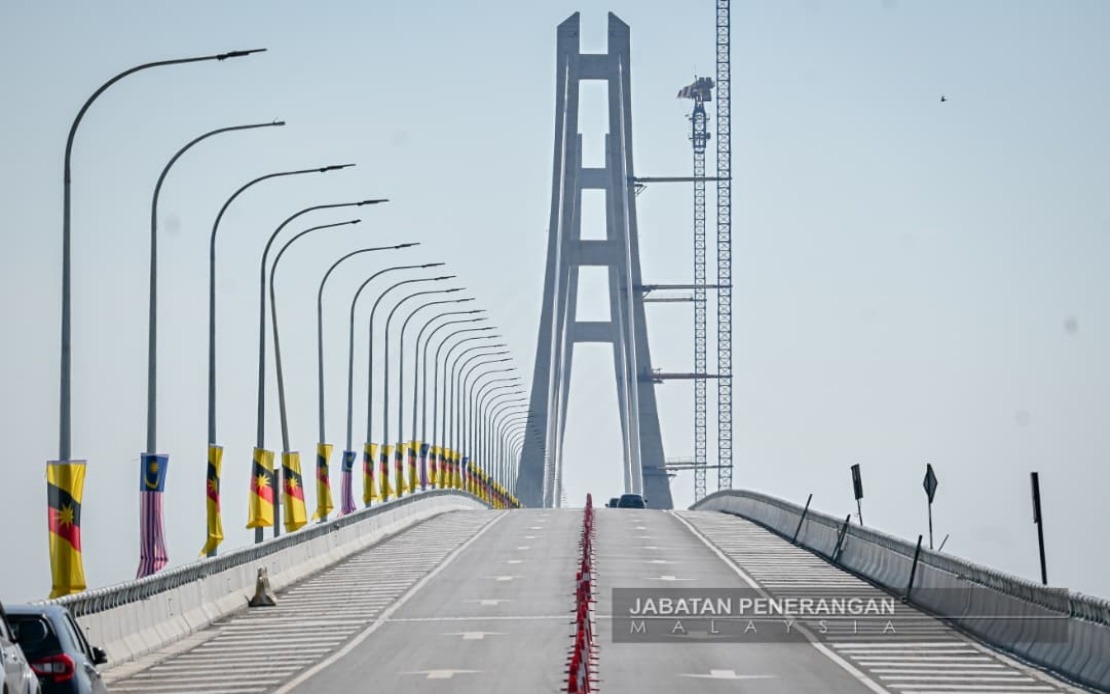
Sarawak has reached a pivotal moment in its infrastructure journey with the official opening of the Batang Lupar 1 Bridge, a RM848.75 million engineering achievement that spans 4.844 kilometres across Malaysia's longest river. According to Sarawak Premier Tan Sri Abang Johari Tun Openg, this landmark project represents far more than concrete and steel—it embodies the state's commitment to transforming the connectivity and economic prospects of its coastal communities. The bridge now links Kuching, Sri Aman, Betong and Samarahan, regions that had long struggled with the limitations and dangers inherent in ferry-dependent transport systems.
The Batang Lupar 1 Bridge assumes a central role within the broader Sarawak Second Trunk Road initiative, an ambitious coastal development framework designed to modernise transportation infrastructure across the state's littoral zones. This integration demonstrates the strategic thinking behind the project—rather than existing as an isolated structure, the bridge functions as a critical node within a comprehensive network aimed at knitting together previously fragmented communities and economic zones. The vision encompasses not merely improved connections but the creation of entirely new commercial possibilities and social integration for residents who have historically endured geographic isolation.
Prior to the bridge's inauguration, residents of these coastal districts faced a precarious dependence on the Sebuyau-Triso ferry service, which presented considerable hazards alongside inconvenience. Abang Johari highlighted how the previous ferry arrangement had generated numerous safety concerns, with strong waves and winds at the Batang Lupar River mouth creating dangerous crossing conditions that periodically claimed lives. These hazards were not abstract statistics but lived realities that shaped daily existence for residents, deterring commerce and limiting economic opportunity. The bridge eliminates this vulnerability entirely, replacing a journey that could stretch to an hour in adverse weather with a swift, reliable crossing.
The infrastructure project directly responds to sustained community advocacy, with both former and current elected representatives channelling local grievances into demands for permanent connectivity solutions. This ground-up origin story underscores the bridge's legitimacy and necessity—it emerged from genuine hardship rather than bureaucratic abstraction. Residents recognised that sustainable development required eliminating the transport bottleneck that had constrained agricultural commerce, resource movement, and basic social mobility for generations. The construction therefore represents a governmental response to democratic pressure, demonstrating how persistent local lobbying can translate into transformative infrastructure investment.
Deputy Premier Datuk Amar Douglas Uggah Embas, who oversees infrastructure and port development, positioned the bridge within an even grander context: the RM3.21 billion Sarawak Coastal Road network initiative scheduled for full completion by 2030. This larger programme, of which the Batang Lupar 1 Bridge forms merely one component, aims to create an entirely reimagined transportation corridor servicing Sarawak's coast. The scale of ambition becomes apparent when examining the projected impact on journey times—the new coastal road will eventually reduce the distance between Kuching and Sibu from 396 kilometres to 252 kilometres, representing a 144-kilometre compression that will substantially enhance regional commerce and tourism prospects.
The economic implications of such connectivity improvements extend far beyond simple time savings. Agricultural producers in the bridged regions can now access broader markets more quickly and reliably, reducing spoilage of perishable goods and enabling participation in higher-value supply chains. Manufacturing and light industry, previously hampered by transport constraints, may now locate in these districts with confidence in their ability to reach consumers and suppliers efficiently. Property values in previously remote areas are likely to appreciate as accessibility improves, generating wealth for existing residents while attracting new investment and development initiatives. The bridge therefore functions as an economic catalyst, fundamentally altering the competitive position of Sarawak's coastal zones within Malaysia and Southeast Asia.
Tourism represents another dimension of potential growth unlocked by the bridge. Previously disconnected coastal areas may now attract visitors seeking cultural experiences, natural attractions and heritage sites, with improved accessibility removing a significant barrier to visitation. The reduction in travel friction allows day-trippers and extended tourists alike to explore regions that were previously accessible only to the most determined and well-equipped travellers. This accessibility creates opportunities for small-scale tourism enterprises—homestays, restaurants, handicraft vendors—to establish themselves with confidence that customer flow will justify their investment.
The bridge's recent recognition by the Malaysia Book of Records as the longest river bridge in Malaysia adds a symbolic dimension to its practical significance. This certification establishes the structure as an engineering landmark with national standing, conferring prestige upon Sarawak and acknowledging the technical achievement involved in its construction. Such recognition serves multiple functions: it reinforces Sarawak's identity as a progressive, forward-thinking state willing to undertake ambitious infrastructure ventures; it attracts domestic and international attention to the project and the region; and it creates a focal point for state pride that transcends the utilitarian function of the structure itself.
The broader context reveals Sarawak's sustained commitment to infrastructure-driven development, with the Batang Lupar 1 Bridge exemplifying a state strategy that prioritises connectivity as a foundation for prosperity. This approach reflects international best practices, where research consistently demonstrates that improved infrastructure correlates with economic growth, poverty reduction, and enhanced quality of life. By investing heavily in transport networks, Sarawak is positioning itself to capture investment flows, facilitate trade, and enable its population to participate more fully in Malaysian and Southeast Asian economies.
For Malaysian observers beyond Sarawak, the bridge's significance extends to lessons about regional development approaches and the importance of investing in peripheral areas. The project demonstrates that large-scale infrastructure can be delivered in geographically challenging environments and that such investments can yield substantial returns through unlocking previously constrained economic activity. The bridge also illustrates how infrastructure decisions made in state capitals have direct implications for quality of life in remote communities, reinforcing the connection between administrative decisions and lived experience across diverse Malaysian constituencies.
The transition from ferry dependence to bridge connectivity represents a threshold moment for Batang Lupar's coastal communities—a shift from geographic isolation to integration within broader economic and social networks. While challenges undoubtedly remain regarding the realisation of the full potential promised by improved connectivity, the bridge's opening represents a tangible commitment by Sarawak's leadership to transforming the prospects of these long-marginalised regions. The coming years will reveal whether the investment yields the anticipated returns in agricultural productivity, economic diversification, and improved living standards for residents who have waited generations for such opportunities.

