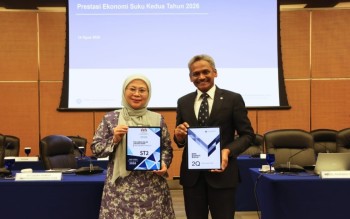
Bank Negara Malaysia has signalled confidence in maintaining its 2026 gross domestic product growth forecast of 5.0 per cent, resisting the temptation to revise upwards despite the economy's recent outperformance. Governor Datuk Seri Abdul Rasheed Ghaffour delivered the reassuring message after unveiling Malaysia's second-quarter performance, which came in at an impressive 6.0 per cent expansion—exceeding the Department of Statistics Malaysia's preliminary projection of 5.8 per cent. The central bank's cautious approach reflects a measured reading of the economic outlook, balancing recent gains against mounting uncertainties in the global environment and persistent geopolitical tensions that could eventually dampen growth momentum.
The decision to hold the line on the full-year forecast demonstrates how Malaysia's monetary authority evaluates economic projections with a long-term lens rather than reacting to quarterly performance data. Abdul Rasheed clarified that formal revisions to growth targets typically accompany the annual Budget announcement, a process that aligns macroeconomic forecasts with fiscal policy announcements and broader government economic strategies. This sequential approach allows policymakers to absorb new information systematically and adjust their frameworks in concert with budgetary measures, rather than issuing piecemeal updates that might create market volatility or signal inconsistency in central bank messaging.
What makes the current forecast retention particularly noteworthy is the sustained strength Malaysia has exhibited over recent quarters. The economy has consistently outperformed the central bank's own expectations, a testament to the resilience of underlying growth drivers that extend across multiple economic pillars. The second quarter's 6.0 per cent expansion builds on this positive trajectory, suggesting that Malaysia's diversified production base and exposure to multiple global supply chains continue generating momentum even as other regional economies face headwinds. This pattern of upside surprise, if it persists, could eventually trigger a formal upward revision to growth forecasts, though the central bank prefers to accumulate more quarters of data before making such adjustments.
Domestic demand has emerged as the primary locomotive pulling Malaysia's economy forward, with consumption demonstrating particular resilience. Household spending expanded 4.8 per cent in the second quarter, underpinned by rising incomes, stable savings levels, and targeted government policy support programmes that have bolstered purchasing power. Abdul Rasheed emphasised that consumer borrowing plays only a marginal role in driving consumption, a crucial distinction for assessing the sustainability of current growth patterns. Unlike economies overly dependent on credit-fuelled demand, Malaysia's consumption expansion rests on firmer foundations of employment growth and income gains, reducing the risk of a sharp contraction should credit conditions tighten or household sentiment deteriorate.
The external sector has provided crucial supplementary support, particularly through export activity, which has maintained its diversified character across multiple product categories and geographies. The electrical and electronics sector, long Malaysia's traditional export cornerstone, continues recording growth, but the economy has benefited from broadening export contributions beyond this historically dominant segment. Non-E&E exports have strengthened, while information and communications technology services have expanded, reflecting Malaysia's gradual economic diversification away from commodity and labour-intensive manufacturing. This sectoral breadth matters significantly because it insulates the overall economy from shocks concentrated in any single industry, a crucial advantage given global trade uncertainties and the ongoing structural shifts in international commerce patterns.
Yet the central bank governor acknowledged that headwinds gathering on the horizon could eventually curtail this relatively benign outlook. Global economic uncertainties—ranging from monetary policy divergences among major central banks to potential demand slowdowns in key trading partners—present genuine risks to Malaysia's external demand trajectory. Beyond conventional economic cycles, geopolitical conflicts threaten to disrupt supply chains, elevate shipping costs, and create unpredictability in energy markets. These factors might not exert immediate pressure on growth, but their lagging effects could materialise through the latter half of the year and into 2027, justifying the central bank's decision to maintain a measured forecast rather than chase recent data with optimistic revisions.
A particular concern flagged by Abdul Rasheed relates to El Niño's potential economic consequences, though his framing suggests the immediate impact should remain contained. The climate phenomenon typically afflicts agricultural output through drought stress and reduced precipitation, sectors less critical to Malaysia's overall GDP than manufacturing and services. Nevertheless, the warning carries significance for rural communities dependent on farming and for food security considerations that extend beyond purely economic metrics. Businesses and households would be prudent to build adaptive capacity now, whether through investment in irrigation infrastructure, diversification of income sources, or strategic inventory accumulation, rather than waiting until climatic stress materialises and options narrow.
The maintenance of the 5.0 per cent forecast also reflects an implicit confidence in government policy continuity and effectiveness. Malaysia's growth has benefited from deliberate policy support in recent years, including targeted fiscal measures, financial inclusion initiatives, and infrastructure investments that have sustained momentum despite intermittent external shocks. The central bank's projection assumes this policy environment persists without major disruption, an assumption that holds for now but could require reassessment if domestic politics or fiscal constraints force policy recalibrations.
For Malaysian investors and businesses, the central bank's steady-handed approach offers some reassurance but also underscores the importance of scenario planning. The 5.0 per cent forecast should be regarded as a central case rather than a guaranteed outcome, particularly given acknowledged global uncertainties. Companies across export-oriented sectors should stress-test their supply chains and customer concentration, while domestic-focused businesses should monitor consumption trends closely for early warning signs of demand softening. The broad-based nature of current growth provides cushion, but complacency would be misplaced given the velocity with which external shocks can propagate through interconnected global economies.
Looking forward, the next significant juncture for growth forecasts will arrive during the Budget announcement, when politicians and technocrats jointly calibrate fiscal and monetary frameworks. If the economy continues its pattern of outperformance and global conditions do not dramatically deteriorate, that occasion may well bring the formal upward revision that the central bank has so far resisted. Until then, Bank Negara's defensive posture—holding fast to 5.0 per cent despite a 6.0 per cent quarterly print—reflects prudent risk management and an appropriate wariness of forecasting overconfidence in an inherently unpredictable global environment.

