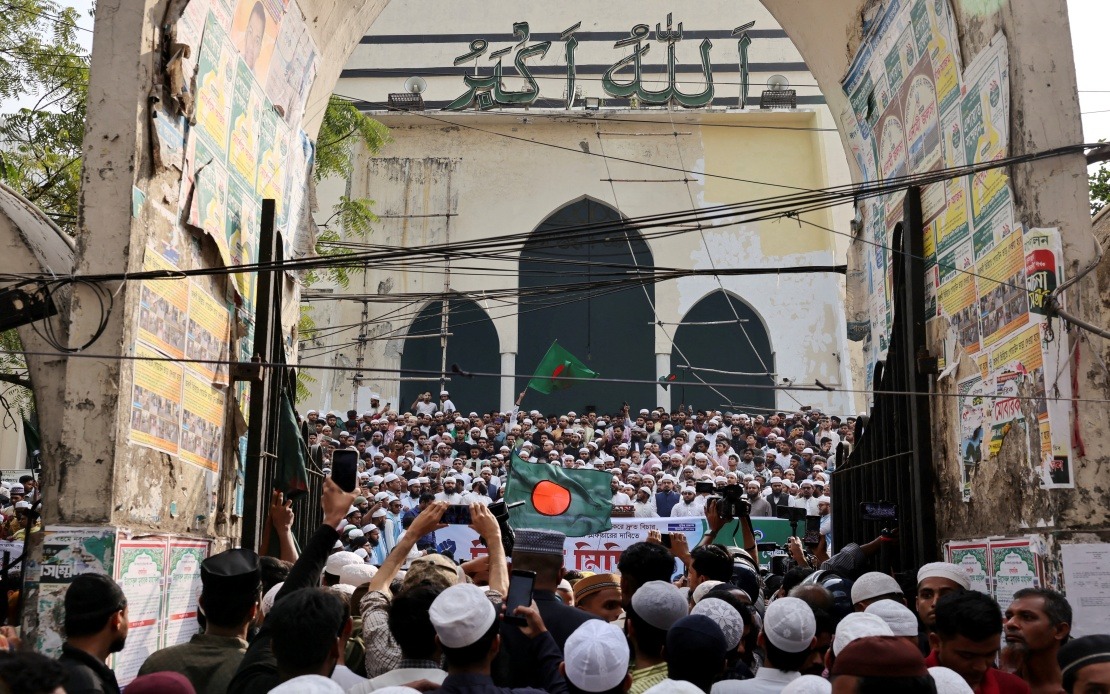
A special International Crimes Tribunal in Dhaka delivered death sentences in absentia on Sunday against three senior police officers held responsible for fatalities during the tumultuous July 2024 uprising that ultimately brought down Bangladesh's government. The three-member panel, chaired by Justice Md Golam Mortuza Mozumder, convicted the defendants of crimes against humanity following investigations into the police response to mass protests that year.
The sentenced officers represent significant figures within Bangladesh's law enforcement hierarchy. Former Dhaka Metropolitan Police Commissioner Habibur Rahman, former DMP Additional Deputy Commissioner Md Rashedul Islam, and former Rampura Police Chief Md Mashiur Rahman all received capital punishment. Rahman, the former police chief, carries the distinction of having already been sentenced to death in a separate case, underscoring the breadth of accountability measures now underway. All three defendants remain at large, classified as fugitives.
The tribunal simultaneously imposed life imprisonment sentences of 20 years each on two additional defendants in the same proceedings. Among them was Tariqul Islam Bhuiyan, a former sub-inspector from Rampura Police Station. These convictions represent part of a broader judicial reckoning with the violence that occurred during the uprising, which drew international scrutiny regarding the proportionality of state response to civilian dissent.
Specific incidents formed the factual basis for the charges. The tribunal found evidence that police officers under these defendants' command were responsible for shooting a young man while he clung to a building in Dhaka, an incident that circulated widely across social media platforms. Additionally, the officers were convicted in connection with the deaths of two other individuals within the capital city during the height of the unrest. These particular killings gained considerable traction online, catalyzing broader outrage and intensifying public pressure for accountability.
The July 2024 uprising represents a watershed moment in contemporary Bangladeshi politics. What began as localized protests metamorphosed into a nationwide movement that exposed deep fractures within the political establishment and raised fundamental questions about governmental legitimacy. United Nations estimates indicate that approximately 1,400 individuals lost their lives during the uprising, with thousands sustaining injuries. The UN attributed the vast majority of these deaths to gunfire discharged by law enforcement personnel affiliated with Prime Minister Sheikh Hasina's Awami League party.
The trajectory from street violence to political upheaval moved with remarkable speed. Initial reports of police brutality, amplified through social media, transformed individual tragedies into symbols of systematic state overreach. Subsequent protest waves swelled dramatically, forcing the political establishment to reckon with demonstrator demands for accountability and institutional reform. By August 2024, less than a month after the uprising's zenith, Prime Minister Hasina had fled the country and subsequently remained in exile, a dramatic departure for a leader who had dominated Bangladeshi politics for years.
The judicial process now underway reflects the new government's determination to address the violence through legal mechanisms rather than permit impunity for security force actions. In November of the previous year, the same tribunal had already sentenced Hasina herself to death in absentia on crimes against humanity charges, a symbolic verdict that positioned her former government as fundamentally culpable for the uprising's bloodshed. These prosecutions signal an intent to establish a comprehensive record of accountability spanning the political and security apparatus.
The convictions carry significance beyond Bangladesh's borders, particularly for Southeast Asian observers monitoring judicial responses to state violence. Malaysia and other regional nations have noted how Bangladesh's courts are addressing the delicate intersection between public order maintenance and human rights protection. The tribunal's willingness to convict serving and former security officials—rather than deflect responsibility to political leadership alone—suggests a model of institutional accountability that extends throughout governmental hierarchies.
Implementation challenges remain formidable, however. The fugitive status of the convicted officers underscores the practical obstacles in enforcing sentences when defendants remain beyond state jurisdiction. Regional cooperation agreements and international law enforcement coordination will likely prove essential in apprehending those convicted. Moreover, the pattern of trials in absentia, while legally valid, creates a distinctive dynamic where defendants cannot mount active defenses or appeal verdicts in real-time, raising questions about procedural fairness that international observers continue to evaluate.
The broader context reveals how mass mobilization, social media connectivity, and security force responses converge in contemporary South Asian politics. Bangladesh's 2024 uprising demonstrated that traditional mechanisms of state control—including police deployments and force—may prove counterproductive when confronting coordinated civilian dissent. The subsequent accountability measures suggest that Bangladesh's emerging political dispensation has internalized these lessons, opting for judicial resolution of contested episodes rather than permitting grievances to fester.
For regional stability, these developments carry implications extending beyond Dhaka. Neighboring countries and international observers assess whether Bangladesh's judicial approach establishes sustainable foundations for democratic governance or represents a transitional phase whose outcomes remain uncertain. The conviction of former security officials carries deterrent effects that may influence how police and military forces approach future civilian protests across the region.

