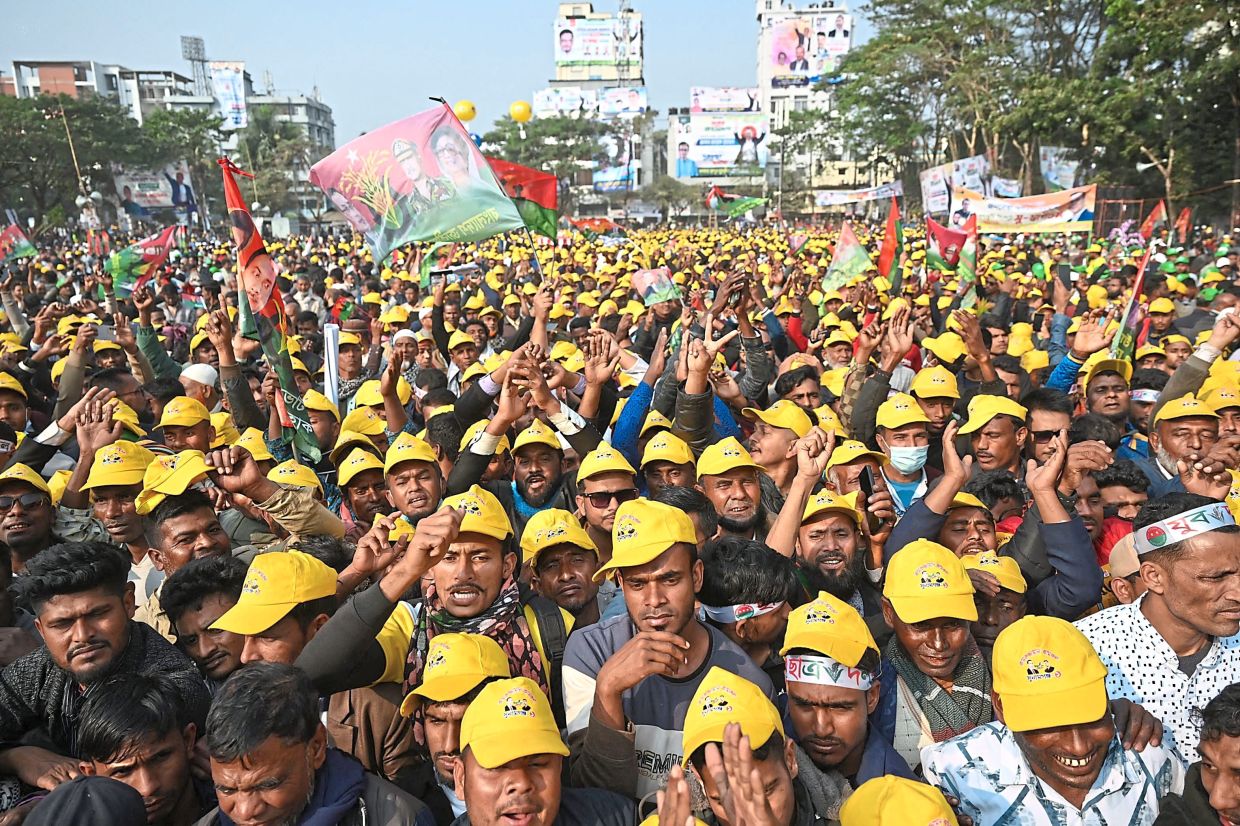
Bangladesh's parliament is scheduled to choose the country's next president on Thursday, with the ruling Bangladesh Nationalist Party strongly positioned to install Mirza Fakhrul Islam Alamgir, 78, into the largely ceremonial five-year role. The veteran politician, who serves as the BNP's secretary general and minister for local government, is widely expected to triumph in the afternoon ballot to become the nation's 23rd president, overseeing a country of approximately 170 million people.
Alamgir expressed surprise and gratitude at his nomination in comments to reporters this week, characterising the selection as a sign of divine favour and party confidence. He struck a populist chord by pledging to remain engaged with ordinary citizens even after assuming the presidency, seeking to frame the largely ceremonial post as an opportunity for continued public service. Such remarks align with the BNP's positioning following its decisive electoral victory and the turbulent transition from the previous administration.
The path to this presidential election reflects the dramatic upheaval that has reshaped Bangladesh's political order in recent months. Prime Minister Tarique Rahman's BNP secured a commanding mandate during February elections, the first democratic exercise since a popular uprising in 2024 swept away the previous government led by Sheikh Hasina. That electoral victory provided the party with sufficient parliamentary strength to effectively determine the presidency through its legislative majority, rendering Thursday's vote largely a formality despite the presence of opposition representation.
The vacancy that Alamgir will fill emerged when Mohammed Shahabuddin, 76, announced his resignation in July after less than a year in office. Shahabuddin, a figure closely aligned with the ousted Hasina regime, had faced mounting pressure to step down and cited health concerns as his rationale for departing. His abbreviated tenure—he was elected in 2023 with an intended five-year mandate running until 2028—underscored the isolation of Hasina's inner circle following the revolutionary upheaval that transformed Bangladeshi politics.
Hasina herself has become a fugitive, remaining concealed in India while refusing to appear for criminal proceedings in Dhaka. A Bangladeshi court convicted her of crimes against humanity in November and imposed a death sentence, validating longstanding accusations from civil society organisations that her administration perpetrated serious abuses. These alleged violations encompassed targeted killings of political adversaries, systematic harassment of opposition movements, manipulation of the judiciary, and electoral fraud—patterns that human rights monitors had documented throughout her tenure.
Alamgir faces nominal competition from Oli Ahmed, the opposition's alternative candidate backed by an eleven-party coalition spearheaded by Jamaat-e-Islami, though this challenger holds no realistic prospect of victory given the BNP's parliamentary dominance. The voting process, anticipated to commence in early afternoon Bangladesh time, will culminate an extended period of political renovation for the nation.
The incoming president brings an extensive political pedigree extending back to the independence era. Born on 26 January 1948, Alamgir emerged as a prominent student activist during the 1969 uprising that resisted military governance imposed by Pakistan—a movement that functioned as a precursor to Bangladesh's 1971 independence. He subsequently pursued economics education at Dhaka University while developing his political consciousness, then built a career encompassing academic work in his field and civil service roles before transitioning to electoral politics.
Throughout his governmental career, Alamgir held various ministerial portfolios including agriculture, aviation, and tourism, accumulating administrative experience across multiple sectors. However, his contemporary prominence derives principally from his work as an opposition figure during Hasina's authoritarian rule, a period when the BNP faced systematic marginalisation. While party chairwoman Khaleda Zia endured imprisonment and her son Rahman remained in external exile, Alamgir became instrumental in preserving the BNP's institutional coherence and political viability through an exceptionally challenging interval.
During those years of political repression, Alamgir himself suffered repeated detention under charges he characterised as vindictive prosecutions orchestrated by the Hasina government to suppress rivals. His resilience through this difficult phase earned recognition from party observers and rank-and-file members who credited him with maintaining organisational structures and political networks when the BNP faced existential pressure. This demonstrated capacity to navigate and survive acute political adversity appears to have influenced the party's selection process for the presidency.
On a personal level, Alamgir maintains a conventional middle-class family structure, being married to Rahat Ara Begum, a former financial administrator, with whom he has raised two daughters. This conventional domestic arrangement contrasts with the dramatic political controversies surrounding many contemporary Bangladeshi figures, potentially lending him a degree of stability and respectability during an transitional phase when the nation seeks to rebuild institutional credibility following the revolutionary rupture.
The presidential election represents one further step in Bangladesh's political reconstruction after the extraordinary events of 2024. While the office remains substantially ceremonial, the choice of Alamgir signals the BNP's intention to consolidate power through systematic institutional control while projecting an image of political continuity and experienced stewardship. His elevation occurs as Bangladesh navigates the aftermath of state collapse and civil upheaval, with governance challenges extending far beyond symbolic positions into substantive questions of economic management, security, and social reconciliation that will define the nation's trajectory in coming years.

