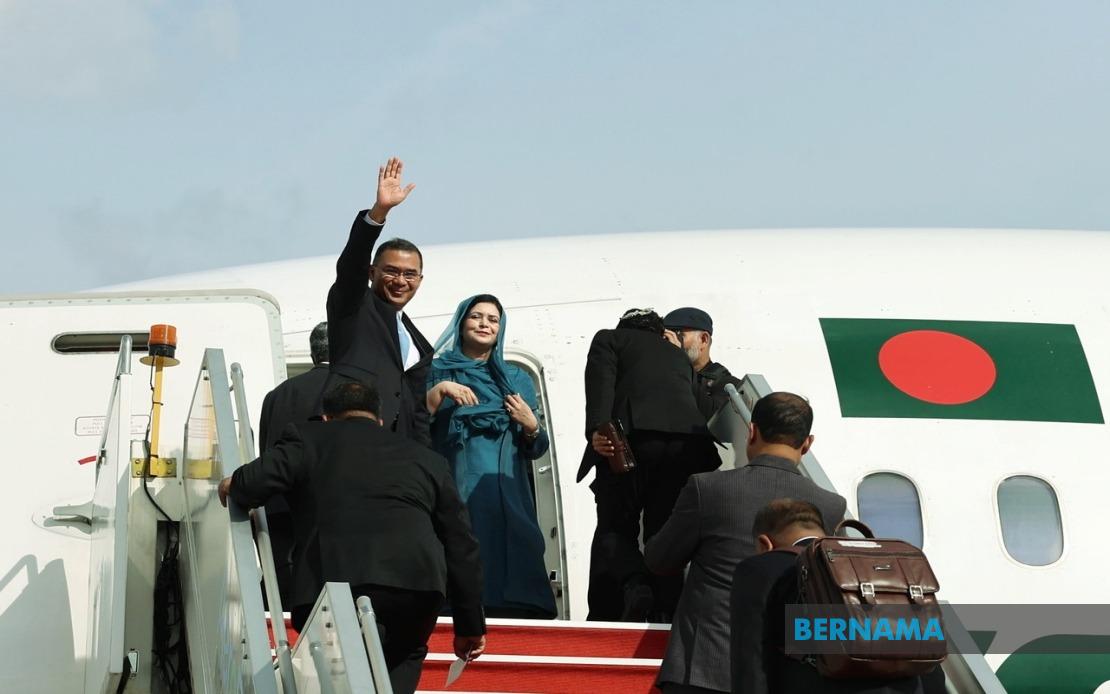
Bangladesh Prime Minister Tarique Rahman departed Malaysia on Sunday evening for China, concluding a two-day official visit that saw substantial progress in bilateral relations between the two South Asian and Southeast Asian nations. His aircraft took off from Kuala Lumpur International Airport's Bunga Raya Complex at 5 pm, after being accorded ceremonial honours by a guard of honour comprising 28 officers and personnel from the First Battalion of the Royal Ranger Regiment. The departure marked the end of Tarique's first bilateral official visit abroad since taking office in February 2026, underscoring Malaysia's strategic importance to Bangladesh's international engagement during this pivotal period of his leadership.
Minister in the Prime Minister's Department (Religious Affairs) Dr Zulkifli Hasan represented the Malaysian government in bidding farewell to the Bangladesh delegation, which included Tarique's spouse Dr Zubaida Rahman. The ceremonial send-off reflected the significance both governments place on strengthening their relationship, particularly as Bangladesh navigates regional geopolitical dynamics and seeks to expand its economic partnerships across Asia.
During the visit, Tarique and Prime Minister Datuk Seri Anwar Ibrahim held substantive bilateral discussions at the Perdana Putra Complex, where they addressed both regional and international issues affecting their nations and the broader Indo-Pacific region. The talks went beyond conventional diplomatic pleasantries to explore concrete opportunities for deepening economic and technical cooperation across multiple sectors critical to both countries' development agendas.
A centrepiece of the engagement was the commitment to pursue a fast-track free trade agreement, signalling both nations' determination to accelerate trade relations beyond current levels. Malaysia and Bangladesh currently trade goods valued at RM12.18 billion, with Malaysia maintaining a substantial surplus—exporting RM10.08 billion in goods, primarily petroleum products, while importing RM2.10 billion, predominantly textiles, apparel and footwear. Bangladesh ranks as Malaysia's 28th-largest global trading partner and second-largest in South Asia after India, indicating significant untapped potential for expanded commerce that a modernised trade framework could unlock.
Beyond trade mechanics, both leaders identified strategic sectors for enhanced cooperation, including semiconductors, energy, agricultural development and education. These sectors reflect complementary strengths: Malaysia's advanced manufacturing capabilities and technology sector expertise paired with Bangladesh's large labour force and growing consumer market. Energy cooperation carries particular weight, given Bangladesh's energy security challenges and Malaysia's hydrocarbon expertise, while the halal industry represents an opportunity to capitalise on shared Islamic heritage and Bangladesh's substantial Muslim-majority population and emerging halal manufacturing base.
The two governments formalised their commitments through multiple instruments. They witnessed the signing of a Memorandum of Understanding on Cultural Cooperation, recognising the importance of people-to-people exchanges and soft power in cementing bilateral ties. Additionally, two Exchanges of Notes were concluded addressing Counter-Terrorism Research and Investment Promotion and Facilitation, areas of mutual strategic concern given regional security dynamics and the potential for increased Malaysian investment in Bangladesh.
Tarique reiterated Bangladesh's ambitions within the broader regional architecture, expressing his nation's aspiration to become an ASEAN Sectoral Dialogue Partner and its interest in joining the Regional Comprehensive Economic Partnership. These aspirations signal Bangladesh's growing strategic reorientation toward Southeast Asia and its desire to participate more deeply in regional integration frameworks. Malaysia, as a key ASEAN member, carries weight in facilitating Bangladesh's engagement with the bloc, making the timing of this visit strategically significant.
The two leaders found common ground on major international questions, demonstrating alignment on global issues beyond bilateral interests. They jointly affirmed support for the Palestinian cause and expressed concern over the humanitarian crisis in Gaza, positions reflecting both nations' constituencies and regional sentiment. They also concurred on the need for peaceful resolution in the Gulf region and with Iran, as well as commitment to just and sustainable solutions to ongoing conflicts—language indicating coordination on Middle Eastern diplomacy at a time of heightened regional tensions.
A particularly salient issue for Malaysian-Bangladesh cooperation is the Rohingya refugee crisis, which has affected both countries differently but significantly. Malaysia hosts over a million registered and unregistered Rohingya refugees, straining resources and social services, while Bangladesh harbours nearly one million in sprawling camps. Both governments acknowledged their commitment to working through ASEAN mechanisms to find durable solutions, including engagement with Myanmar authorities. This approach recognises that bilateral efforts alone cannot resolve the crisis and that regional diplomatic pressure and coordination are essential for any sustainable resolution that would allow refugees to return safely and with dignity to their homeland.
Tarique's visit to Malaysia, arriving at Anwar's invitation, reflects the strategic importance both capitals place on South-Southeast Asian connectivity. The timing comes as Bangladesh, under its current leadership, recalibrates its international positioning following domestic political transitions. Malaysia's role as a developed ASEAN member and gateway to Southeast Asian markets makes it an important partner for Bangladesh's economic and geopolitical ambitions.
The bilateral engagement demonstrates how nations at different development stages but with complementary economic structures can identify mutually beneficial areas for cooperation. Malaysia brings technological sophistication, capital availability and regional integration experience, while Bangladesh offers demographic dividends, manufacturing cost advantages and expanding market opportunities. Successful implementation of the commitments made during this visit—particularly the fast-track free trade agreement and sectoral cooperation initiatives—could substantially elevate bilateral relations and contribute to broader South-Southeast Asian integration.